
The axle nut is the single highest-torque fastener a tech touches on a Camry front end, and it is also the one most often put back wrong. It gets confused with the lug nut spec, reused when it shouldn’t be, run down with an impact, or left unstaked. The number itself is easy. Everything around it is where the job goes sideways.
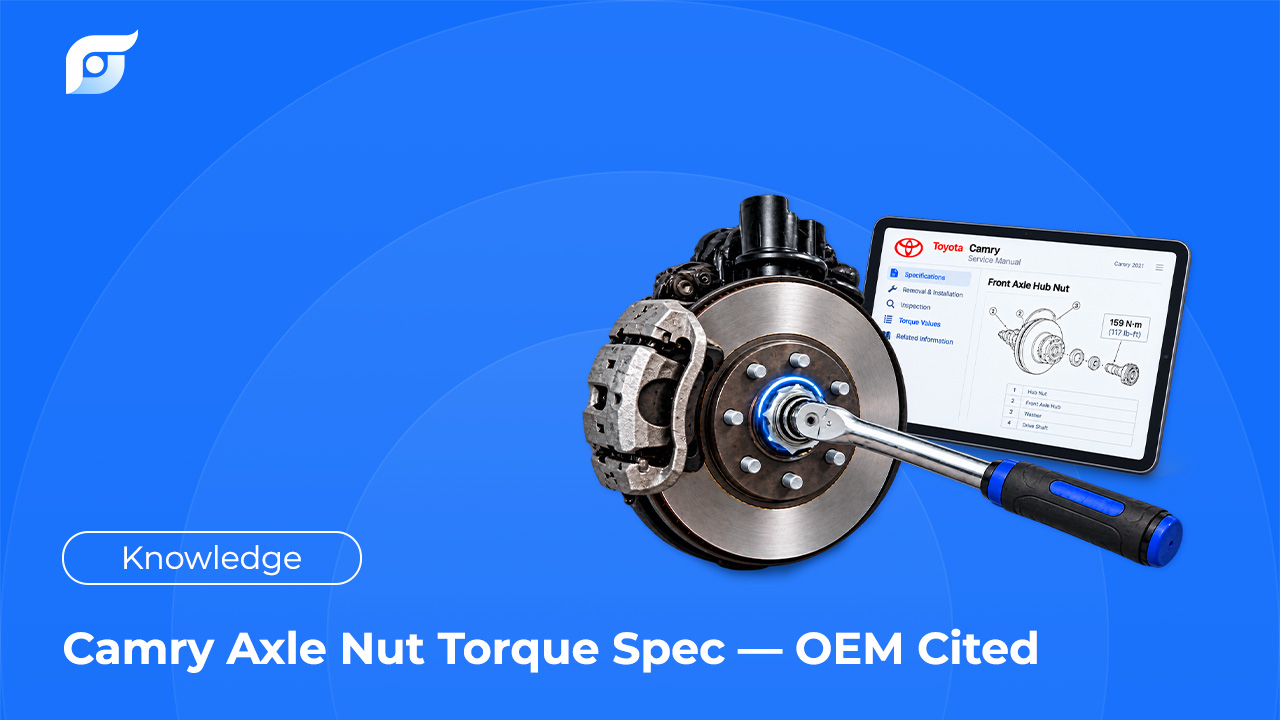
Quick Answer: The front drive axle nut (hub or spindle nut) on the Toyota Camry is specified at 217 lb-ft (294 N·m), a figure that appears consistently across aftermarket torque charts covering four-cylinder and V6 Camrys from the early 2000s through the current generation. The nut is a one-time-use staked fastener — install a new one and stake the collar into the axle groove after torquing. Mid-2000s and later Camrys take a 30 mm 12-point deep socket on that nut. Do not confuse this with the wheel lug nut spec, which Toyota owner literature lists as 76 lb-ft (103 N·m). Because the 217 lb-ft figure circulates through aftermarket charts rather than Toyota’s own published page, confirm it against the service data for your exact year, engine, and drivetrain before final torque.
What Is the Camry Axle Nut Torque Spec by Generation?
The same figure — 294 N·m, or 217 lb-ft — turns up across every Camry generation covered by the public torque references reviewed for this page. What changes between generations is the nut style and socket size, not the number.
| Generation / years | Axle nut torque | Nut type | Sourcing |
|---|---|---|---|
| XV30 (2002–2006) | 217 lb-ft (294 N·m) | Staked collar on later builds | Listed for the 2002–03 2.4L in published axle/spindle nut charts |
| XV40 (2007–2011) | 217 lb-ft (294 N·m) | Staked, non-reusable | Covered by the 2004–2015 V6 chart range |
| XV50 (2012–2017) | 217 lb-ft (294 N·m) | Staked, non-reusable | Covered by the 2004–2015 V6 chart range |
| XV70 (2018–2024) | 217 lb-ft (294 N·m) | Staked, non-reusable | Listed for the 2019 2.5L front end |
| XV80 (2025+, hybrid) | Not covered in public charts | Verify before assuming | No public figure found — use service data for the VIN |
Two honest caveats belong with that table. First, these values come from aftermarket spec charts and parts-supplier documentation, not from Toyota’s own service page — that is the difference between an aftermarket repair guide and the OEM procedure, and it matters on a fastener carrying this much load. Second, a torque chart that groups a dozen model years into one row cannot account for a mid-generation running change in hub or bearing design. On the current hybrid-only generation, no public figure surfaced at all, and an absent number is better information than a borrowed one.
Why the Camry Axle Nut Cannot Be Reused
Since the mid-2000s, Toyota has used a staked spindle nut on the Camry: a thin collar on the nut is deformed into a machined groove on the axle shaft after final torque, which is what physically prevents the nut from backing off. The stake replaces the older cotter-pin arrangement, and it is the reason the nut is a replace-once item.
Three practical consequences follow from that design:
- Un-stake before loosening. Drive the crimped section out of the groove with a punch first. Spinning the nut off over an engaged stake can damage the threads on the drive shaft, which turns a bearing job into an axle job.
- Fit a new nut every time. The collar has already been work-hardened and deformed once, and on Camry nuts the washer face is integral to the nut, so there is no reusable hardware to salvage.
- Stake it after torquing, not before. The stake is a mechanical lock applied at final spec — crimping first and torquing after defeats the point.
How Do You Torque a Camry Axle Nut Correctly?
At 217 lb-ft, this fastener is beyond the working range of most 3/8-inch torque wrenches. A 1/2-inch drive click-type wrench with headroom above the spec is the right tool, and an impact gun is for removal and running the nut down only. Running a hub nut to “tight” with an impact is one of the most common ways a new bearing arrives over-torqued.
Two further points are worth stating precisely, because general bearing advice and vehicle-specific procedure diverge here:
- Don’t roll the vehicle with the nut loose. The nut clamps the hub assembly together; moving the car with it backed off lets the bearing take load it was never designed to carry unclamped.
- On-the-ground versus in-the-air final torque is design-specific. Bearing-industry guidance is explicit that the correct method depends on the bearing type — adjustable tapered-roller setups and sealed unit bearings do not share a procedure — so this is a case to read the vehicle’s own service step rather than apply a rule of thumb from another platform.
The time cost in a working bay is almost never the torquing itself. It is stopping mid-job to find the spec across a chart, a forum thread, and a video that may or may not be about the same model year.
Camry Axle Nut vs. Lug Nut Torque: Don’t Mix Them Up
These two fasteners sit inches apart and differ by roughly 140 lb-ft.
| Fastener | Spec | Reusable? | What goes wrong when it’s mixed up |
|---|---|---|---|
| Front axle / hub nut | 217 lb-ft (294 N·m) | No — staked, one-time use | At 76 lb-ft, the hub is under-clamped: bearing play, noise, early failure |
| Wheel lug nut | 76 lb-ft (103 N·m) per Toyota owner literature | Yes | At 217 lb-ft, studs stretch or shear and rotors distort |
Published lug nut charts for the Camry are not perfectly consistent — 76 lb-ft is the figure attributed to Toyota’s owner’s manual, while some third-party charts round to 80 lb-ft. That gap is small enough to be harmless and large enough to show how spec values drift as they get copied between sites. It is the same drift that makes a torque figure produced by a language model a liability on a wheel fastener: the model will return a confident number for a vehicle it cannot identify, which is exactly the failure mode behind the decision never to generate repair procedures.
What Does Getting This Wrong Actually Cost?
Under-torque leaves the hub assembly insufficiently clamped, which shows up as wheel bearing noise, play at the 12-and-6 check, and a repeat visit weeks after the axle was replaced. Over-torque loads the bearing beyond its designed preload, and on a sealed unit bearing there is no adjustment to walk it back — the part is compromised from installation.
Either way the shop eats a comeback: the same axle or hub job, done twice, plus the diagnostic time to work out why a new part is noisy. That is why the estimate should carry factory-standard OEM labor times for the job rather than a remembered number, and why the torque step is worth doing to spec the first time.
Confirming the Spec for Your Camry
Three cases on this platform need the vehicle-specific document rather than a chart. AWD Camrys (2020 and later) add a rear drive axle whose nut spec did not surface in any public reference reviewed here. The 2025-and-later hybrid generation is likewise uncovered. And any Camry with a replaced hub, an aftermarket bearing assembly, or non-original axle hardware follows the part manufacturer’s spec, not the platform baseline.
On hybrid Camrys, the axle-nut job itself involves no high-voltage components — the drive axle bolts to the transaxle, and nothing in the procedure requires opening an orange-cabled circuit. Any work that does go behind orange high-voltage cabling is different territory: that requires ASE L3 (Light Duty Hybrid/Electric Vehicle Specialist) certification or equivalent OEM training, a verified zero-energy state, and insulated Class 0 gloves — not a socket and a torque wrench.
For the axle nut itself, the figure to trust is the OEM specification for that build, retrieved for the year, engine, and drivetrain in front of you. That is a lookup, not a judgment call — which is the whole argument for retrieving repair information rather than generating it when the answer is a number a wheel bearing depends on.