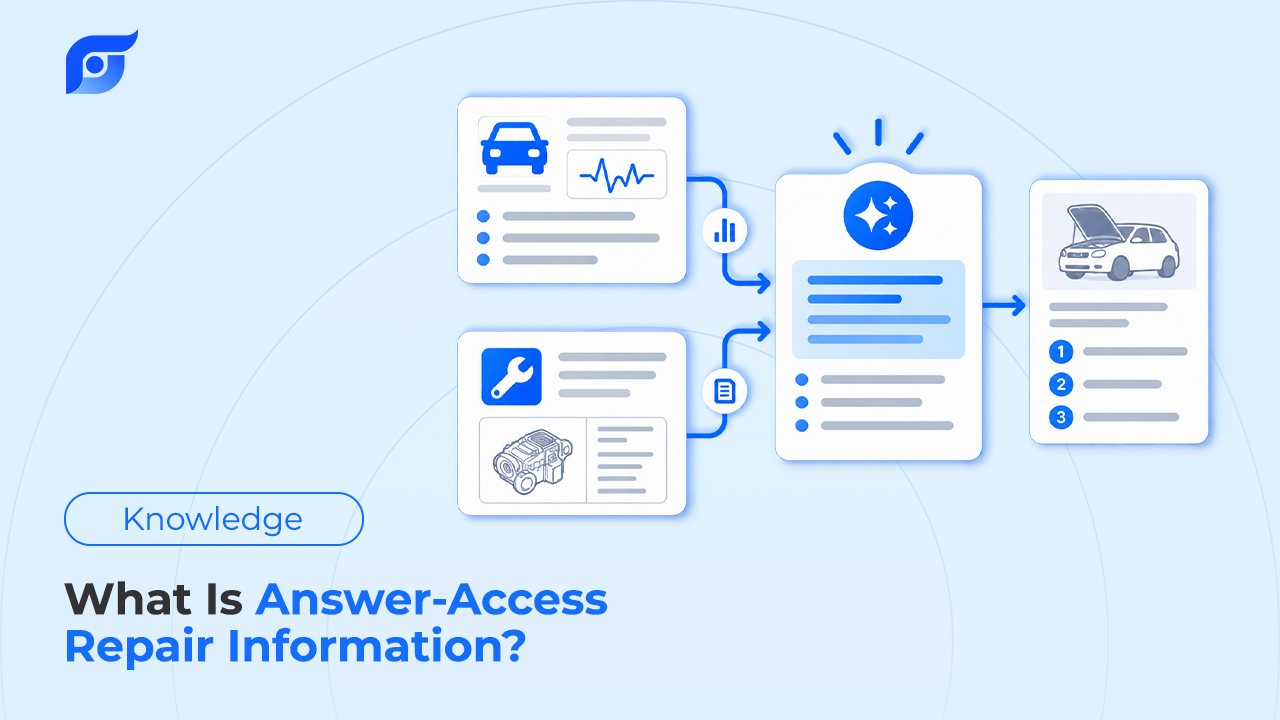

Direct Answer: ALLDATA and Mitchell 1 are lookup libraries — they give you a searchable archive of OEM manuals, and you navigate to the page you need. Jayda is a sourced answer engine — you ask a specific question and get the OEM procedure, spec, or diagram back directly, with the exact source cited. Both start from the same kind of OEM data. The difference is what happens between opening the app and getting the number you need on the vehicle in front of you.
Two Ways to Access the Same Kind of Dat
Repair information access has gone through one real shift: from paper manuals to digital libraries. ALLDATA and Mitchell 1 ProDemand made that first shift — they turned OEM repair information into a searchable digital archive, and for most shops, that’s still how the day-to-day lookup works: pick the vehicle, drill into a category, find the page.
A second model is emerging alongside that one, not replacing it overnight: instead of handing you the library and letting you navigate it, the tool reads the question you actually have and returns the specific answer, cited back to its source. That’s the model Jayda is built on.
Neither model is “wrong.” They solve different parts of the same job. The rest of this article walks through what each one actually gives you at the vehicle.
What a Lookup Library Gives You (ALLDATA & Mitchell 1)
ALLDATA and Mitchell 1 both provide extensive, OEM-sourced repair libraries — component locations, DTCs, wiring diagrams, TSBs, labor times, specs. Mitchell 1 adds features like guided wiring diagram navigation and a real-fixes database on top of that library.
The tradeoff is structural, not a flaw in either product: you have to know where to look. You select the vehicle, then work down through a folder tree — system, subsystem, component — until you land on the right page. For a technician who already knows the manual’s layout, that’s fast. For a less familiar job, or a page buried several menu layers deep, it takes longer. If you’re weighing the two libraries directly, how ALLDATA and Mitchell 1 stack up feature-by-feature is worth a closer look before deciding between them.
That’s a known cost in the industry, not a knock on any one vendor: technicians commonly spend 15–45 minutes per repair order navigating between menus, cross-referencing PDFs, and confirming they’ve landed on the procedure for the exact year, engine, and trim.
What a Sourced Answer Gives You (Jayda)
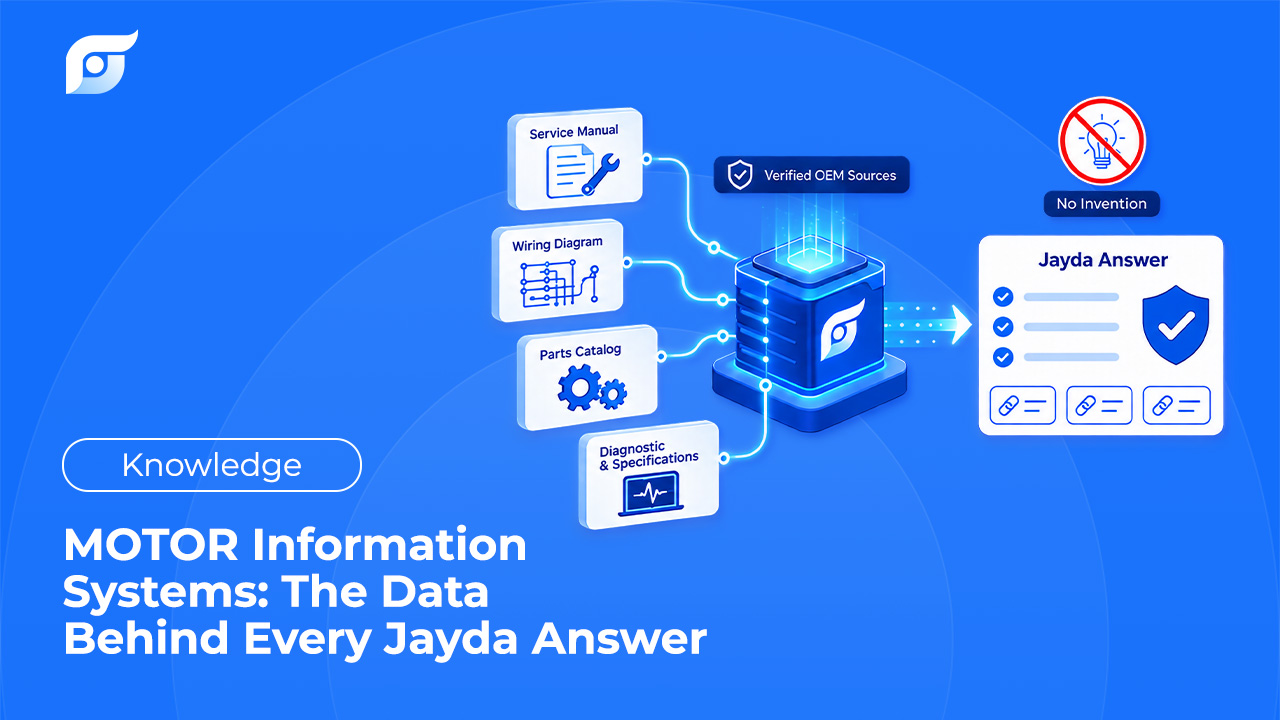
Jayda works from the same category of OEM data — sourced from MOTOR Information Systems, a Hearst company supplying automotive data since 1903 — but changes what happens after you open the app.
Instead of browsing to a page, you ask the question directly: “Wiring diagram for the fuel pump relay circuit, 2021 F-150 3.5L EcoBoost.” Jayda matches that request to the correct OEM procedure for that exact vehicle and returns it — with the source document, manufacturer, and model year cited, so you can verify it before you rely on it. This works because Jayda’s AI is built to search for the procedure, not generate one — it matches your question to OEM content instead of writing repair steps itself.
You’re still the one making the call on the repair. Jayda’s job is narrower: get you to the correct, cited page faster than navigating for it yourself.
Side-by-Side: Lookup Library vs. Sourced Answer
| Lookup Library (ALLDATA / Mitchell 1) | Sourced Answer (Jayda) | |
|---|---|---|
| How you get an answer | Browse categories to find the page | Ask the specific question |
| Wiring diagram lookup | ~45 min navigating manually | ~30 sec, diagram returned directly |
| What you land on | The manual page containing the answer | The answer, cited to the source page |
| Source verification | You read the page yourself | Citation shown with every answer |
| Mobile / shop-floor use | Menu depth makes small screens slower | Built for one-handed use at the vehicle |
That 45-minute gap isn’t hypothetical — it’s what happens when a fault traces through a shared harness and tracing the circuit by hand means paging through connector-by-connector documentation instead of asking for the one circuit you need.
Why “Sourced” Is the Part That Matters for Trust
Technicians are right to be skeptical of AI in a repair context — a generic AI tool that “sounds confident” but invents a torque value is a real liability, not a hypothetical one.
That’s the specific problem “sourced” is built to solve. Jayda never generates OEM repair procedures with AI — it retrieves them from MOTOR’s database and shows you where each one came from. If a procedure isn’t in the database, Jayda says so instead of guessing. Nothing is trained on that data, nothing is rewritten, and nothing is presented as an answer unless it traces back to a real OEM document.
That boundary also protects the technician’s role, not just the data. AI isn’t replacing the mechanic — it’s replacing the searching: you’re still the one deciding how to apply the procedure. Jayda’s job is just getting you to the source faster.
Why It Matters for the Shop, Not Just the Tech
For a lead technician, the cost of a lookup library is time — minutes per RO that don’t get billed. For a shop owner, it compounds: multiply that per tech, per day, across a team where not everyone knows the manual’s layout equally well. That’s the hidden cost of searching before every repair order — it doesn’t show up on an invoice, but it shows up in how many ROs get closed in a day.
It also isn’t only a wiring-diagram problem. The same gap shows up whenever technicians spend time looking for repair information instead of applying it — torque specs, maintenance intervals, labor times. A sourced answer model gives every tech on the team — new hire or 15-year veteran — the same starting point: ask the question, get the cited procedure.
FAQ
Does Jayda replace ALLDATA or Mitchell 1?
Not necessarily. Many shops run Jayda alongside their existing system and compare the workflow on real jobs before deciding whether to change anything. If you’re already evaluating options, how independent shops are weighing ALLDATA alternatives covers the broader landscape, not just Jayda.
Can Jayda’s AI make up a repair procedure?
No. Jayda’s AI is used only to match your question to the right OEM content — it doesn’t write, summarize, or generate repair steps. If a procedure isn’t in the database, Jayda tells you instead of guessing.
Is Jayda’s data the same as ALLDATA’s or Mitchell 1’s?
All three draw on OEM-sourced repair data. Jayda’s is sourced from MOTOR Information Systems, the same data foundation used by platforms like Autel diagnostic tools and Identifix Direct-Hit.
How do I decide which model fits my shop?
It depends on how your team already works and what’s actually slowing ROs down. A practical framework for choosing OEM repair software walks through the tradeoffs beyond this article.
Stop Searching. Start Knowing.
ALLDATA and Mitchell 1 built the library. Jayda answers the question — cited, from the source, for the exact vehicle in front of you. It’s part of how OEM repair information is evolving industry-wide, not just a Jayda feature.
Try Jayda free for 3 days — no credit card, up to 5 questions — and see the difference on your next RO.