
Quick answer: “Best” depends on what you’re optimizing for. Legacy databases like ALLDATA and Mitchell 1 ProDemand offer the deepest OEM catalog coverage and are the industry default. Identifix Direct-Hit adds crowd-sourced confirmed fixes on top of OEM data for common repairs. A newer category — AI-powered answer-access tools like Jayda — searches licensed OEM content and returns a cited answer to a direct question instead of requiring menu navigation. Most shops aren’t choosing just one; they’re deciding which combination fits their workflow and budget.
Key takeaways:
- OEM repair software isn’t a single category anymore — it splits into legacy full-coverage databases, diagnostic-shortcut tools, and AI answer-access tools, each solving a different problem.
- Legacy databases (ALLDATA, Mitchell 1 ProDemand) win on catalog depth and industry trust; the tradeoff is navigation time and cost — typically $100–$200+/month per individual license.
- Identifix Direct-Hit adds a layer of crowd-verified “confirmed fixes” on top of OEM data, strongest for common repeat repairs.
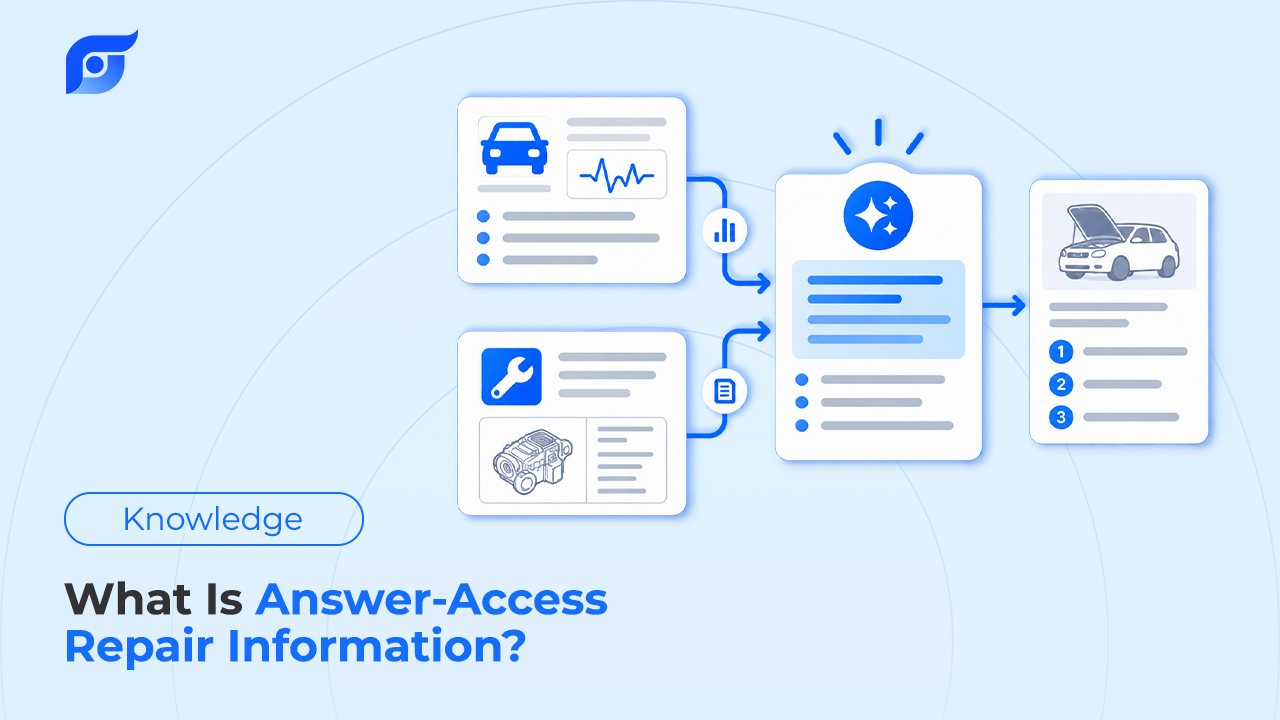
- AI answer-access tools like Jayda retrieve and cite official OEM content in response to a direct question, rather than requiring you to browse a document tree.
- Whatever you choose, the tool should show its source and admit when a procedure isn’t in the database — not generate a plausible-sounding answer.
OEM Repair Software Isn’t One Category — It’s Three
Most “best software” roundups compare products as if they’re interchangeable. They’re not. OEM repair software today splits into three distinct approaches, and picking the “best” one depends on which problem you’re actually solving.
Legacy full-coverage databases license the manufacturer’s own documentation — procedures, specs, diagrams, TSBs — and organize it into a searchable library. Diagnostic-shortcut tools layer real-world fix data from other technicians on top of OEM content, aimed at getting to a common fix faster. AI answer-access tools are the newest category: they take a direct, specific question and return the cited OEM answer without requiring you to navigate a menu at all.
Jayda: AI-Powered Answer Access for OEM Repair Data
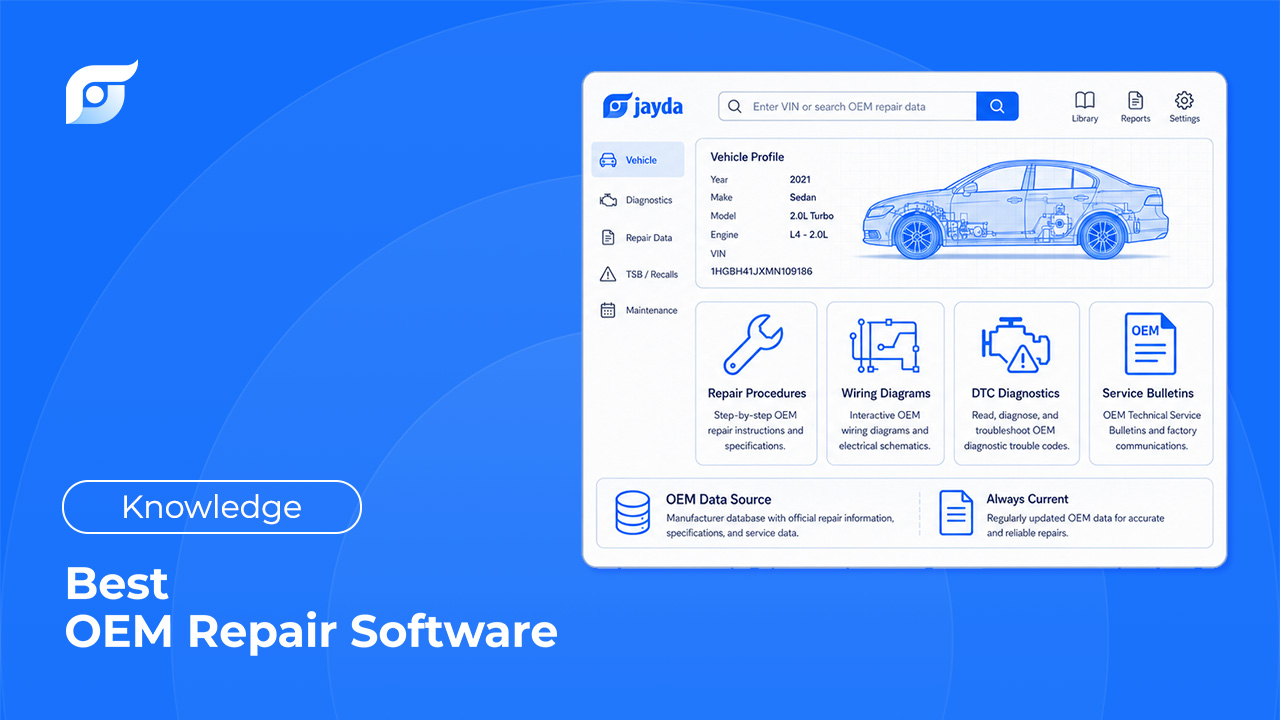
Jayda belongs in this comparison because it solves the specific problem the other categories don’t: getting a cited OEM answer without navigating a menu or waiting on a crowd-sourced fix to exist for your case. Type a direct, specific question — “F-150 10-speed shudder TSB,” “torque sequence for a 2021 Mazda 3 cylinder head” — and Jayda returns the exact procedure, spec, or diagram for that vehicle, sourced from licensed MOTOR Information Systems data and cited to the document, manufacturer, and model year.
What makes it a strong fit for shops evaluating options in this category:
- Source-bound, not generated. Every answer is retrieved from licensed OEM content — the same data foundation trusted by Autel, Identifix, and Fullbay — never written or paraphrased by AI.
- Exact vehicle context. Year, make, model, engine, and VIN when available, so the answer matches the vehicle in the bay, not a similar one.
- Answer access instead of navigation. No menu tree to browse — ask the question, get the cited result, typically in seconds.
- Priced for individuals and small teams. Starter at $7.95/month, unlimited queries on Pro Tech at $14.95/month, and Business at $149/month for a 10-seat shop team — well under typical per-seat legacy database pricing.
What it deliberately doesn’t do: diagnose the vehicle, rank probable causes, or generate a repair procedure that isn’t in the OEM data. If the exact procedure isn’t found, Jayda says so directly rather than approximating — the technician still owns the diagnosis and the decision to proceed.
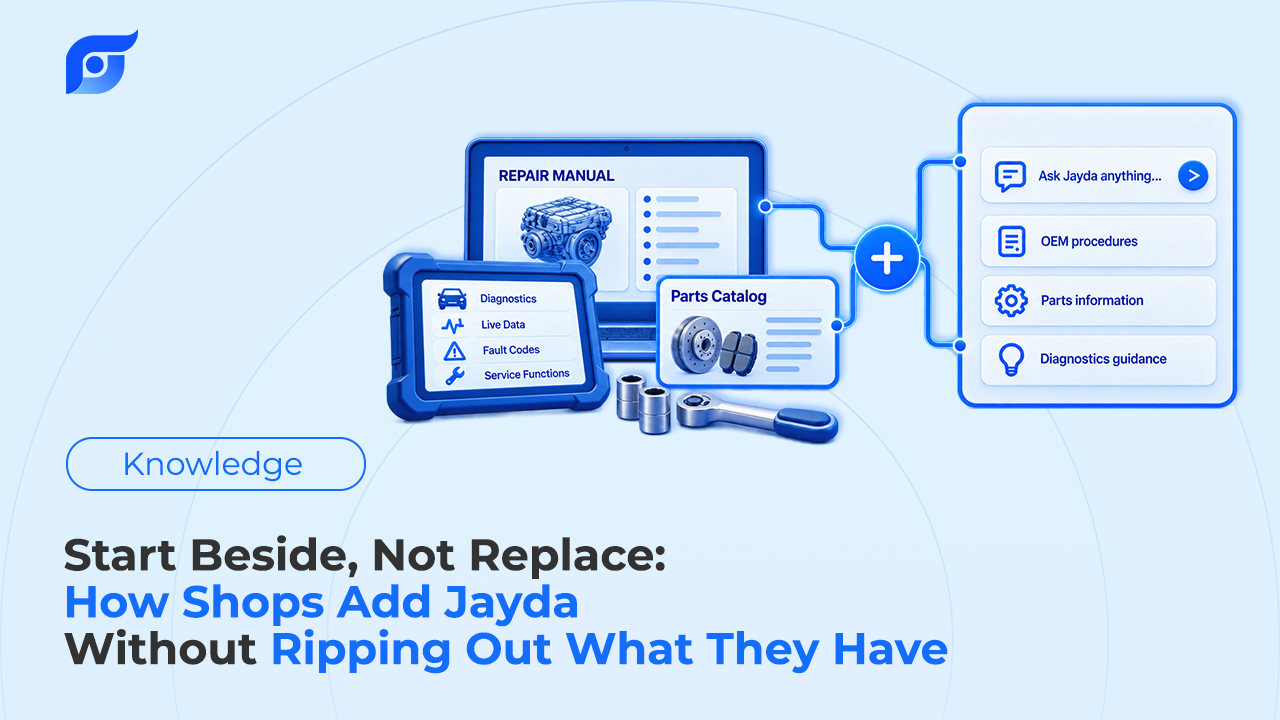
For a shop already paying for ALLDATA, Mitchell 1, or Identifix, Jayda isn’t necessarily a replacement on day one — it’s worth testing on a real job to see how much navigation time it actually removes before deciding whether to consolidate.
Legacy OEM Databases: ALLDATA and Mitchell 1 ProDemand
These are the industry standard, and for good reason: both license extensive OEM documentation and have built decades of trust with professional shops. Mitchell 1 ProDemand pairs its OEM data with shop-management integration. ALLDATA is known for close-to-original manufacturer content across a wide range of makes.
The tradeoff is navigation and cost. Individual licenses commonly run $100–$200+ per month, with annual costs in the $1,200–$2,400 range, and finding a specific spec or diagram typically means working through several menu levels — system, subsystem, document — before landing on the right page.
Diagnostic-Shortcut Tools: Identifix Direct-Hit
Identifix Direct-Hit takes a different approach: instead of only presenting OEM documentation, it surfaces “confirmed fixes” drawn from real repair data across many shops, aimed at getting to a common diagnosis faster than reading through a full procedure. That’s genuinely useful for repeat, well-known issues. It’s less clean for a newer vehicle, a rare trim, or anything outside the pattern of common fixes already in its dataset — at that point, you’re back to the underlying OEM documentation.
Where AI Answer-Access Tools Fit
The newest shift in this category isn’t one vendor’s marketing claim — it’s a pattern showing up across multiple companies at once. ALLDATA has added a Diagnostic Intelligence layer with AI-assisted insights on top of its existing database. Newer entrants like Mastertech.ai and emanuals.ai are building specifically around ask-a-question, get-an-answer access. Three separate companies moving the same direction in the same window is a category shift, not a trend one vendor invented.
Jayda is built for this category specifically: type a direct question — “F-150 10-speed shudder TSB,” “torque sequence for a 2021 Mazda 3 cylinder head” — and get back the exact OEM procedure, spec, or diagram for that vehicle, cited to the source document, manufacturer, and model year. It’s worth being precise about what that means: Jayda retrieves and cites licensed OEM content from MOTOR Information Systems. It doesn’t generate an answer, interpret a symptom, or rank likely causes — the diagnosis and the decision to proceed stay with the technician.
Comparison at a Glance
| Category | Example | How You Get an Answer | Best For | Starting Cost |
|---|---|---|---|---|
| Legacy OEM database | ALLDATA, Mitchell 1 ProDemand | Navigate menus to a document | Full-catalog depth, established trust | ~$100–$200+/mo (individual) |
| Diagnostic-shortcut tool | Identifix Direct-Hit | Search + confirmed-fix suggestions | Common, repeat diagnoses | Comparable subscription range |
| AI answer-access | Jayda | Ask a direct question, get a cited answer | Fast lookup at the vehicle, individual and small-shop budgets | $7.95/mo (Starter) |
What to Check Before You Choose
Whichever category you’re evaluating, the same questions apply: Does it cover the makes and models you actually service? Does it show a citation — document, manufacturer, model year — or just an answer with no way to verify it? Does it say “not found” when a procedure isn’t in its data, or does it fill the gap with something that sounds plausible? For a fuller walkthrough of the evaluation process, see our guide on how to choose OEM repair software.
Frequently Asked Questions
What is the best OEM repair software for auto shops?
It depends on what you need. ALLDATA and Mitchell 1 ProDemand offer the deepest OEM catalog coverage and shop-management integration. Identifix Direct-Hit adds crowd-verified fixes for common repairs. Jayda offers AI-powered answer access — a direct question returns a cited OEM answer without menu navigation. Many shops use more than one.
What’s the difference between a legacy OEM database and an AI answer-access tool?
A legacy database organizes OEM documentation into a searchable library that you navigate by year, make, model, and system. An AI answer-access tool like Jayda takes a specific question and returns the matching OEM procedure or spec directly, with a citation, instead of requiring navigation.
Does Jayda replace ALLDATA or Mitchell 1?
Not automatically. Most shops keep their existing subscription and use a tool like Jayda for fast lookup at the point of need. Whether it earns a permanent spot — or replaces anything — depends on each shop’s own workflow.
Can AI-powered repair software make up an answer?
A tool built to generate content can. Jayda is built differently: it retrieves and cites licensed OEM documentation rather than generating or paraphrasing an answer, and it says so directly when a procedure isn’t in the database.
Is Identifix Direct-Hit better than ALLDATA for diagnostics?
They solve different problems. Identifix is strong on common, previously-confirmed fixes; ALLDATA and Mitchell 1 offer broader OEM documentation depth for procedures outside that pattern. Neither replaces the need for a citable OEM source on torque specs, wiring, and TSBs.