
A tech pulls out his phone between jobs and asks a general AI chatbot for the torque spec on a wheel bearing hub nut. It answers immediately, with a specific number, in a confident tone. No source attached, no page reference, nothing to check it against — just a number that sounds plausible enough to type into a torque wrench and trust. He doesn’t use it. Not necessarily because it’s wrong, but because there’s no way to know if it’s right.
That’s the actual risk with AI in a repair context — not that it’s always wrong, but that it can be wrong with exactly the same confidence as when it’s right, and give you no way to tell the difference.
Why General AI Chat Tools Guess — and Sound Sure Doing It
A general-purpose AI chatbot generates text by predicting what’s statistically likely to come next, based on patterns in what it was trained on. That’s a fundamentally different process from looking something up. When you ask it a broad question — “how does a wheel bearing fail” — that pattern-matching produces something reasonable, because the training data is full of consistent explanations of how wheel bearings generally fail.
Ask it something narrow instead — the exact torque spec, in the exact sequence, for one specific trim and model year — and the same process still runs. If that precise fact wasn’t clearly represented in what it learned from, the model doesn’t stop and say so. It produces the most plausible-sounding number anyway, in the same confident tone it would use for something it “knows” cold. The fluency of the answer isn’t a signal of its accuracy — the model wasn’t built to track that distinction.
How Jayda Is Built to Not Do That
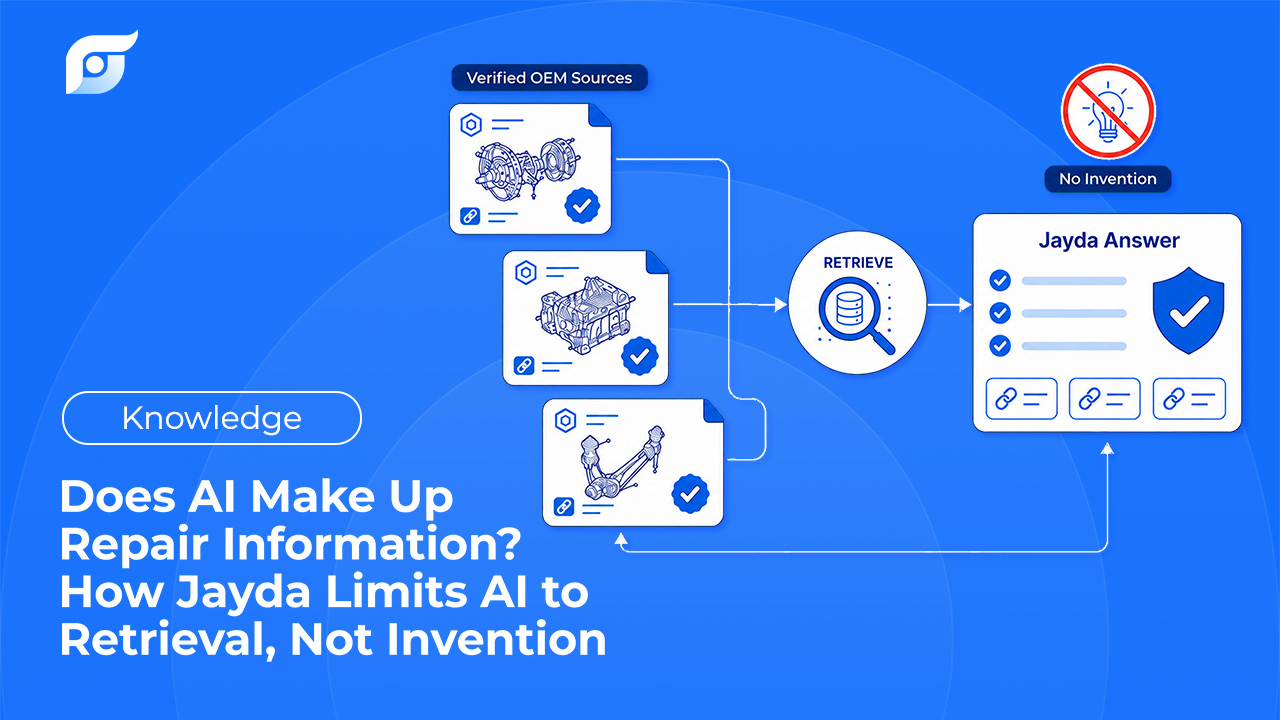
Jayda’s AI operates under a different constraint from the start: it’s used only to understand what you’re asking and match it to the right OEM procedure. It doesn’t write repair steps, doesn’t paraphrase them, and doesn’t fill in a gap with something that sounds close enough. Jayda never generates OEM repair procedures with AI — every torque spec, wiring diagram, and procedure you see is retrieved unedited from OEM data licensed through MOTOR, not authored by a model in response to your question.
That distinction — retrieval versus generation — is also the same shift happening across the OEM repair information category more broadly, as more tools move away from search boxes and toward AI-mediated answers. Not every tool making that move handles the difference the same way.
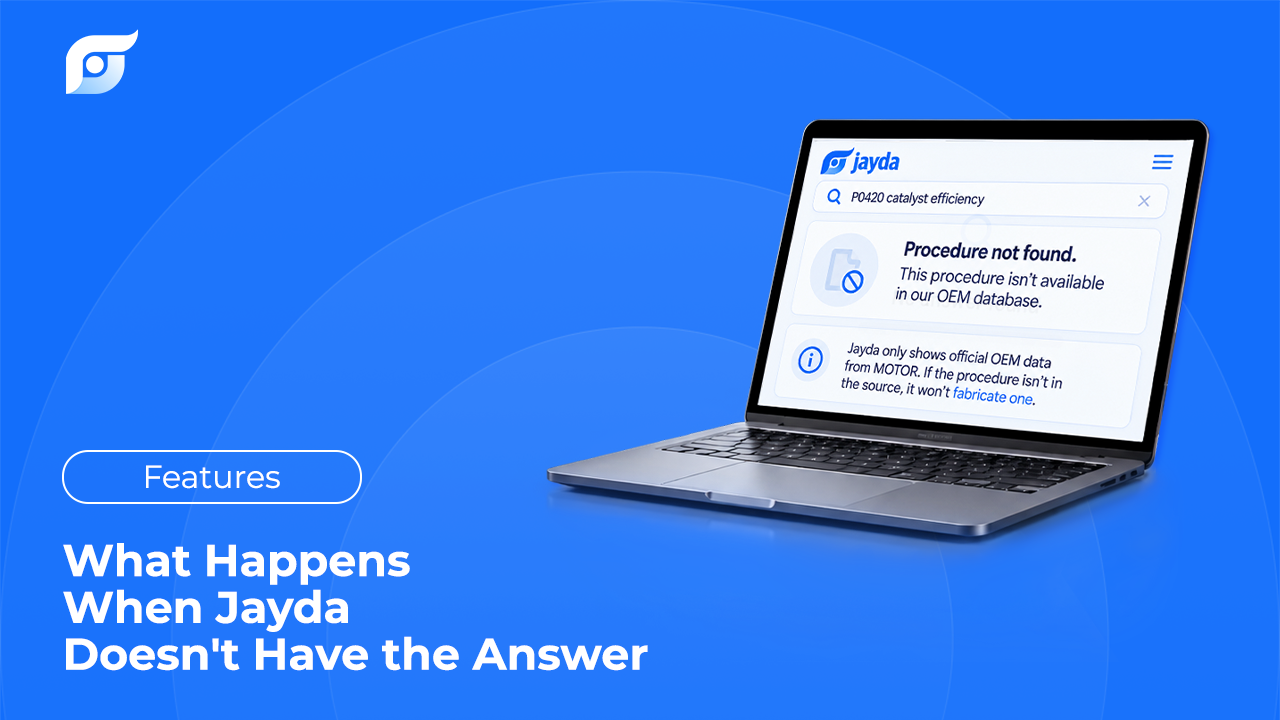
The practical result of building it this way: if the exact procedure isn’t in the database, Jayda says so. No fallback to “based on a similar vehicle.” No approximation dressed up as an answer. Silence is the honest response when the alternative is a guess with real consequences attached.
Side by Side: General AI Chat vs. Jayda
| General AI Chat Tool | Jayda | |
|---|---|---|
| Where the answer comes from | Patterns learned during training | Licensed OEM data via MOTOR |
| Source shown with the answer | Rarely, if at all | Every answer, cited |
| Behavior when the exact fact isn’t known | Often answers anyway, confidently | Says “not found” instead of guessing |
| Repair content | Can be generated or paraphrased | Retrieved only — never written by the AI |
| Vehicle-specific accuracy | Not matched to a VIN or exact trim by default | Matched to year, make, model, and VIN where available |
What “Source-Verified” Actually Lets You Do
A cited answer isn’t just a trust signal — it’s something you can act on. When Jayda returns a spec or procedure, it comes with the source document, the manufacturer, and the model year attached, so you can check it against the original before it goes into the repair. That’s the same source-bound model covered in the difference between a lookup library and a sourced answer, and it runs consistently across all 12 categories of OEM data Jayda covers — not just the spec you happened to ask about.
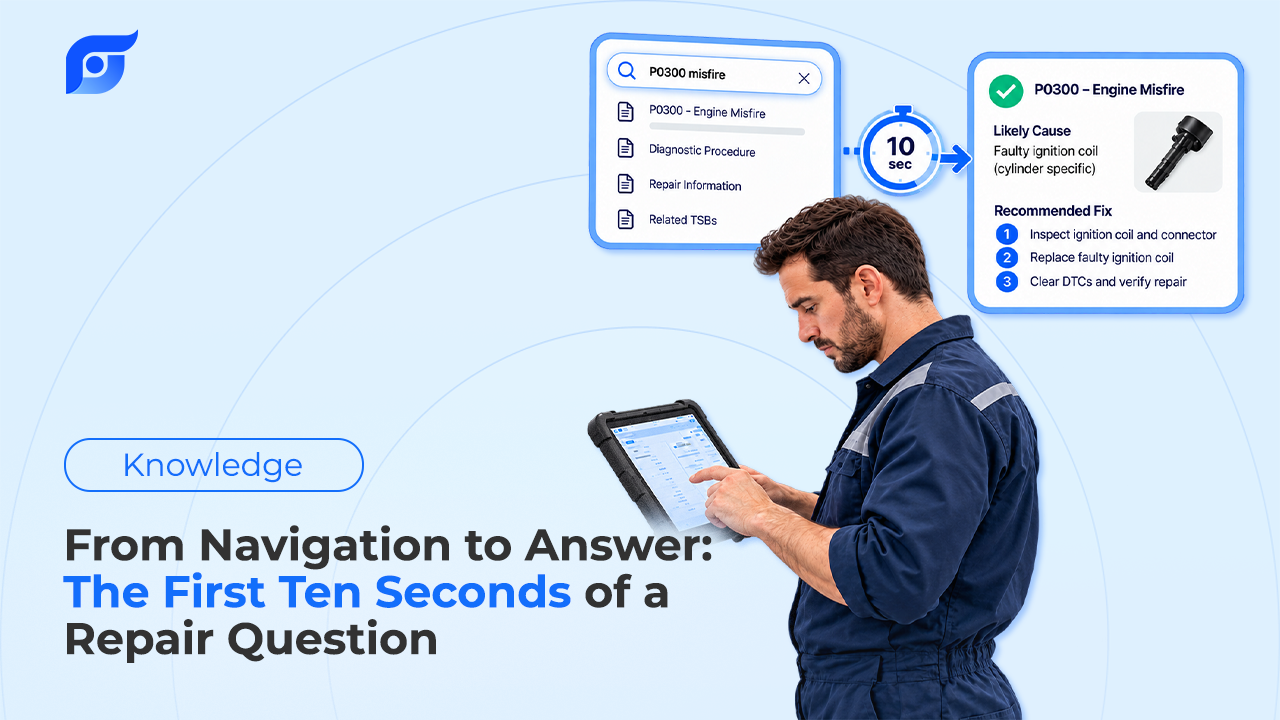
It also doesn’t change who’s responsible for the repair. Jayda’s AI finds the source faster than navigating for it — it doesn’t diagnose, and it doesn’t make the call on how to proceed. That stays with the technician, the same as it always has.
Frequently Asked Questions
Is this a problem specific to one AI tool, or all of them? Any tool that generates repair content — writing, paraphrasing, or summarizing a procedure in its own words — carries this risk, regardless of which company built it. The relevant question for evaluating any AI repair tool is whether it’s retrieving from a licensed source and showing that source, or producing text that sounds plausible without one.
Can the underlying OEM data itself be wrong? That’s a separate question from AI invention. OEM manufacturers and MOTOR’s editorial process are the source of truth for that content — Jayda’s AI matches your question to that content, it doesn’t edit or verify it independently. If OEM guidance changes, an updated bulletin or revised procedure is what corrects it, not the AI.
What is “OEM repair information,” exactly? Procedures, specs, diagrams, TSBs, and DTC workflows published directly by a vehicle’s manufacturer — as opposed to aftermarket guides or general advice not tied to the exact vehicle. A fuller definition covers what counts and what doesn’t.
Should I still double-check a Jayda answer before using it? Yes — and Jayda is built to make that easy rather than optional. Every answer shows its source specifically so it can be checked, not just trusted on tone.
If you run a shop, contact us for a trial to see how source-verified answers hold up across your team’s real jobs. If you’re a technician working solo, start a free trial and check the citation on your next lookup before you rely on it.