
If you’ve searched “What is a TSB,” it’s usually because a shop mentioned one on your repair order, or you found a reference to one online and aren’t sure what it means for you. The two questions people actually want answered are simple: is this the same as a recall, and am I going to have to pay for it? Here’s what a Technical Service Bulletin actually is, how it differs from a recall, and how to find out if one applies to your vehicle.
What Is a Technical Service Bulletin (TSB)?
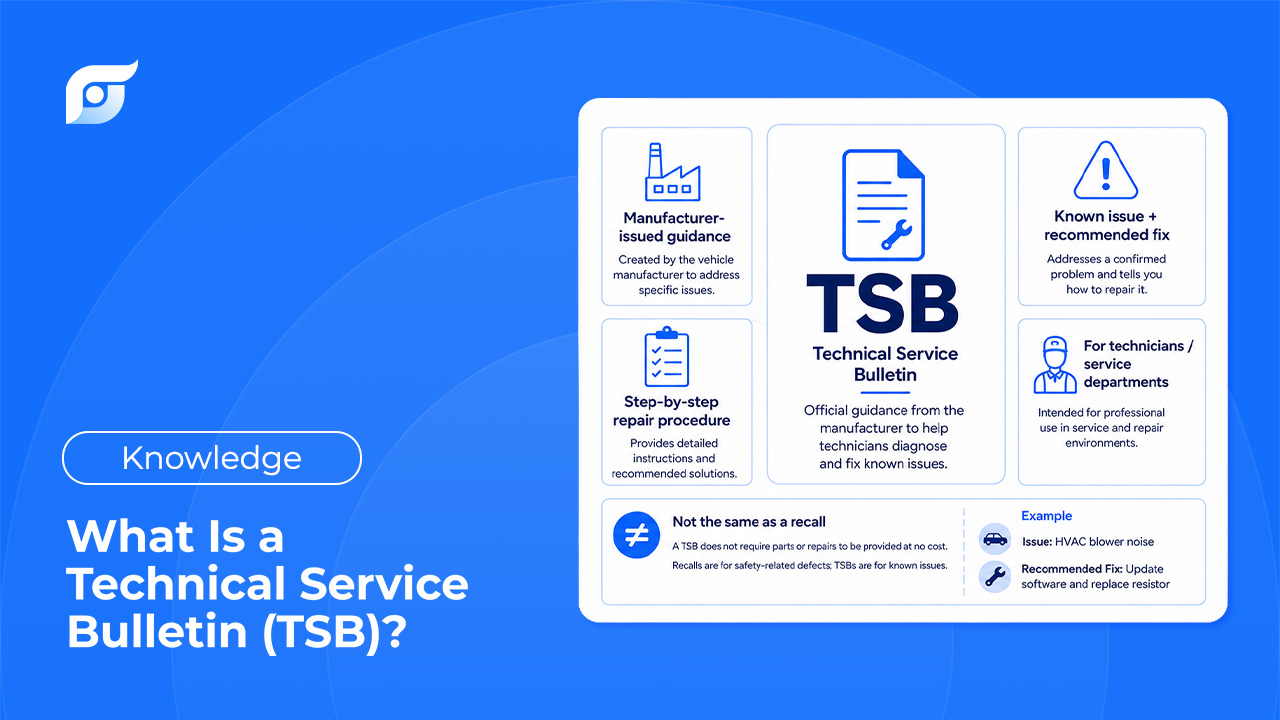
A Technical Service Bulletin (TSB) is an official document a manufacturer issues to dealerships and repair shops when a known issue shows up repeatedly on a specific vehicle, model year, or engine. It describes the symptoms, the root cause, and the manufacturer-approved repair procedure — so technicians don’t have to diagnose the same problem from scratch every time it appears.
TSB vs. Recall: What’s the Real Difference?
These two terms get confused constantly, and the difference matters for both safety and your wallet.
| Technical Service Bulletin (TSB) | Recall | |
|---|---|---|
| Safety-related? | Usually not — addresses comfort, drivability, or reliability issues | Yes — addresses a safety or emissions defect |
| Regulated by | Not government-mandated | NHTSA (safety) or EPA/CARB (emissions) |
| Who pays? | Often the vehicle owner, unless covered by warranty or a warranty extension | Always free — manufacturers are required to fix recalls at no cost |
| Is it mandatory? | No — the owner can choose whether to get the repair | Manufacturers must notify owners and offer the repair |
| How you find out | Not usually mailed to owners — found by a technician during diagnosis or lookup | Manufacturer sends a notice by mail |
The short version: a recall means “this could be unsafe, and it’s free.” A TSB means “we’ve seen this issue before, and here’s the fix” — it may or may not be covered depending on your warranty status.
Why Manufacturers Issue TSBs (and Why They Matter to Technicians)
TSBs exist because manufacturers would rather standardize the fix than let every shop re-diagnose the same failure independently. For technicians, that has real value:
- Faster diagnosis — if a TSB already documents the exact symptom, a tech can skip hours of trial-and-error testing.
- Updated part numbers — TSBs often reference a revised or superseded part that fixes an issue the original part didn’t.
- Warranty coverage clues — some TSBs include a warranty extension, meaning a repair that looks like it’s out of pocket for the customer might actually be partially or fully covered.
The Traditional Struggle: Finding the Right TSB in Legacy Databases
Here’s where it gets frustrating in practice. Databases like ALLDATA and Mitchell 1 do carry TSBs — the content itself isn’t the problem. The problem is that finding the right one usually assumes you already know what you’re looking for. If you know the TSB number, you can pull it up. But most of the time, a tech doesn’t start with a TSB number — they start with a customer describing a noise, a warning light, or a shift that feels off, and no clean way to search a TSB library by symptom alone.
That gap means technicians sometimes miss a TSB that would have saved them an hour of diagnosis — or worse, miss one that would have saved the customer a warranty-covered repair.
Jayda — Find the Right TSB by Describing the Symptom
This is the specific gap Jayda is built to close. Instead of needing a TSB number up front, you describe what the vehicle is doing — the same way a customer would describe it to you — and Jayda searches for the TSB that matches the vehicle and the symptom.
One real example: a 2020 Chevrolet Silverado brought in with a knocking noise on cold start matches TSB 21-2315, which covers an AFM valve failure. The repair runs about $1,800 — and under GM’s warranty extension, 89% of that cost was covered. A tech who checks TSBs before diagnosing catches that kind of coverage before quoting the customer full price out of pocket.
Worth being precise about what Jayda does here: it finds and displays the TSB content exactly as the manufacturer published it, cited to its source. It doesn’t summarize, rewrite, or interpret the bulletin for you — the full OEM text is what you get, unedited, because that’s what protects you if you’re relying on it for a warranty claim or a repair record. If no matching TSB exists for a vehicle, Jayda says so directly rather than guessing at “similar” issues. Ask once. Know the OEM procedure.
Finding a TSB: Legacy Database vs. Jayda
| ALLDATA / Mitchell 1 | Jayda | |
|---|---|---|
| How you search | By TSB number, or browsing by system/category | By describing the symptom in plain language |
| Do you need to know the TSB number first? | Usually, yes | No |
| Content shown | Full OEM bulletin | Full OEM bulletin, cited to source |
| Best for | Techs who already have a TSB number or case reference | Techs starting from a customer’s description of the problem |
FAQ
Are TSBs free to fix? Not automatically. Unlike recalls, TSB repairs are often paid by the vehicle owner unless the vehicle is still under standard warranty or the manufacturer has issued a specific warranty extension for that issue. It’s worth checking the TSB itself — some do include coverage details.
How do I find TSBs for my specific vehicle? You’ll need your vehicle’s year, make, model, and ideally engine or trim, since TSBs are usually issued for a specific configuration. A technician with access to OEM repair data can search by those details — or, if you know the symptom but not a TSB number, a tool like Jayda can search by the symptom description directly.
Am I required to get a TSB repair done? No. TSBs are optional unless the issue is later escalated to a recall. You can choose to have the repair done, wait, or not do it at all — it’s a maintenance/reliability decision, not a legal requirement.
Where can I check if my vehicle has an open TSB? NHTSA’s public database lists TSBs and recalls by VIN for basic lookups. For the full bulletin content and repair procedure, you’ll generally need access to OEM repair data through a shop, dealership, or a repair information tool.
Conclusion
A TSB isn’t a red flag — it’s a manufacturer telling you they’ve already solved a problem your vehicle might be having. The hard part has never been whether the fix exists. It’s finding it before you start diagnosing from zero.
Next time a vehicle comes in with a symptom that feels familiar, describe it to Jayda and see if the manufacturer already has an answer on file.
Individual techs can start a 3-day free trial on Pro Tech (5 questions included, no credit card required). Shop owners can contact Jayda to activate a 7-day team trial on Business.