
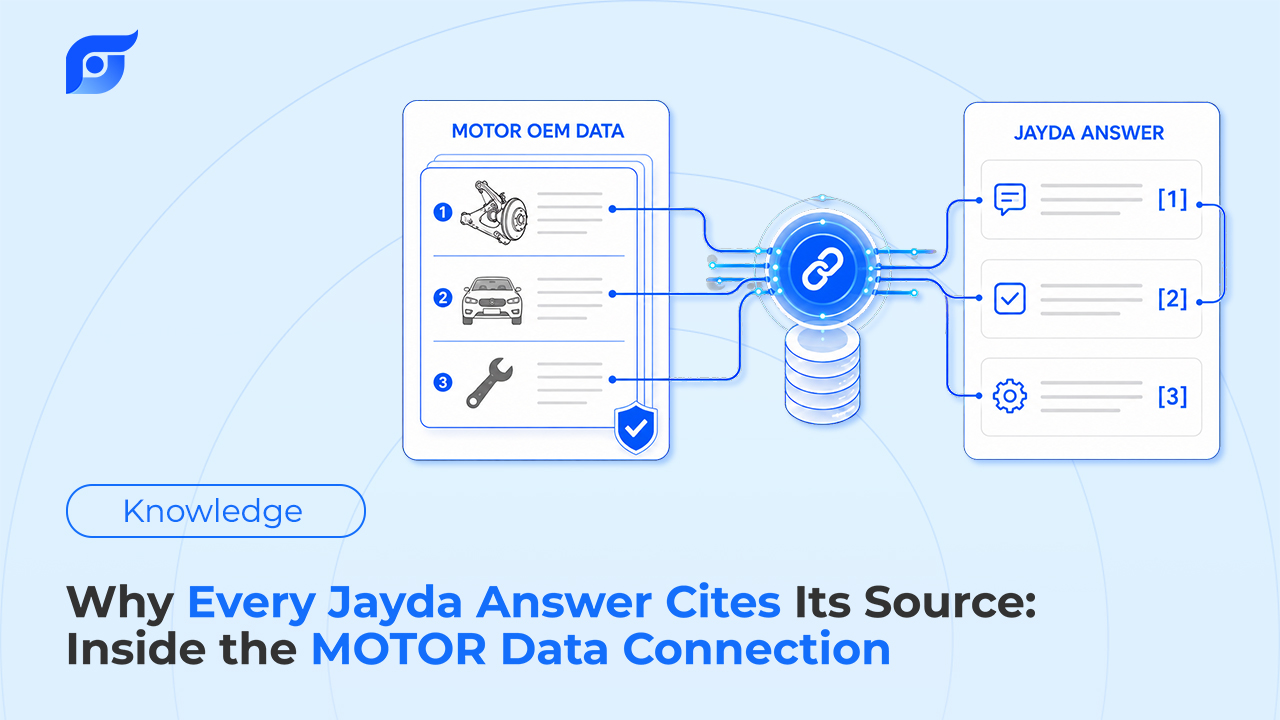
A tech gets a torque spec back from Jayda for a suspension job — a number that, if it’s wrong, means a fastener that backs out on the highway instead of staying put. Before it goes into the torque wrench, he taps the citation. Document name, manufacturer, model year, last update — right there, matching the truck on the lift. He uses the number because he checked it, not because the app sounded sure.
That citation isn’t a UI flourish. It’s the whole reason an AI tool is usable for something this unforgiving in the first place.
Why “Confident” Isn’t the Same as “Sourced”
A general-purpose AI tool asked for a torque spec will answer — fluently, specifically, and with no indication of whether that number came from a document or from a statistical guess dressed up to sound like one. There’s no citation to check, because there’s nothing behind the answer to cite. For a repair shop, that’s not a minor UX gap. A wrong spec that reads exactly as confident as a right one is how a comeback happens — a second round of labor, a part that got swapped for nothing, and a customer with a reasonable question about the first invoice.
The fix isn’t a more careful AI. It’s an AI that only retrieves what’s already documented, and shows you where.
Where Jayda’s Data Comes From: MOTOR Information Systems
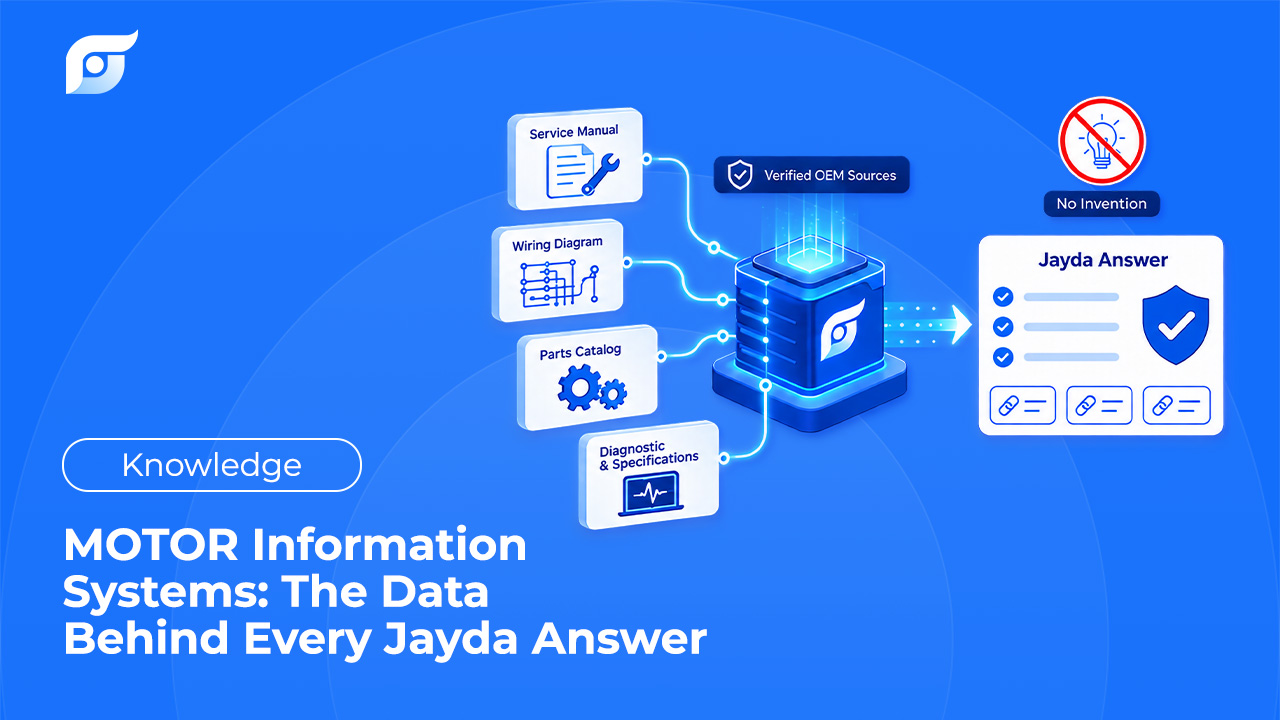
Jayda’s OEM content is sourced from MOTOR Information Systems, a Hearst company that’s supplied automotive service and repair data since 1903. MOTOR’s data underpins tools across the industry — Autel diagnostic equipment, Identifix Direct-Hit, and EBSCO’s Auto Repair Source among them — covering repair procedures, DTCs with diagnostic flowcharts, TSBs and recalls, wiring diagrams, component locations, maintenance schedules, specifications, labor times, and parts data across all 12 categories Jayda organizes that content into.
To be precise about the relationship: Jayda licenses this data from MOTOR — it’s a data customer, not a co-branded partner, and nothing here implies MOTOR endorses or has reviewed Jayda’s product. New OEM content typically becomes available within days of a manufacturer’s own release, which is what keeps a cited answer current instead of a snapshot from whenever the data was last refreshed.
Retrieval, Not Generation: How the Citation Actually Works
Think of Jayda’s AI as a very fast librarian, not a co-author. Its job is to understand what you’re asking and find the exact shelf and page in MOTOR’s data that answers it — not to read the material and write you a summary in its own words.
That distinction is a hard boundary, not a style choice: Jayda’s AI is used only to match a question to the right OEM content — it doesn’t write, paraphrase, or condense a procedure. That matters for a reason that’s easy to miss: a caution like “fastener is single-use, do not reuse” is exactly the kind of line a summarizing AI could quietly drop while “simplifying” a procedure. Retrieval doesn’t have that failure mode, because nothing gets rewritten in the first place — what you see is the manufacturer’s own text, unedited.
What Verifying a Source Actually Looks Like
Every answer on Jayda comes with the source document name, the manufacturer, the model year, and the last update date attached — not as a footnote, but as the thing that makes the answer checkable rather than just stated. That’s what turns “the app said so” into “I confirmed it against the OEM document before I used it.”
It’s also tied to getting the right vehicle in the first place — a citation only means something if it’s citing the procedure for the exact engine and trim on the lift, not the closest-sounding configuration. Source and vehicle match are two different checks that both have to hold for an answer to be trustworthy, not one substituting for the other.
None of this is a substitute for judgment. A citation gives a tech something concrete to check before relying on a number — it doesn’t make the decision for them, and it isn’t a guarantee against every possible dispute. It’s information a tech can stand behind, because they looked at it themselves.
General AI vs. Source-Bound Retrieval
| General-Purpose AI Tools | Jayda | |
|---|---|---|
| Source of the answer | Patterns learned during training | Licensed OEM data via MOTOR |
| Citation shown | Rarely, if at all | Document, manufacturer, model year, last update |
| How the answer is produced | Generated / paraphrased | Retrieved, unedited |
| Behavior when the exact fact isn’t available | Often answers anyway | Says “not found” instead of guessing |
That gap between “generated” and “retrieved” is the same distinction behind treating an answer as sourced rather than just searched — a library gives you a page to read yourself; a general AI tool gives you a paragraph with nothing behind it; a sourced answer gives you both the number and the document it came from.
Frequently Asked Questions
Is MOTOR a partner of Jayda? No — Jayda licenses OEM data from MOTOR Information Systems as a customer. MOTOR hasn’t endorsed or co-branded Jayda’s product, and nothing here should be read as implying that.
Does citing a source mean the answer is guaranteed accurate? It means the answer traces back to a real OEM document that you can check yourself before relying on it. The underlying content is MOTOR’s and the manufacturer’s — Jayda’s AI matches your question to it, it doesn’t independently verify or edit it.
What happens if Jayda can’t find a cited source for something? It says so directly instead of answering without one. No fallback to general knowledge, no “based on a similar vehicle” approximation.
Can I open the original document behind a citation? Every answer shows the source document name, manufacturer, model year, and last update date so you can identify and confirm it. For the specific citation format inside the app, see the walkthrough in-product — details there are still evolving.
If you run a shop, contact us for a trial to see how source citations hold up across your team’s real jobs. If you’re a technician working solo, start a free trial and check the citation on your next lookup before you rely on it.