
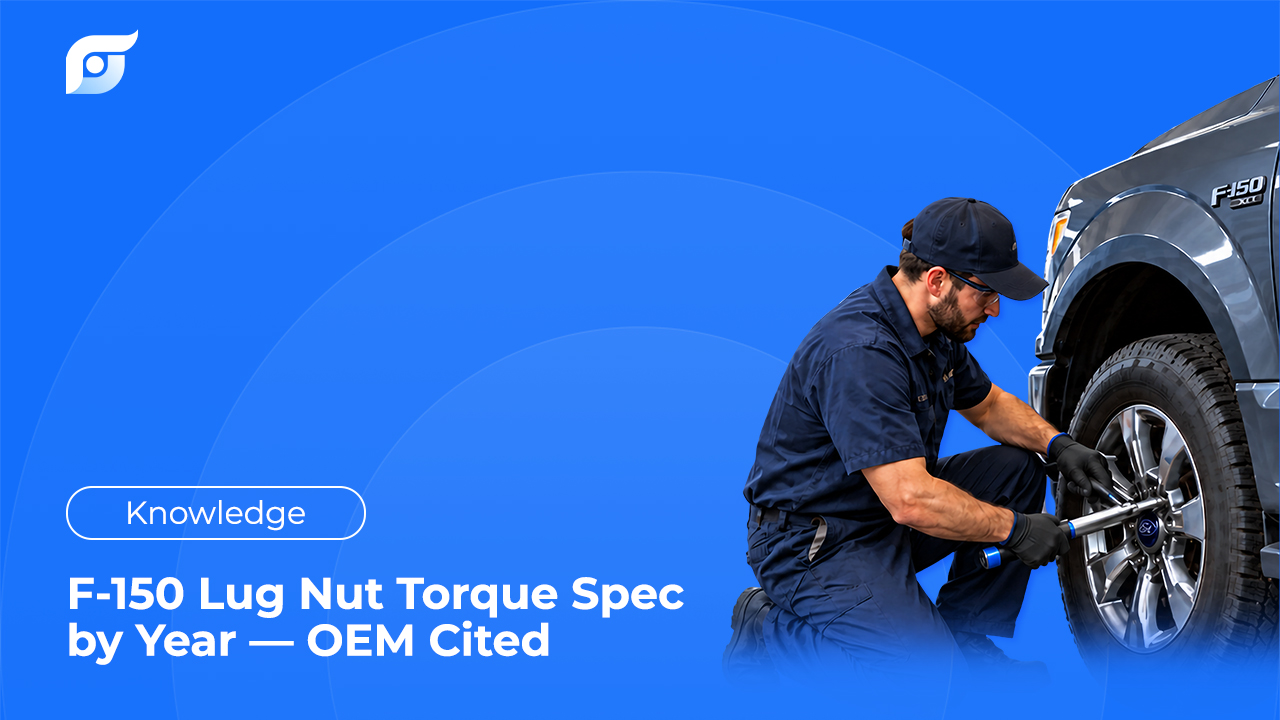
Most F-150 torque charts online are organized by model year, which is exactly where they go wrong. Ford changed the F-150 wheel stud from M12 to M14 partway through a generation, so two trucks with the same year on the title can take two different torque figures. The number that matters is stamped into the hardware, not the registration.
Quick Answer: Every Ford F-150 built from 2004 onward uses M14 x 1.5 studs torqued to 150 lb-ft (203 N·m) with a 21 mm socket. F-150s built before the changeover use M12 studs torqued to 100 lb-ft (135 N·m). Ford moved from M12 to M14 partway through the 1997–2003 generation, so trucks from roughly 2000–2003 can be either — identify the stud before you pull the trigger, because applying 150 lb-ft to an M12 stud will typically shear it. Tighten in a star pattern in two passes with a click-type torque wrench on clean, dry threads, then re-check the torque after the first 100 miles.
F-150 Lug Nut Torque Specs by Model Year
The table below is the year-by-year view, with the caveat that the 2000–2003 rows depend on which stud your truck actually has.
| Model years | Stud size | Torque spec | Socket |
|---|---|---|---|
| 2004–2026 (11th–14th gen) | M14 x 1.5 | 150 lb-ft (203 N·m) | 21 mm |
| ~2000–2003 (10th gen, later build) | M14 x 1.5 | 150 lb-ft (203 N·m) | 21 mm |
| 1997–~2000 (10th gen, earlier build) | M12 | 100 lb-ft (135 N·m) | 19 mm |
| 1975–1996 | M12 | 100 lb-ft (135 N·m) | 19 mm |
The 150 lb-ft figure has an unusually strong paper trail behind it. When Ford filed its remedy instruction with NHTSA for recall 22V-675, the fix it ordered dealers to perform was to loosen the lug nuts and re-torque them to 200 N·m in a star pattern — Ford’s own number, in a federal filing, converting to roughly 148 lb-ft. That is about as close to a primary source as a torque spec gets outside the service manual itself.
Why Stud Size Decides the Spec, Not the Model Year
An M12 stud and an M14 stud do not have the same cross-section, so they do not have the same clamping capacity. The 50 lb-ft difference between the two specs is not a safety margin someone added for comfort — it is the difference between correctly preloading a fastener and stretching it past its elastic limit. Overtightening an M12 stud to the M14 figure will usually shear it, either on the spot or on the highway three weeks later.
How to tell which stud your truck has
The fastest check is socket fit. M12 studs on these trucks take a 19 mm lug nut; M14 studs take 21 mm. If a 21 mm socket slips loosely over the nut and the 19 mm seats properly, you are working on the 100 lb-ft spec. Measuring the stud shank directly settles it beyond doubt, but the socket test is reliable enough for a wheel that is already off the hub.
Why torque charts disagree on 2000–2003 trucks
Sources genuinely conflict here, and it is worth naming the conflict rather than papering over it. Some charts draw the line at 2004 and call everything earlier a 100 lb-ft truck. Others place the M12-to-M14 changeover in late 2000 and assign 150 lb-ft from that point forward. Both are describing the same mid-generation running change, just with different confidence about when it reached production — and a running change does not land on all build dates cleanly, which is why a year-only lookup cannot resolve it.
This is the practical difference between a spec table someone assembled from forum consensus and an OEM procedure written against a specific build. It is also why a torque figure produced by a language model rather than retrieved from manufacturer data is a liability on a wheel fastener — the model will give you a confident number for a truck it cannot identify, which is precisely the failure mode behind the decision never to generate repair procedures and to return only what the source data actually says.
How Do You Torque F-150 Lug Nuts Correctly?
The spec assumes a specific method. Hitting 150 lb-ft the wrong way does not produce the clamp load Ford engineered for.
- Use a click-type torque wrench for the final pass. An impact gun is for removal and for running nuts down, never for setting final torque — even a torque-stick setup varies enough to matter on a fastener this size.
- Tighten in a star pattern, not around the circle. Ford specifies this explicitly, including in the 22V-675 remedy instruction. Sequential tightening cocks the wheel against the hub face and leaves uneven clamp load.
- Work in two passes. Snug all nuts in the star sequence first, then make a second pass to full spec in the same sequence.
- Keep the threads clean and dry. Ford’s torque figures are specified for clean, dry threads. Oil, grease, and anti-seize cut the friction the spec assumes, so the same wrench setting produces substantially more tension in the stud. Published estimates of how much more vary by the friction coefficient assumed — figures from roughly 30% to 50% appear across sources — but every one of them lands in territory that will damage the stud.
- Re-check after the first 100 miles. Ford’s owner literature calls for a re-torque after the initial drive; shop practice often re-checks closer to 50 miles. Either way the check is not optional on a wheel that has just been off.
None of this takes long once the number is in front of you. The time cost in a working bay is almost never the torquing — it is the interruption of stopping to find the spec across three tabs and a forum thread before the wrench comes out.
What Happens If You Over-Torque F-150 Lug Nuts?
Two failure modes, and the second one usually gets misdiagnosed.
Stretched and broken studs. Excess torque pulls the stud past its elastic limit so it no longer springs back. Each subsequent wheel service stretches it further, and the stud eventually snaps — sometimes during a routine rotation, sometimes under load. A single broken wheel stud on an F-150 typically runs $134–$169 at a shop, driven mostly by labor: most estimates put the job between 0.5 and 2.0 hours depending on how much has to come apart to back the old stud out. That spread is exactly the kind of gap factory-standard OEM labor times exist to close before the estimate goes out.
Brake vibration blamed on warped rotors. Uneven or excessive clamping force distorts the rotor hat and hub flange, producing lateral runout that shows up as pedal and steering-wheel vibration under braking. The rotor is usually not warped in any thermal sense — it was installed into a distortion. Replacing the rotor without correcting the torque practice reproduces the symptom on the new part.
Is There a Recall on F-150 Lug Nut Torque?
Yes, for a narrow population. NHTSA campaign 22V-675 (Ford reference 22S59) covers certain 2022 F-150 Raptor vehicles equipped with the 37-inch tire package, on which, in NHTSA’s wording, “lug nuts on the wheels may have been incorrectly tightened.” The stated consequence is that incorrectly tightened lug nuts “can loosen and result in wheel separation from the vehicle, increasing the risk of a crash.”
If a truck falls under an open recall, that repair is performed free of charge by an authorized dealer, regardless of vehicle age, mileage, or ownership history. The stud-replacement costs above apply only to damage that is not covered by an open campaign. Recall status is VIN-specific and can already be closed if a previous owner had the work done, so check the 17-character VIN at nhtsa.gov/recalls to confirm current open status rather than assuming either way.
Worth keeping straight: this is a recall, not a bulletin. The distinction between a TSB and a recall decides whether a repair is a mandatory free federal remedy or technician guidance that may still be billable — and a TSB documents a known pattern without carrying any entitlement to a free fix.
Confirming the Spec for Your Specific Truck
Recall 22V-675 is itself the argument for build-level verification: a single option package on a single model year produced a wheel-fastener campaign that no generation-wide chart would ever surface. Raptor wheel packages, Lightning, and any aftermarket wheel with its own seat type or lug hardware can all diverge from the platform baseline, and aftermarket lug nuts in particular carry the wheel manufacturer’s spec rather than Ford’s.
For anything outside a stock wheel on a stock truck, the figure to trust is the OEM specification for that build — the door placard, the owner’s manual, or the service data for the VIN in front of you. That is a lookup, not a judgment call, which is the whole reason repair information should be retrieved rather than generated when the answer is a number a wheel depends on.