
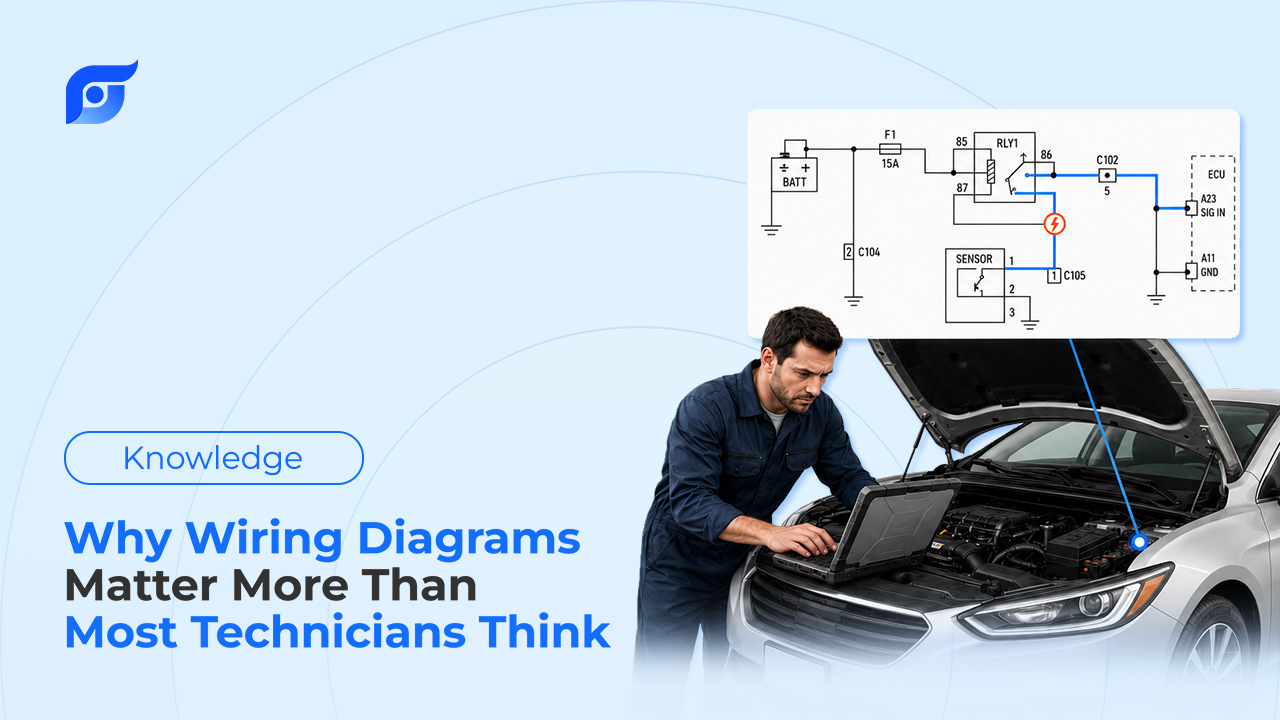
A shop replaces a $500 ECU chasing an intermittent no-start. The real fault: a corroded ground wire behind the intake, worth about nothing in parts, that the wiring diagram would have flagged in the first five minutes. The ECU gets returned, the comeback gets logged, and the hour spent swapping it never gets billed to anyone.
That’s not a rare story. It’s what happens by default when a wiring diagram gets treated as something to pull up after the guessing hasn’t worked, instead of before the meter comes out.
The Real Cost of Skipping the Wiring Diagram
Electrical diagnosis without a diagram isn’t faster — it just moves the time from “looking something up” to “finding out the hard way.” That shift shows up as real cost, not just wasted minutes:
Parts thrown at the wrong fault. Swapping a sensor or module because it’s a plausible suspect, rather than because the circuit points to it, means paying for a part that was never the problem.
Comebacks. A vehicle that returns for the same symptom costs more than the diagnostic time it would have taken to trace the circuit correctly the first time — it costs a second round of labor, plus the customer’s confidence in the shop.
Flat-rate efficiency. A tech paid on book time loses ground on every job that turns into trial-and-error, because the clock keeps running long after the book time assumed the job would be done.
Trust. A customer who gets billed for a part that didn’t fix the problem, followed by a second part that did, has a very reasonable question about the first invoice.
None of this is about a technician’s skill. It’s about what happens when the fastest path to an answer — swap the obvious part — gets taken instead of the fastest path to the right answer, which starts with the circuit.
Three Reasons Modern Vehicles Make the Wiring Diagram Non-Negotiable
Electrical systems on current vehicles don’t fail the way they did on a car with a handful of relays and point-to-point wiring. Three shifts make the diagram required reading, not optional backup:
Multiplexing and CAN-bus networks. Modules on a modern vehicle don’t each get their own dedicated wire back to a switch — they share a data bus. A symptom on one module can trace back to a wiring fault, a connector, or even a different module entirely on the same network. Without the diagram, there’s no way to know which modules are even on the same bus.
High-voltage systems on hybrids and EVs. The wiring diagram is often the only way to confirm which cables and connectors carry high voltage before work starts near them — orange sheathing is the visual warning, but the diagram confirms exact routing and connector locations. That’s reference information for a technician already trained and certified on high-voltage systems, not a substitute for that training — HV work stays certified-technician-only regardless of how clear the diagram is.
Pinouts that change within the same model line. Two model years of the same nameplate, or even two trims in the same year, can carry different connector pinouts. A diagram pulled for the wrong year or trim isn’t a shortcut — it’s a wrong answer that looks like a right one.
The Real Bottleneck Isn’t Reading Diagrams — It’s Finding Them
Most technicians already know how to read a wiring diagram. The friction is getting to the correct one, for the exact vehicle, from where the vehicle actually is.
That usually means walking back to a shop computer that’s nowhere near the bay, opening legacy shop software, and clicking through a menu tree by year, make, model, and system to find the right page — assuming the diagram on file is even legible. A lot of what’s in circulation is a low-resolution scan where wire colors and connector labels have gone soft enough to guess at, which puts the tech right back to trial-and-error, just one step removed.
The diagram was never the hard part. Getting to it, for the right vehicle, from the fender instead of the front office, was.
Getting the Right OEM Diagram in Seconds, Not Minutes
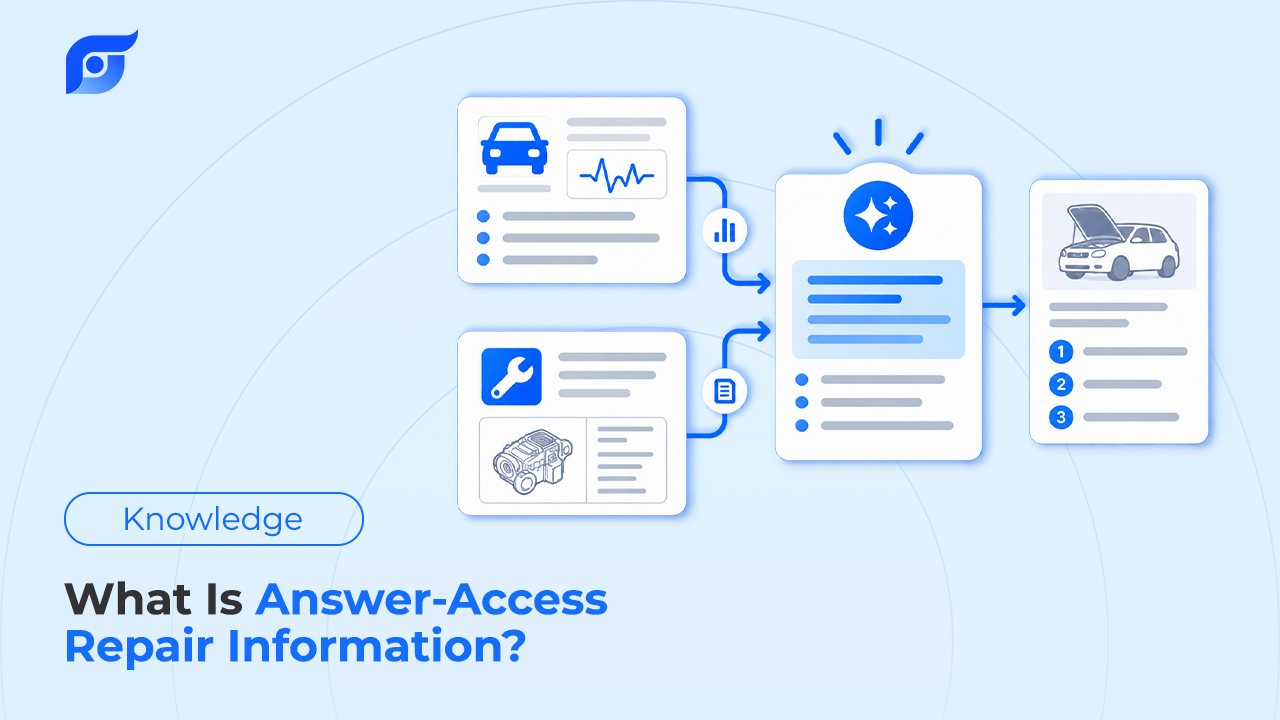
Ask Jayda something like “wiring diagram for headlights, 2018 Civic” and get back the OEM circuit for that exact vehicle — wire colors, connector pinouts, splice and ground locations — with the source cited, in seconds.
A few things that make this hold up at the vehicle instead of at a desk:
VIN-locked accuracy. Enter the VIN and the year, make, model, and engine are matched automatically — no picking the closest trim and hoping the pinout matches.
MOTOR-sourced, not AI-drawn. The diagram itself comes from OEM data via MOTOR. Jayda’s AI matches the query to the right diagram — it doesn’t draw one, redraw one, or fill in a faded section with something that looks plausible. If the exact diagram isn’t in the data, Jayda says so instead of showing something close.
Works from a phone, at the vehicle. Typing the query on a phone standing at the fender replaces the walk back to the shop computer — the same lookup, without leaving the bay.
If you run a shop, contact us for a trial to see it across your team. If you’re a technician working solo, start a free trial and pull up your next wiring diagram before you reach for a meter.
Frequently Asked Questions
Is a wiring diagram the same thing as a schematic? Not quite. A schematic shows how a circuit works logically — how current flows through it. A wiring diagram shows how it’s actually built into the vehicle: wire colors, connector locations, splice points, and physical routing. Diagnosing a real vehicle depends on the wiring diagram, since that’s what matches what’s actually in front of you.
Why do connector pinouts differ between model years of the same car? Manufacturers revise wiring and connectors across a model’s production run — a mid-cycle refresh, a new module supplier, or a trim-specific option can all change a pinout without changing the nameplate. That’s why a diagram needs to match the exact year, and ideally the VIN, rather than “close enough” for the model.
Can a wiring diagram tell me if a circuit is safe to test? It tells you what’s in the circuit — voltage, wire routing, connector locations — which is what you need before deciding how to test it safely. On high-voltage EV and hybrid systems, that information is a starting point for a technician already trained and equipped for HV work, not a stand-in for that training.