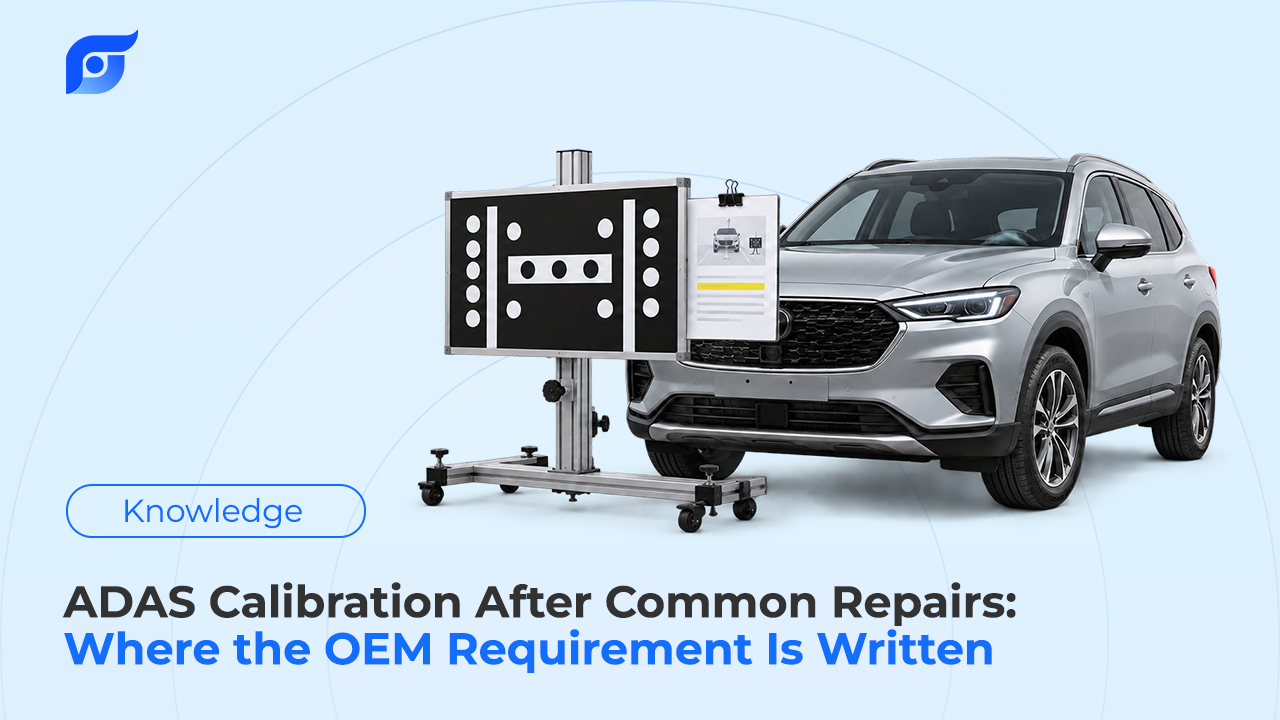
“Does this job need a calibration?” has no general answer. It has a per-manufacturer, per-system, per-event answer, and it is written down in the manufacturer’s own service information. Two brands can take opposite positions on the same repair: Ford lists suspension repair or alignment as a trigger for lane keeping camera calibration, while Honda’s aiming job aid says camera and radar calibration is not required after a wheel alignment unless the service information says otherwise. This page shows where those requirements live and how to read them for the vehicle in front of you.
Quick Answer: The calibration requirement is written in the OEM’s service information for that vehicle, and manufacturers also publish summary documents. Ford’s Ford and Lincoln ADAS Job Aid (11/2021) states that lane keeping camera calibration is required when a windshield, camera, or IPMA is replaced; if the windshield is removed for structural repairs that affect windshield position; on a change in tire size; after suspension repair or alignment; and after front air bag deployment. The same document says the cruise control radar sensor requires calibration when the vehicle has been in an accident and whenever the sensor or its mounting bracket is removed for access, and that parking aid and active park assist sensors need an Azimuth System Check whenever a sensor is removed and reinstalled or replaced. Honda’s aiming job aid takes a different line on alignment and requires a Honda genuine windshield for camera aiming to succeed. Triggers are written by event, not by fault code, so the absence of a warning lamp does not mean calibration is unnecessary. Ford’s job aid is explicitly “for reference only” and points back to the Workshop Manual — treat every summary that way, including this page.
Where the Requirement Is Actually Written
Four places, in order of authority:
- The OEM service information for that vehicle. The calibration procedure, its preconditions, and the events that trigger it sit inside the manufacturer’s workshop manual. This is the document that governs.
- OEM job aids and ADAS information documents. Ford/Lincoln, GM, and Honda/Acura publish summary documents that compile ADAS components and when calibration is required. They’re fast to read and explicitly secondary to the service manual.
- OEM position statements. Manufacturers publish statements on scanning, calibration, and repair methods; I-CAR’s RTS portal aggregates links to them by brand.
- Your repair information system. Whatever platform you use should carry the OEM procedure itself. MOTOR-licensed data, which is what sits behind Jayda, includes ADAS repair and calibration detail alongside OEM policy statements.
Everything else — a forum thread, a calibration vendor’s blog, a general article — is a pointer at best. The distinction matters here more than on most topics, because the requirement varies by brand and model year, which is exactly what an aftermarket summary tends to flatten.
What Ford’s Job Aid Actually Says
The Ford and Lincoln ADAS Job Aid organizes this as a table of component, when calibration is required, and notes. Selected rows, quoted as written:
| Component | When calibration is required |
|---|---|
| Lane Keeping Camera | When a windshield, camera or IPMA is replaced; if the windshield is removed for structural repairs that affect windshield position; change in tire size; suspension repair or alignment; front air bag deployment |
| Cruise Control Module and Radar Sensor | New CCM installed; when a vehicle has been in an accident; whenever the sensor itself or the bracket support in which it is mounted is removed from the vehicle for access |
| 360 Degree Cameras | When any camera is replaced or removed; when a camera or any body component that a camera is attached to is removed or adjusted |
| Head Up Display Module | HUD removed and reinstalled or replaced; instrument panel removed and installed or replaced; a new windshield is installed |
| Parking Aid / Active Park Assist Sensors | Whenever a sensor is removed and reinstalled or replaced (Azimuth System Check) |
Two notes in that document do real work. On the lane keeping camera, Ford writes that these systems “are developed and calibrated based on the manufacturer’s specified ride height and wheel/tire combinations. If the ride height or wheels have been altered this will affect system accuracy.” And at the top of the calibration section: “Any aftermarket alteration could cause a system to malfunction or not accept a correct calibration.” A lift kit, oversized tires, or a non-OEM bumper cover is a calibration problem before it is a styling choice.
The radar row is worth reading twice. Calibration is triggered by removing the sensor or its bracket for access — which happens during plenty of jobs that have nothing to do with the radar itself, including front-end work where the bracket is in the way.
Why You Can’t Carry One Rule Across Brands
Honda’s aiming job aid for driving support systems, published on techinfo.honda.com, states that unless instructed by the service manual or available service information, camera and radar calibrations are not required after a wheel alignment. It also specifies that a replacement windshield must be a Honda genuine windshield, warning that aftermarket glass will cause the aiming to fail or behave abnormally.
Set that beside Ford’s list, where suspension repair or alignment is a stated trigger, and the lesson is clear: a tech who learns “alignment means recalibrate” from one brand will over-service one make and, worse, may assume the reverse rule elsewhere. Both documents are also dated — Honda’s job aid is a 2021 version, Ford’s is 11/2021 — so the current service information for the specific vehicle remains the authority. That’s the same discipline as checking whether a bulletin has been superseded.
Common Repairs That Frequently Trigger Calibration
Use this as a prompt to go look, not as the answer:
- Windshield replacement or removal, where a forward-facing camera is mounted to the glass or the header
- Alignment, suspension work, or anything that changes ride height, on brands that tie camera aim to ride height
- Tire size changes, including a customer’s plus-size wheel package
- Front-end and bumper work, where radar sensors and their brackets are removed for access
- Mirror, grille, or body panel work near a camera or blind-spot sensor
- Airbag deployment and post-collision repair generally
- Module replacement or reprogramming, which often pairs calibration with programmable module installation
Note what these have in common: they are ordinary mechanical and body jobs, not ADAS jobs. The calibration requirement arrives attached to work the customer booked for another reason, which is why it belongs in the estimate from the start — alongside the OEM labor times for the calibration operation itself.
Static, Dynamic, and What the Shop Needs
I-CAR’s guidance puts it simply: calibrations can be static (in-shop) or dynamic (on-road), and the requirements vary by OEM. Which one applies, and what it demands, is specified in the procedure for that vehicle rather than by a general rule.
What the procedure typically specifies, and what you have to be able to meet before accepting the work:
- Targets and fixtures for the specific make, positioned at distances and heights the procedure dictates
- A level floor and clear, controlled space around the vehicle, with the lighting and background conditions the procedure calls for
- Vehicle conditions — tire pressures, fuel level, load, and alignment within spec, because the aim reference is the vehicle’s own geometry
- A scan tool capable of running the manufacturer’s calibration routine, including the road-test portion where a dynamic step is required
If your shop can’t meet the stated conditions, the professional answer is to sublet the calibration to a shop or mobile service that can, and to say so on the estimate. Ford’s radar procedure, for example, pairs a vertical mechanical adjustment with a horizontal alignment performed during a road test using the scan tool routine — a sequence that needs both the equipment and the space to do properly. A calibration signed off without meeting the procedure’s conditions is worse than no calibration, because the paperwork now says the system was verified.
No Warning Lamp Is Not Proof of Calibration
Read the triggers again and notice how they’re written: by event, not by symptom. “When a windshield is replaced.” “Whenever the sensor or its bracket is removed.” None of them says “when a code is present.”
That phrasing is deliberate. The requirement exists because the physical relationship between the sensor and the road has changed, and a sensor pointed slightly wrong can still report that it is working. Waiting for a lamp is not a diagnostic strategy on these systems, and knowing exactly where each sensor is mounted is the first step in recognizing when a routine repair has disturbed one.
Finding It for the Vehicle in Front of You
The workflow is short, and it happens before the estimate rather than after the repair:
- Identify the vehicle precisely, by VIN, including trim and option content — ADAS equipment varies within a model line.
- List the components your repair will disturb, including brackets and body panels that sensors attach to.
- Pull the OEM calibration requirement for each of those components for that vehicle and model year.
- Check the preconditions before quoting: equipment, space, and the vehicle conditions the procedure specifies.
- Record the document you relied on, and note the calibration result on the repair order.
Step 3 is a lookup, not a judgment call, which is where asking for the manufacturer’s document beats searching for a general answer. Jayda retrieves OEM repair information for the exact vehicle with the source shown, and when the document isn’t in the database it says so rather than offering a near match — the policy behind never generating repair procedures and retrieving rather than writing them. On a system that steers or brakes the car, that distinction isn’t academic.
This page summarizes published manufacturer documents and is not a substitute for them. Requirements change by model year and by revision, so confirm against the current service information for the vehicle you’re working on. For broader criteria on choosing where that information comes from, see how to choose OEM repair software.