Every shop can be talked into measuring lookup time. Multiply techs by lookups by minutes by your labor rate and you get a number that sounds like money. The harder question is what certainty is worth — the repair that didn’t come back, the part that wasn’t ordered twice, the diagnosis that stopped early because someone found the bulletin. That value is real and it never appears on a report, which is why it loses every budget argument it enters.
Quick Answer: Lookup cost and lookup accuracy are two separate ledgers. The cost of finding is measurable: technicians × lookups per day × avoidable minutes × your labor rate. The value of knowing is avoided loss — comebacks caused by wrong information, parts ordered for the wrong build, diagnostic hours spent on a complaint a bulletin already documented, and jobs you can’t substantiate afterward. You cannot measure avoided loss directly, because the correct repair leaves no trace. You can measure four proxies over 90 days: comebacks with an information cause, parts returns and the restocking fees attached to them (published retailer policies commonly run 15–25% of the part), “a bulletin existed” events, and repair orders with no recorded source. Use the first ledger to build the budget case and the second to decide how much error your shop can tolerate. Every figure on this page is an estimate — replace it with your own numbers.
Two Ledgers, One Invoice
The first ledger is about speed and it behaves like any other capacity question. If a tech spends three minutes per lookup finding the page rather than reading it, those minutes are recoverable, and their value depends on whether another repair order is waiting. That arithmetic is worked through in the hidden cost of searching before every repair order, and most of the minutes go to navigation rather than reading, as where lookup time actually goes describes.
The second ledger is about being right. Its unit isn’t minutes, it’s events that didn’t happen. A shop that improves only the first ledger gets faster at being wrong. A shop that improves only the second takes longer to be right. Most owners are sold the first and quietly care about the second.
Why the Second Ledger Is Always Under-Counted
Three structural reasons, none of them about discipline:
- The correct repair is invisible. Nobody logs “used the right spec, car didn’t come back.” The ledger only ever records failures, so its true size is unknowable from the inside.
- The counterfactual is unprovable. You can’t demonstrate that a comeback would have happened. Any honest estimate here is an estimate, which is exactly why vendors prefer to sell minutes.
- There’s no line item. A redo gets absorbed into labor, a wrong part into parts, a long diagnosis into the tech’s efficiency number. The cost is real and distributed, so it never arrives as a single figure anybody argues about.
Four Proxies You Can Actually Measure
| Proxy | How to capture it | What it stands for | Honest limit |
|---|---|---|---|
| Comebacks with an information cause | On every comeback, record one cause: part failure, workmanship, information, or diagnosis | Repairs done to the wrong spec, procedure, or build | Cause coding is a judgment call, and “information” is easy to under-report |
| Parts returned as not-needed or wrong | Count returns per month and the restocking fees paid | Decisions made without confirming the exact vehicle or the documented cause | Some returns are supplier errors, not information errors |
| “A bulletin existed” events | When a bulletin turns up after diagnosis started, log the hours already spent | Time lost by not checking documentation first | Only counts the ones you eventually found |
| ROs with no recorded source | Sample 20 closed tickets; count how many name the document used | Your ability to substantiate work later | Measures documentation, not correctness |
None of these is precise. Together they move the second ledger from “a feeling” to “four numbers that change month to month,” which is enough to make decisions with.
Putting Estimated Numbers on Them
Use your own labor rate; the figures below are illustrative estimates, not measurements from any shop.
- Comeback redo. A two-hour redo at a $132/hour labor rate ties up about $264 (estimate) of bay capacity before parts, and it displaces a job you could have sold that slot to.
- Wrong part. The visible cost is the restocking fee, commonly 15–25% of the part in published retailer return policies. The larger cost is usually the delay: a vehicle on a lift waiting for a second delivery.
- Late bulletin. Diagnostic hours spent before finding documentation convert directly at your rate. Three hours at $132 is $396 (estimate) on a complaint that was already written up by the manufacturer.
- Unsubstantiated work. This one has no clean dollar value, and pretending otherwise would be dishonest. Treat it as risk exposure rather than cost, and judge it by how comfortable you’d be defending a repair six months later with the notes you have.
Two of these also distort your other numbers. Comeback hours and late-bulletin hours inflate your labor-hours-sold figure while destroying margin, and they make technician efficiency look worse than the technician is. Quoting from OEM labor times doesn’t fix that by itself, but it does stop the estimate from absorbing the error silently.
A 90-Day Method
- Month 1: count, don’t change anything. Capture the four proxies with no process changes. This is your baseline.
- Month 2: change one thing. Pick the cheapest intervention — usually “check for a bulletin before diagnosing,” and “record the document used on the RO.”
- Month 3: compare. Same four numbers, same counting rules. Look at direction, not precision.
Then run the first ledger alongside it: a week of lookup tallies gives you find-time per lookup, which is the input the time arithmetic needs. Together the two produce a defensible case, one built on capacity and one on error, each labeled as the estimate it is.
Where Certainty Actually Comes From
Knowing isn’t a feeling of confidence. It’s four conditions you can check: the document names the exact vehicle including build date where scoped, the source is visible, the conditions around the value are stated, and you know what isn’t covered. Those conditions are what OEM repair information supplies and what a consolidated chart usually strips out.
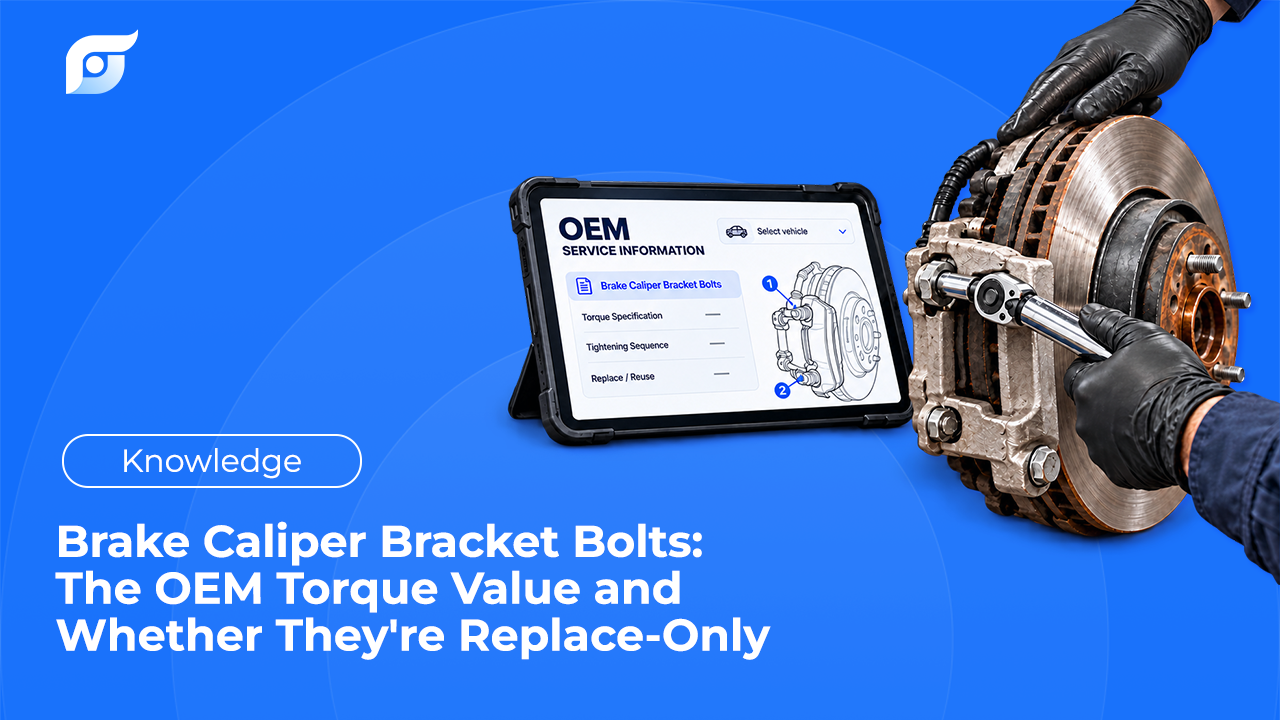
Two federal filings show how small the margin is. In recall 22V-675, Ford reported a plant tool set to 170 N·m instead of the intended 200 N·m on wheel lug nuts, and an audit found 236 of 477 vehicles below spec. In recall 25V-191, Chrysler described front caliper bracket bolts that, when not properly torqued, “may become separated from the steering knuckle” — and under warnings that can occur, the filing says None. If an automated factory tool and a 30 N·m difference can produce a recall, a remembered number on a Friday afternoon is not a safe bet.
That’s also the reason a confident-sounding answer from a tool that writes rather than retrieves is worse than no answer, which is the logic behind searching repair information rather than generating it and never generating a procedure that doesn’t exist. Checking whether a bulletin already documents the complaint is the cheapest certainty available, and it’s free.
How to Decide
Use the two ledgers for two different questions.
The budget question — can we justify the spend — belongs to the first ledger, because it’s the one with arithmetic behind it. At a $132/hour rate, a $149/month team plan equals roughly 68 billed minutes a month across the whole shop (estimate), and an individual plan at $14.95/month equals about 7 billed minutes. Those are break-even thresholds, not savings claims.
The risk question — how much error can we live with — belongs to the second. It doesn’t produce a number you can defend in a spreadsheet, and it shouldn’t be dressed up as one. It produces a judgment about whether your shop’s comeback and wrong-part rates are where you want them.
Buy on the first. Review on the second. If you test a change, design the trial to measure both: find-time per lookup for the time ledger, and the four proxies for the certainty ledger. Jayda’s Business plan runs at $149/month on a 12-month agreement for up to 10 technicians, and its 7-day trial is activated through the Jayda team rather than self-serve signup, so plan the week around real repair orders rather than demo questions. For the broader comparison criteria, including data licensing and coverage, see how to choose OEM repair software.