Finding a bulletin is a different skill from reading one. Every manufacturer publishes to its own portal, under its own numbering scheme, behind its own login, and the free federal database holds a parallel copy that is searchable in a different way. This sheet covers the three places a bulletin lives, what each one will and won’t give you, and the traps that make a real bulletin the wrong answer.
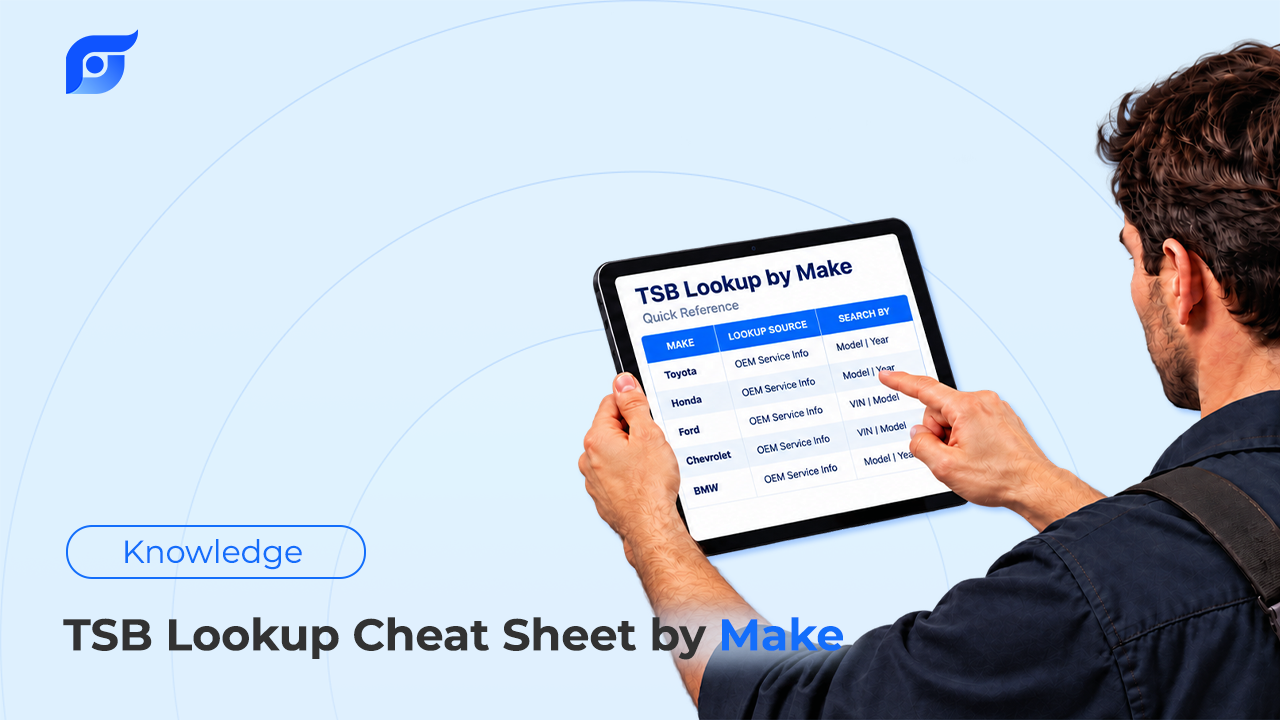
Quick Answer: A technical service bulletin can be found in three places. 1. Your repair information subscription, which is the fastest route if it carries the make. 2. NHTSA, free: recalls are searchable by 17-character VIN at nhtsa.gov/recalls, and manufacturer communications, including TSB filings, are searchable by year, make, and model — not by VIN. 3. The manufacturer’s own portal, indexed for 43 brands at OEM1Stop, where each automaker’s site “requires its own registration/login process” and “may also require the purchase of daily/weekly/monthly/annual subscriptions.” NASTF maintains the OEM service information matrix and takes Service Information Requests when a needed procedure can’t be obtained. Numbering schemes differ by make — Ford uses a year-and-sequence format such as 23-2123, recent Toyota bulletins appear as T-SB-0104-23, recent Honda bulletins as A23-089 — so never infer coverage from a number. Always confirm the build-date scope and whether a later bulletin has superseded the one you found.
The Three Places a Bulletin Lives
| Source | What you get | Main limit |
|---|---|---|
| Your repair information subscription | Bulletins alongside the procedures, specs, and diagrams for the vehicle | Coverage varies by make and model year |
| NHTSA (free) | Recalls by VIN; manufacturer communications, including TSB documents, by year, make, and model | No VIN search for bulletins; the agency holds what manufacturers filed, which may not be the current revision |
| OEM portal | The authoritative, current bulletin and the procedure it points to | Separate registration per brand, often a paid subscription per day, week, month, or year |
Most shops use all three in sequence: subscription first, NHTSA to check what exists, and the OEM portal when the job justifies buying access for that one vehicle.
What NHTSA Gives You Free, and What It Doesn’t
NHTSA publishes manufacturer communications — the documents automakers file with the agency — and makes them searchable by year, make, and model. The recall side is different and more precise: recall lookup accepts the 17-character VIN, which is the only way to know whether a specific vehicle has an open campaign.
Two limits matter in the bay. First, you can’t search bulletins by VIN there, so you still have to know the build you’re working on and read the scope inside the document. Second, the agency’s copy is what was filed, not a live feed from the manufacturer’s system, so treat it as evidence that a bulletin exists rather than proof that it’s the current version. For the difference between the two document types and who pays for the repair, see TSB vs. recall.
Going Straight to the Manufacturer
OEM1Stop indexes the repair information sites for 43 brands, from Acura and Audi through Volkswagen and Volvo, including makes that no longer exist as current nameplates. The page is blunt about what’s behind each button: the sites are operated independently by each automaker, each one “requires its own registration/login process,” and they “may also require the purchase of daily/weekly/monthly/annual subscriptions to access repair information.”
Two practical notes from documents that reference these systems directly. Ford’s own federal recall filing tells owners that dealers can confirm whether a campaign applies to a specific vehicle using the “Ford On-line Automotive Service Information System (OASIS) database” — a reminder that the dealer-side lookup is VIN-level even when the public one isn’t. And Honda publishes service documents, including its driving-support aiming job aid, on techinfo.honda.com.
When a procedure simply isn’t obtainable, NASTF is the industry route. It maintains the OEM service information matrix of contacts for service manuals, bulletins, and wiring diagrams, offers a free membership level that opens each brand’s service and subscription information, and accepts Service Information Requests from repairers who can’t get what a job requires.
Reading a Bulletin Number
Numbering is per-manufacturer, and it is worth knowing only to the extent that it helps you spot a mismatch. Verified examples:
- Ford and Lincoln use a two-digit year plus a sequence: 20-2117, 22-2428, 23-2123, 26-2171. All four are real Ford bulletins filed with NHTSA, and the leading digits track the year of issue, not the vehicle’s model year.
- Toyota bulletins appear in a T-SB-0104-23 pattern on recent documents.
- Honda bulletins appear as a letter plus year and sequence, such as A23-089.
Patterns for other makes exist, but this page doesn’t list them, because the per-brand conventions I could not confirm against primary documents would be guesses dressed as a cheat sheet. Numbering also changes over time: older bulletins from the same manufacturers used entirely different schemes. Use the number to track a document, never to judge whether it applies.
The Three Traps
- Supersession. Ford’s 10R80 harsh-shift bulletin 22-2139 was superseded by later bulletins with different vehicle and build-date coverage, including 23-2123 and 22-2428. A number copied from a forum thread can be real and obsolete at the same time.
- Build-date scope. Bulletin 20-2117 applies to 2017–2018 F-150s with the 10R80 built on or before 20 November 2017. Model year alone does not tell you whether a truck is covered.
- Title matches for the wrong vehicle. Ford’s bulletin titled “Torque Converter Shudder,” 26-2171, covers the 2019–2024 Edge and 2019–2023 Nautilus with the 8F35 transmission. Searching an F-150 shudder complaint will surface that title, and it is not the truck’s bulletin.
All three are reasons to open the document and read its Model and Issue sections rather than trusting a search result list. That’s also what separates OEM repair information from a secondhand summary of it.
A Lookup Sequence That Works on Any Make
- Pin the vehicle. VIN, engine, and build date where you can get it.
- Check recalls first, by VIN at nhtsa.gov/recalls, because an open campaign changes both the procedure and who pays.
- Search bulletins by symptom and system, not by the part you suspect.
- Open the document and read the scope: models, model years, build dates, transmission or engine codes, and the DTC list where one is given.
- Check for supersession near the top of the document.
- Record what you used on the repair order — number, title, and date — so a comeback can be traced to a document rather than a memory.
Step 4 is where most wasted time gets recovered, and it’s also where the estimate gets more accurate, since a bulletin can add a software update or a revised part that the labor time for the original complaint never accounted for. The whole sequence is covered in more depth in what a TSB is and how to use one.
Where a Repair Information Tool Fits
The point of a subscription is to collapse steps 3 through 5 into one question for the vehicle you’re on. With Jayda, a tech asks for what they need and gets the matching OEM document with its source shown, including bulletins, and when nothing matches, Jayda says so rather than returning a near miss. The data is licensed from MOTOR Information Systems, covering 43 manufacturers from 1985 to 2026, and coverage isn’t uniform: Toyota, Lexus, and Scion data is pending, so verify your mix before relying on any single source.
That boundary is the reason the retrieval model matters on bulletins specifically. A bulletin that doesn’t exist for your build cannot be summarized into existence, which is the thinking behind never generating repair procedures and retrieving documents rather than writing about them. For the broader criteria when comparing platforms, see how to choose OEM repair software.