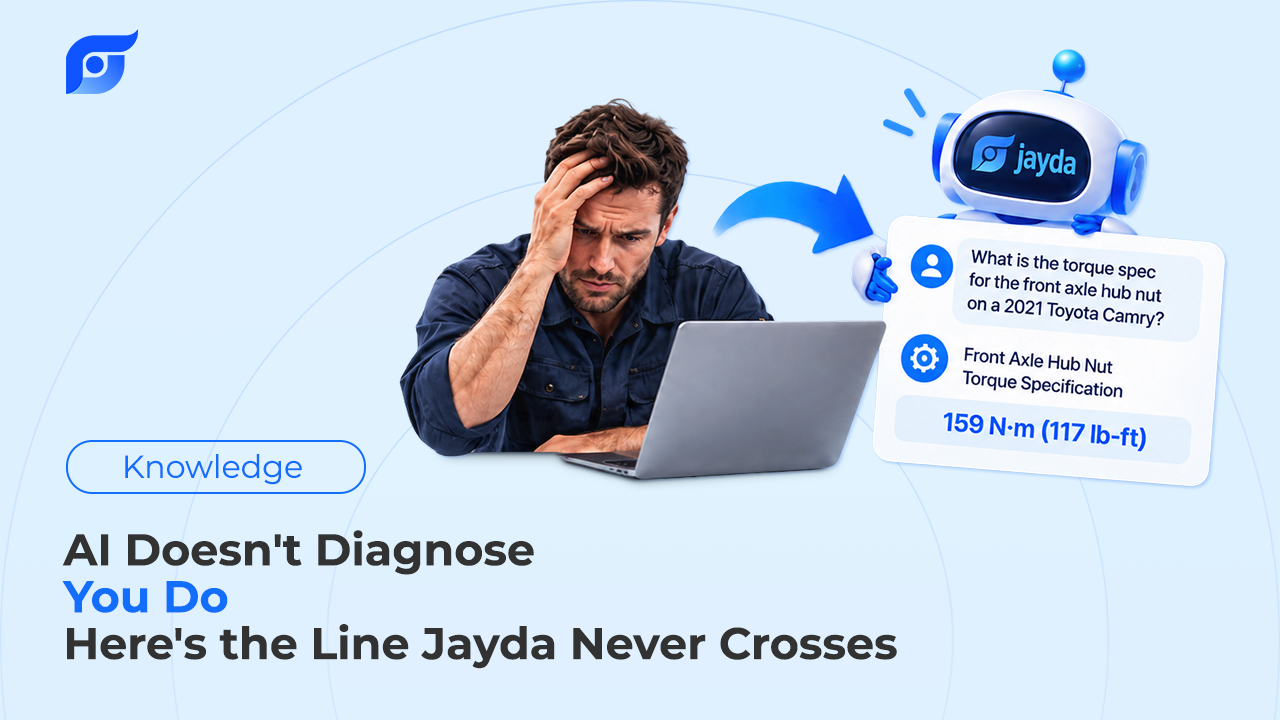
Every new tool in the bay gets the same silent question from the tech holding it: is this thing going to tell me how to do my job? For AI tools the question is louder, because a lot of them are built to do exactly that: read a code, rank the likely causes, and tell you what to replace. Jayda isn’t. The line between what Jayda does and what the technician does is a product decision, and this page spells out where it sits and why.
Quick Answer: Jayda’s AI does one job: it finds the manufacturer’s document for the vehicle in question, whether a procedure, spec, wiring diagram, DTC definition and test steps, or TSB, and returns it with the source shown. It never diagnoses the vehicle, ranks likely causes, judges how urgent a fault is, tells the technician what to do next, writes or summarizes repair steps, or fills a gap with a guess when a document isn’t in the database. Diagnosis stays with the technician because it depends on what only the person at the vehicle can verify: the actual symptom, measured values, prior repairs, aftermarket parts, and damage no document knows about. GM’s Strategy Based Diagnostics, as presented by I-CAR, describes good diagnosis as combining “the technician’s knowledge and skill with the available service information.” Jayda supplies the second half. The first half is yours.
Where Exactly Is the Line?
| Jayda does | Jayda never does |
|---|---|
| Finds the OEM procedure, spec, diagram, or bulletin that matches your question and vehicle | Tells you what’s wrong with the vehicle |
| Returns the DTC definition and the manufacturer’s test steps | Ranks which cause is most likely, or picks one for you |
| Shows the source document with every result | Rewrites, summarizes, or “simplifies” a repair procedure |
| Lists related OEM documents, when available | Judges how urgent a fault is or whether the vehicle is safe to drive |
| Says so when a procedure isn’t in the database | Approximates from a “similar” vehicle or general knowledge |
The left column is retrieval: finding a manufacturer’s document and putting it in front of you. The right column is judgment, and judgment about a specific vehicle requires information that only exists at that vehicle. The data behind the left column is OEM repair information licensed from MOTOR Information Systems, covering 43 manufacturers from 1985 to 2026.
Why Does Diagnosis Belong to the Person at the Vehicle?
The industry’s own diagnostic method answers this. Strategy Based Diagnostics was first published by General Motors after studying how successful technicians work, and I-CAR presents it as a best practice for diagnosing collision-damaged vehicles. Condensed, its sequence runs:
- Understand and verify the concern
- Perform a vehicle diagnostic system check
- Run preliminary checks
- Check for related bulletins, recalls, and preliminary information
- Review the diagnostic categories
- Isolate the root cause, then repair and verify the correction
Service information feeds several of those steps. Checking whether a technical service bulletin covers the complaint is a lookup, and so is pulling the system check or the test procedure. But verifying the concern, reading the measurements, and isolating the root cause happen at the vehicle, with a meter, a scan tool, and a set of hands. A document can’t hear the noise, see the chafed harness, or know that the last shop installed an aftermarket sensor.
That is also why the method keeps “verify” at both ends. The tech confirms the concern before diagnosing and confirms the repair after it. No lookup tool, however fast, can do either.
What Would Crossing the Line Look Like?
It usually doesn’t look dramatic. It looks like a helpful sentence.
An earlier version of Jayda’s own website described a warning-light feature that would tell a driver “exactly what it means, how urgent it is, and what to do next.” That copy was rewritten. The feature now pulls the OEM definition and the manufacturer’s troubleshooting steps for the exact vehicle. Deciding urgency and next steps belongs to whoever is looking at the vehicle and the manufacturer’s document, not to a model’s interpretation.
The risk isn’t hypothetical. When AI rewrites or summarizes source material, it can misstate it even with citations attached. A 2024 Stanford RegLab study of AI legal research tools built on retrieval found that they still produced incorrect or misgrounded answers in 17% to 33% of queries. In a bay, a misstated source is a wrong torque value or a test step from another model year, which is why Jayda shows the manufacturer’s document itself rather than a paraphrase. The full reasoning is in why AI should search repair information, not generate it and why Jayda never generates repair procedures.
Doesn’t That Make Jayda Less Useful Than a Tool That Diagnoses?
It depends on what you want from the tool, and it’s worth being straight about the trade-off. Some repair platforms now offer AI diagnostic features. ALLDATA’s Diagnostic Intelligence, for example, combines OEM service information with frequency-ranked known fixes, community answers, and AI-guided insights. That is a legitimate product choice, and some technicians will want exactly that.
Jayda makes a different bet. A technician who knows the trade doesn’t usually need software’s opinion on what’s wrong. They need the right manufacturer document for this vehicle, now, without navigating a menu tree to find it. If you want a tool to suggest the likely cause, Jayda won’t do that. If you want the wiring diagram, the test procedure, and the spec for the exact vehicle, with the source attached, that is the whole job.
How Can You Test Any Tool Against This Line?
Whatever tool your shop uses, four quick checks show which side of the line it’s on:
- Ask something with no documented answer. A retrieval tool says it didn’t find one. A generating tool produces an answer anyway.
- Ask it what’s wrong with the vehicle. See whether it names a cause, or returns the manufacturer’s diagnostic procedure for the symptom.
- Check the source on every answer. You should be able to open the manufacturer’s document behind a result, not just see a citation label.
- Give it the wrong engine. Ask for a spec on one engine and check whether the answer quietly matches a different one.
For a broader set of criteria, including data licensing and coverage, see how to choose OEM repair software.
Needing the Right Page Isn’t a Skill Gap
Nobody expects a tech to memorize the torque spec for every fastener on 43 manufacturers’ vehicles, or the pinout of every connector. Looking it up is the job, and GM built its diagnostic method around technicians using service information, not around replacing their judgment. What changes with Jayda is how fast the right page arrives, not who does the diagnosing. That is the point of keeping AI on the searching side of the job: you’re the expert, and Jayda finds the data.