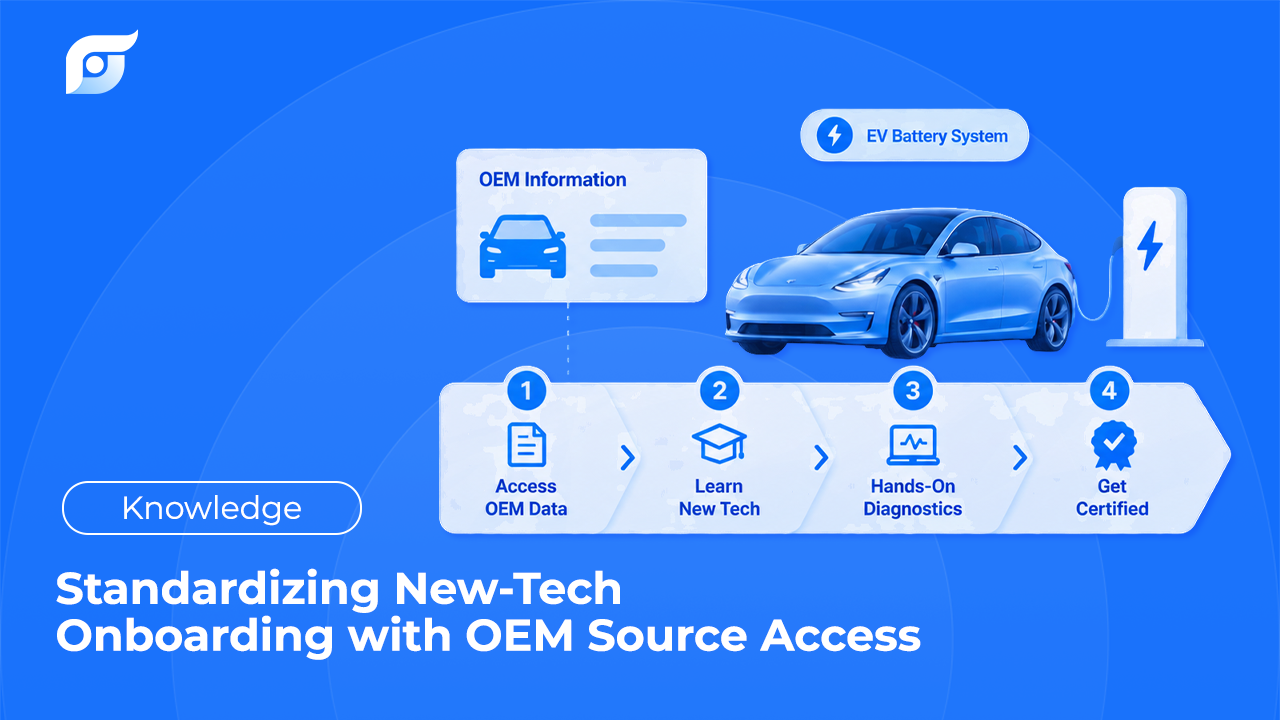
Most shops onboard a new technician the same way: pair them with the lead tech, start them on maintenance work, and tell them to ask when they’re stuck. That plan works for wrenching skills. It breaks down on information. “Ask when you’re stuck” means the answer depends on who gets asked, what they remember, and which forum thread they trust. A shop can fix that with one written rule about where answers come from, and a first month built around it. This guide lays out both.
Quick Answer: Standardizing new-tech onboarding with OEM source access means writing down one rule: every torque spec, procedure, wiring diagram, and TSB used on a repair order comes from the manufacturer’s document for the exact vehicle, and the tech can show which document it was. The first 30 days are built around that rule.
Week 1: give the new tech their own login and teach the lookup standard.
Week 2: supervised lookups, each one checked by the lead tech against the source.
Week 3: independent lookups on routine jobs, signed off by lookup type.
Week 4: diagnostic work that starts from the manufacturer’s procedure, with every lookup recorded in the job notes. The payoff is that the lead tech’s time goes to judgment (“what does this reading mean?”) instead of finding pages (“where is the spec?”). Any OEM repair information system can support the standard; what matters is that everyone uses the same source.
Why Does New-Tech Onboarding Need a Standard Now?
Because most shops are hiring people who will learn largely on the job. TechForce Foundation’s 2026 Technician Supply, Demand & Opportunity report puts automotive demand at about 70,000 openings a year against roughly 42,000 graduates. The U.S. Bureau of Labor Statistics projects about 66,200 openings a year for automotive service technicians through 2035. It also notes that techs without a formal training program usually need longer on-the-job training and often start as trainees or helpers.
Shop owners feel the gap. In PartsTech’s 2025 survey of 752 shops, as summarized by MOTOR, 31% named the technician shortage their biggest challenge, and training for complex vehicles was the top industry challenge at 20%. The same research found that 69% of owners recognize the need for career growth paths, but only 10% formally offer one. A written onboarding plan is the first rung of that path, and it costs nothing but the time to write it down.
What Is a Lookup Standard?
A lookup standard is a short, written rule for where repair information comes from in your shop. It takes one page, and it narrows the gap between how your best tech and your newest tech find answers. A workable version has four parts:
- Specs, procedures, and diagrams come from the manufacturer. Torque values, fluid capacities, wiring diagrams, and repair procedures come from OEM repair information for the vehicle, not from memory, a video, or a forum post.
- Confirm the exact vehicle before reading the answer. Year, engine, and submodel, or the VIN where the system supports it. A spec for the wrong engine is one of the easiest ways for a correct-looking answer to be wrong.
- Check for bulletins before diagnosing. Before chasing a complaint, look for a technical service bulletin that already covers it.
- Record the source. Note which document was used in the job notes, so the lead tech or the next tech can see it.
Forums and videos still have a place: tips, access tricks, and what to expect on a tough job. They just aren’t the source for a number that ends up on a fastener. That distinction is the practical difference between an OEM repair procedure and an aftermarket repair guide, and new techs learn it faster when it’s written down than when they absorb it one correction at a time.
What Does a 30-Day Onboarding Plan Look Like?
The plan below covers only the information side of onboarding. Tool skills, safety training, and shop procedures run alongside it.
| Week | New tech does | Lead tech checks | Sign-off at end of week |
|---|---|---|---|
| 1 | Gets their own login; reads the lookup standard; looks up specs and capacities for the maintenance jobs they’re assigned | Every lookup, against the source document and vehicle configuration | Specs and fluid capacities |
| 2 | Pulls procedures for supervised repairs before starting each job | That the procedure matches the vehicle and that the tech read the whole thing, including precautions | Repair procedures on routine jobs |
| 3 | Handles routine jobs independently; starts pulling wiring diagrams and component locations on electrical work | A sample of lookups, plus every diagram used on a live circuit | Wiring diagrams and component locations |
| 4 | Starts diagnostic work from the manufacturer’s DTC procedure and checks for bulletins first | Test results against the procedure’s specs, and the decision to replace any part | DTC procedures and TSB checks |
Why sign off by lookup type
Signing off by lookup type, not by calendar date, tells you what the new tech can be trusted with alone. A tech who pulls torque specs reliably may still misread a connector view. Reading a circuit correctly depends on understanding what the OEM wiring diagram actually shows, and finding the part it describes is a component location question that takes practice on its own.
What a new tech shouldn’t sign off alone
Some work stays with a qualified tech regardless of how the first month goes. Anything behind orange high-voltage cabling on a hybrid or EV requires ASE L3 (Light Duty Hybrid/Electric Vehicle Specialist) certification or equivalent OEM training, a verified zero-energy state, and insulated Class 0 gloves. That is not part of new-tech onboarding at all. Most ASE professional certifications also require hands-on work experience, typically about two years or a combination of training and experience, which is a reasonable guide to when broader independent sign-off makes sense.
How Do You Keep the Lead Tech From Becoming the Help Desk?
Without a standard, a new tech’s questions land on the lead tech, and every question stops two people. A 4-minute question costs 8 tech-minutes, one of them from your most productive tech. That cost is spread across the day, which is why time lost to lookup rarely shows up on a report.
The lookup standard splits questions into two kinds. “Where is the spec?” and “which procedure applies?” go to the source first. “What does this reading mean?” and “should I replace this part?” go to the lead tech. The second kind is the mentoring the lead tech should be doing, and it’s easier to protect when the first kind has somewhere else to go.
Where Does the Lookup Tool Fit?
Any OEM repair information system can support a lookup standard. What the standard needs from the tool is simple: every tech has their own access, the answer is tied to the exact vehicle, and the source is visible so the lead tech can check it.
Jayda is built around those three things. Each tech on a Business plan has an individual login, asks the question the way they’d ask another tech, and gets the matching OEM document with its source shown. The data is licensed from MOTOR Information Systems and covers 43 manufacturers from 1985 to 2026. Jayda’s AI retrieves the manufacturer’s document and does not write repair steps, the reason laid out in why Jayda never generates repair procedures. That matters more for a new tech than anyone, because a new tech is the person least able to spot a plausible wrong answer.
Business Projects also make the week 2–4 checks practical. A Project holds the saved questions and answers, images, and vehicle owner information for a job, and it can be shared with team members. The lead tech can see which document the new tech used without standing over the bay. Business is $149/month on a 12-month agreement for up to 10 techs, and its 7-day trial is activated through the Jayda team rather than self-serve signup.
How Will You Know the Standard Is Working?
Jayda doesn’t publish a figure for reduced training time, and any shop’s result depends on who it hires and what it fixes. Track your own numbers from the first hire you onboard this way:
- Days to sign-off for each lookup type, compared with your next new hire
- Lead-tech interruptions per day during the new tech’s first month
- Comebacks on the new tech’s jobs, and whether any trace to a wrong spec or the wrong vehicle
- Lookups with the source recorded in the job notes
Those four numbers show whether the standard is doing its job, and they give you a real baseline for weighing the hidden cost of searching before every repair order across the whole team.