
If your shop mentioned a TSB, or a mail notice showed up about a recall, you’re probably asking the same two questions most people ask: is this going to cost me anything, and am I required to get it fixed? The two terms get lumped together constantly, but they mean very different things for your safety and your wallet. Here’s how to tell them apart — and exactly what to do once you know which one you’re dealing with.
The Quick Answer
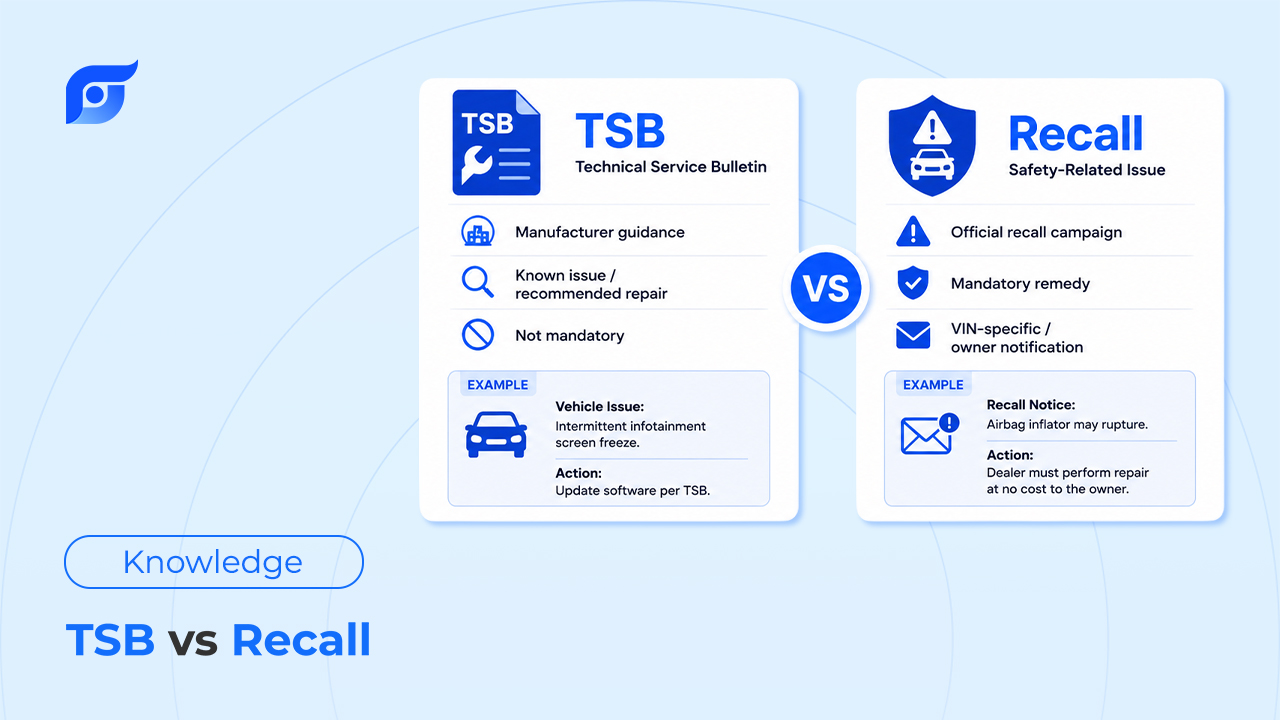
A recall means the manufacturer found a safety or emissions defect, it’s regulated by NHTSA or the EPA/CARB, and the repair is always free. A TSB (Technical Service Bulletin) means the manufacturer has documented a known, non-safety issue and the approved fix — it’s optional, and it’s only free if you’re still under warranty or the manufacturer has issued a specific warranty extension for it.
What Is a Safety Recall?
A recall is issued when a manufacturer or NHTSA determines a vehicle has a defect that creates a safety risk or fails to meet federal safety/emissions standards. Once issued, the manufacturer is legally required to notify every registered owner by mail and repair the vehicle at no cost — there’s no warranty clock involved.
The Takata airbag recall is the largest example in US automotive history: over 60 million airbag inflators across nearly every major manufacturer were recalled after the inflators were found to rupture and send metal fragments into the cabin. If your vehicle has ever had a recall notice mailed to you, this is the category it falls into.
What Is a Technical Service Bulletin (TSB)?
A TSB is a document a manufacturer sends to dealerships and repair shops describing a known issue on a specific model and the approved way to fix it — usually something related to drivability, noise, or a software update rather than a safety defect. Unlike a recall, no one mails you a notice about it; a technician has to find it during diagnosis or lookup. For a full breakdown of how TSBs work, see [What Is a Technical Service Bulletin (TSB)?].
TSB vs. Recall Comparison Matrix
| Technical Service Bulletin (TSB) | Recall | |
|---|---|---|
| Severity | Drivability, comfort, reliability — not safety-critical | Safety or emissions defect |
| Who pays | Vehicle owner, unless still under warranty or covered by a warranty extension | Always free, by law |
| Regulated by | Not government-mandated | NHTSA (safety) or EPA/CARB (emissions) |
| Owner notified? | No — not proactively mailed | Yes — manufacturer must notify by mail |
| Mandatory? | No, it’s the owner’s choice | Manufacturer must offer the repair; owner can decline but the defect remains on record |
| How long it’s valid | Can be superseded or updated over time; not always time-limited | Remains open until the vehicle is repaired, regardless of age |
What To Do When Your Vehicle Has a Recall
Check your VIN on NHTSA’s recall lookup tool to confirm the recall is open, then contact your dealership to schedule the repair — it’s free regardless of your vehicle’s warranty status or how many previous owners it’s had. If a dealer tries to charge you for a confirmed open recall, that’s worth pushing back on directly.
What To Do When Your Vehicle Has a TSB
First, confirm whether your vehicle is still under the manufacturer’s warranty. If it is, the TSB repair is often included at no cost. If the warranty has expired, ask the dealer specifically whether a warranty extension applies to that TSB — some do, even after the standard warranty ends. If you’re working with an independent shop instead of a dealer, they’ll need access to OEM repair data to pull the exact TSB and procedure for your vehicle.
The Real Challenge: Matching a Symptom to the Right TSB or Recall
Here’s the part that’s harder than it sounds. A customer doesn’t walk in saying “I think I have TSB 21-2315” — they say the vehicle knocks on cold start, or the transmission shudders under 40 mph. Both TSBs and recalls are searchable if you already know the bulletin number, but most shops start from a symptom, not a number. Digging through hundreds of pages of manufacturer documents to find the one that matches what’s actually happening is where a lot of diagnostic time disappears.
Jayda — Match the Symptom, Get the Cited OEM Answer
This is the exact gap Jayda is built to close for both sides of this comparison. Describe what the vehicle is doing, and Jayda searches for a matching TSB or open recall for that specific vehicle — in one lookup, without needing a bulletin number first.
A cold-start knock on a 2020 Silverado, for example, points to a documented AFM valve failure with a partial warranty extension — the kind of thing that’s easy to miss if you’re diagnosing from scratch instead of checking for a known issue first.
What Jayda shows you is the manufacturer’s own bulletin, cited to its source — not a rewritten or shortened version of it. The AI’s job is to find the right document and match it to your vehicle and symptom; it doesn’t summarize or interpret the repair procedure for you, because the exact OEM wording is what protects you if you’re relying on it for a warranty claim. And if nothing matches, Jayda says so directly instead of guessing at something “similar.” Ask once. Know the OEM procedure.
FAQ
Can a TSB become a recall? Yes. If a manufacturer or NHTSA later determines that an issue originally documented as a TSB actually poses a safety risk, it can be escalated to a formal recall — at which point the free-repair requirement applies.
Does a TSB show up on a vehicle history report (like Carfax)? Not usually. TSBs are internal manufacturer-to-dealer documents and aren’t required to appear on vehicle history reports the way recalls and reported accidents are.
How long is a TSB valid? There’s no fixed expiration, but manufacturers can supersede or update a TSB over time as more data comes in, so the version a technician pulls should always be the most current one on file.
Conclusion
Recall and TSB both exist for the same reason: the manufacturer already knows something about your vehicle that you don’t. The difference is just who’s on the hook to fix it. With a recall, that’s the manufacturer, full stop. With a TSB, it depends on your warranty — which makes it worth checking before anyone quotes you full price for a repair that might already have a documented shortcut.
Either way, the fix starts with knowing which bulletin applies to your vehicle. Describe the symptom to Jayda and get the manufacturer’s answer, cited, instead of guessing your way there.
Individual techs can start a 3-day free trial on Pro Tech (5 questions included, no credit card required). Shop owners can contact Jayda to activate a 7-day team trial on Business.