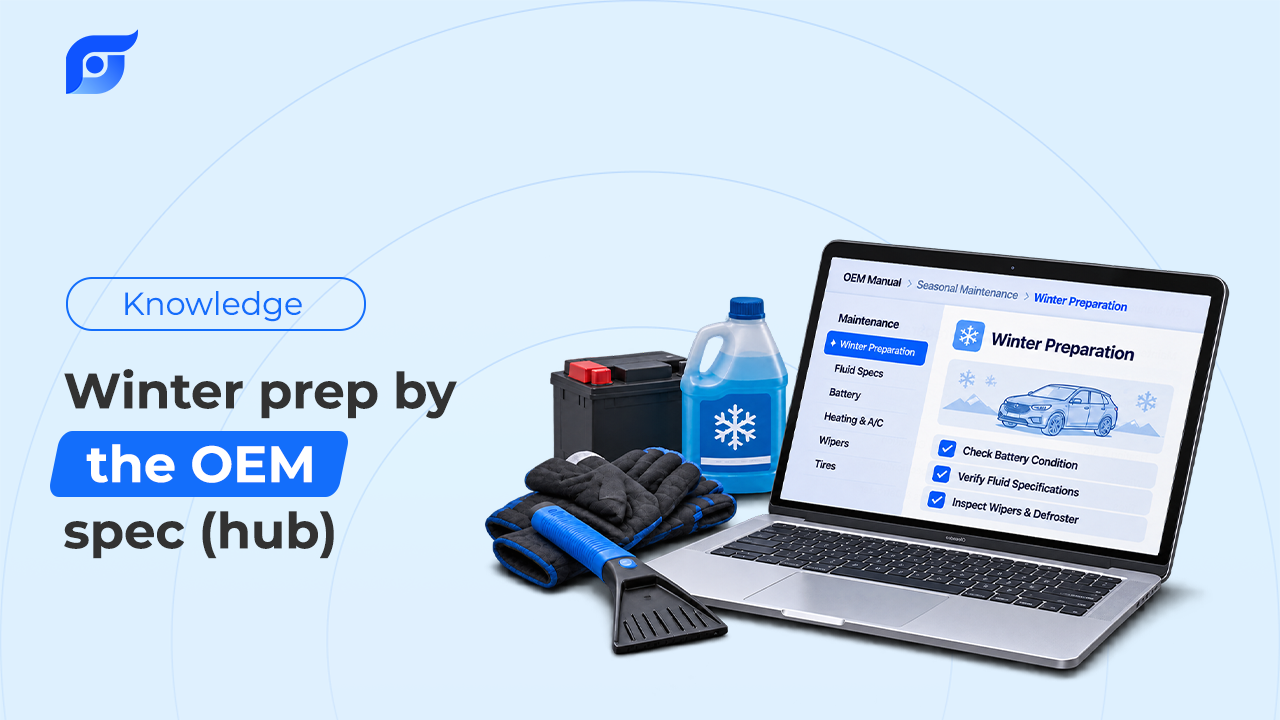
Most winter checklists say the same three things: test the battery, check the coolant, top up the tires. They stop short of the part that decides whether the job is right, which is the number. The correct battery, the correct coolant and the correct tire pressure are all written down by the manufacturer for one specific vehicle, and a value that’s right for the car next door can be wrong for yours. This page covers what each spec means, where it’s published, and how to read it.
Quick Answer: Winter prep comes down to three manufacturer specs for the exact vehicle. Battery: match the BCI group size (physical dimensions and terminal position), meet the specified cold cranking amps (CCA), which is the current a battery can deliver for 30 seconds at 0°F while holding at least 7.2 volts, and keep the same battery type the vehicle was built with. Some vehicles also need the new battery registered or the battery monitor reset. Coolant: use the coolant type the manufacturer specifies at the mix it specifies. GM owner’s manuals state that a 50/50 mix of DEX-COOL and clean water protects to −34°F (−37°C), and manufacturers warn against mixing coolant types. Tire pressure: set it to the value on the Tire and Loading Information label on the driver’s door jamb, not the maximum printed on the tire sidewall, with the tires cold. Pressure falls about 1 psi for every 10°F drop in temperature. Never open a radiator cap on a hot engine, wear eye protection around a battery, and hand the job to a technician when a step calls for a scan tool or you’re not sure.
Battery: Group Size, CCA and Registration Steps
Cold is hardest on the battery because the engine needs more current to turn over at the same time the battery has less to give. Three specs decide whether a replacement is the right one.
- Group size. Battery Council International (BCI) group sizes standardize a battery’s physical dimensions and terminal locations. The number tells you whether the battery fits the tray and whether the cables reach. A suffix matters as much as the number: Group 51 and 51R can share the same case size with the positive terminal on opposite sides.
- Cold cranking amps. CCA is the number of amps a 12-volt battery can deliver for 30 seconds at 0°F while staying at or above 7.2 volts, a test defined in SAE standard J537. Don’t confuse it with cranking amps (CA), which is the same test run at 32°F. Battery makers put a CA figure roughly 20–25% above the CCA figure for the same battery, so a CA number can look like more battery than it is.
- Battery type. Vehicles with start-stop systems are built with AGM or EFB batteries, and battery manufacturers’ guidance is to replace like with like. A standard flooded battery in a start-stop vehicle is the wrong part even when the group size and CCA match.
The owner’s manual or the OEM battery specification gives all three for the vehicle. The label on the old battery only tells you what the last person installed.
The step after the battery is in
On a growing number of vehicles the job isn’t finished when the hold-down is tight. Ford and Lincoln vehicles from the 2011 model year on use a battery management system that, according to Snap-on’s diagnostics knowledge base, needs a reset after battery replacement. It resets on its own after the vehicle sits for about eight hours, or right away through a scan tool. BMW, Volkswagen and several other European brands require the new battery to be registered or adapted so the charging system stops treating it like the worn one it replaced. Which step applies is written in the manufacturer’s battery replacement procedure, and finding the OEM registration and reset steps covers how to look it up.
Safety: wear safety glasses any time you work around a battery, and turn the engine off and remove the key first. Disconnect and reconnect the terminals in the order the manufacturer gives. Honda’s HR-V hybrid owner’s manual, for example, says to always disconnect the negative cable first and reconnect it last.
Coolant: Type and Capacity for the Exact Engine
Coolant’s winter job is freeze protection, and that depends on using the right product at the right mix.
Mix. GM owner’s manuals state that a 50/50 mixture of clean, drinkable water and DEX-COOL coolant gives freezing protection down to −34°F (−37°C). That figure belongs to that coolant. A Kia owner’s manual lists a 50/50 mix for roughly −31°F. The numbers are close but not the same, which is the reason to read the table in your own manual and not go by a general rule.
Type. Coolants are not interchangeable by color. Manufacturers specify a chemistry, and the warnings about mixing are direct:
- GM’s parts listing for DEX-COOL says that if coolant types or technologies are mixed, you will not get the full protection of the added product.
- Chrysler’s documentation for its HOAT coolant warns that mixing coolants other than the one specified may result in engine damage that may not be covered under the new vehicle warranty.
A jug labeled “all makes, all models” on the store shelf is a claim by the company that bottled it. The specification in the owner’s manual is the manufacturer’s.
Capacity. Cooling system capacity is listed per engine, not per model. Two versions of the same truck with different engines can hold different amounts, and the published capacity tells you what a full system holds and how much concentrate a given mix needs. Identify the engine first, the way Jayda confirms year, make, model and engine before it answers, then read the capacity for that engine.
Safety: never remove the radiator or reservoir pressure cap while the engine is running or hot. Kia, GM and Chrysler all print this warning, because a hot system is under pressure and can spray scalding coolant. Let the engine cool completely before you open anything.
Tire Pressure: The Door Placard, Not the Sidewall
The pressure printed on a tire’s sidewall is the tire’s maximum. The pressure your vehicle should run is set by the vehicle manufacturer and printed on the Tire and Loading Information label. NHTSA says that label is on the driver’s side door jamb (the B-pillar) on new vehicles, or on the rear edge of the driver’s door if there is no B-pillar, and the same value is in the owner’s manual.
The manufacturer’s own service data points to the same place. For a 2022 Chevrolet Silverado 1500, the MOTOR-sourced specification record for tire pressure doesn’t give a single number. For each tire size it reads “See Footnote,” and the footnote says: “Tire inflation pressures should be found on tire placard, located on the drivers side door lock pillar or in the owner manual.” The truck is sold with several tire sizes and load ratings, and the placard on the door is the one that matches the truck as built.
What cold weather changes:
- Pressure falls with temperature. AAA puts the loss at about 1 psi for every 10°F drop. Tire Rack describes it as about 2% per 10°F, which works out to the same thing on a typical passenger tire. A tire set correctly on a 60°F afternoon is several psi low on a 20°F morning.
- Measure cold. The placard value is a cold pressure. Volvo’s owner’s manuals define cold as the tire being at the same temperature as the surrounding air, normally after the vehicle has been parked for at least three hours. A reading taken after a highway drive is higher than the true cold pressure.
- The warning light is late. AAA notes the tire pressure monitoring system typically doesn’t alert until a tire is about 25% below the recommended pressure. Use a gauge and don’t wait for the lamp.
- Check the spare if the vehicle has one.
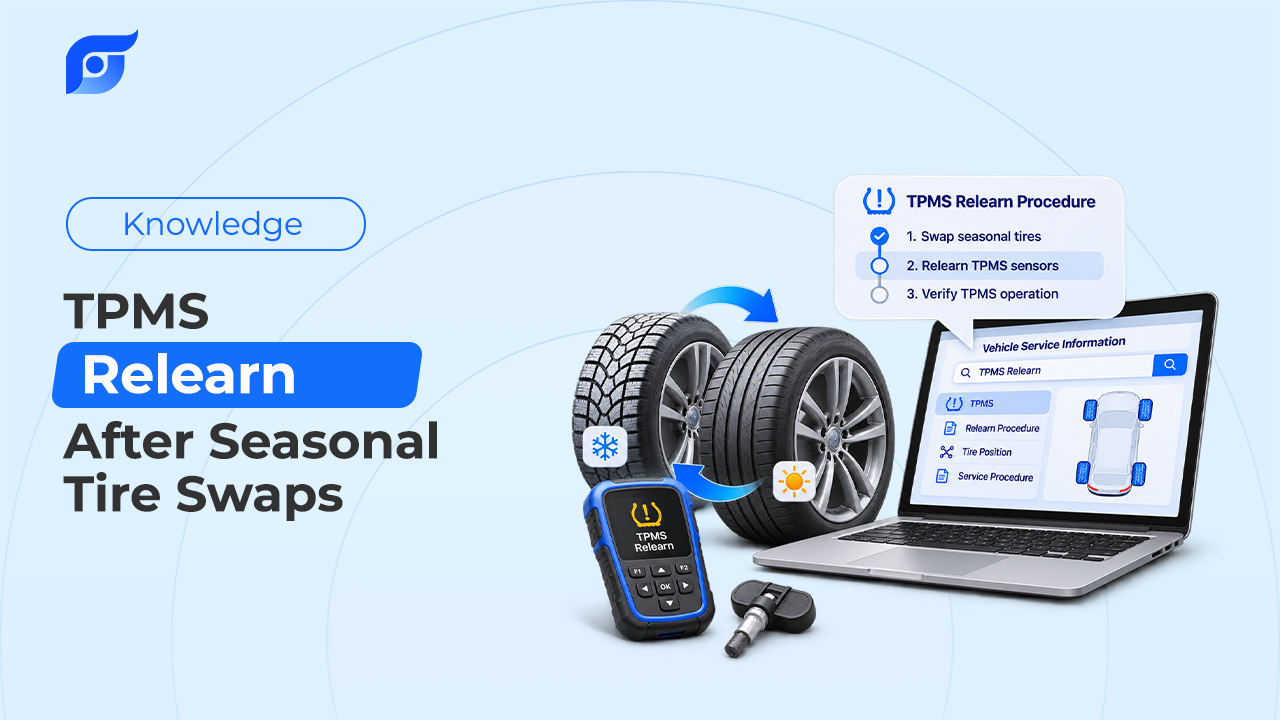
If winter means a second set of wheels, the sensors in them may need to be introduced to the car. The method differs by vehicle, and TPMS relearn after seasonal tire swaps covers how to find the right one.
When to Have a Pro Do It
Checking pressures and reading a coolant level through the reservoir are owner jobs on almost any vehicle. Hand the work to a technician when:
- The battery needs registration or a reset your tools can’t do. A basic OBD-II code reader generally can’t register a battery.
- The battery isn’t where you can reach it safely. Trunk, under-seat and under-floor batteries are common on the same vehicles that need registration.
- The coolant is the wrong type, mixed or contaminated. That means a drain and refill done to the manufacturer’s procedure.
- The vehicle is a hybrid or EV and the job goes past the 12V battery. High-voltage batteries, inverters and their cooling circuits sit behind orange cabling and are not owner-serviceable. That work requires a technician with ASE L3 (Light Duty Hybrid/Electric Vehicle Specialist) certification or equivalent manufacturer training.
- A warning light stays on after the pressures are set and the battery is in. That’s a diagnosis now, and it’s the technician’s call.
- You’re not sure. A shop can check all three specs in one visit.
Where Each Spec Comes From
| Spec | Where the manufacturer publishes it | What to watch for |
|---|---|---|
| Battery group size, CCA and type | Owner’s manual; OEM battery specification | Terminal orientation suffix; AGM or EFB on start-stop vehicles |
| Battery registration or reset | OEM battery removal and installation procedure | Post-installation steps at the end of the procedure |
| Coolant type and mix | Owner’s manual; OEM fluid specification | The specification name, not the color |
| Cooling system capacity | OEM capacities table | Listed per engine |
| Tire pressure | Tire and Loading Information label; owner’s manual | It is a cold pressure, and it is not the sidewall maximum |
These documents are what OEM repair information means: the manufacturer’s own specs and procedures for one vehicle. Manufacturers also revise them through technical service bulletins, so a spec from an old forum post may no longer be current.
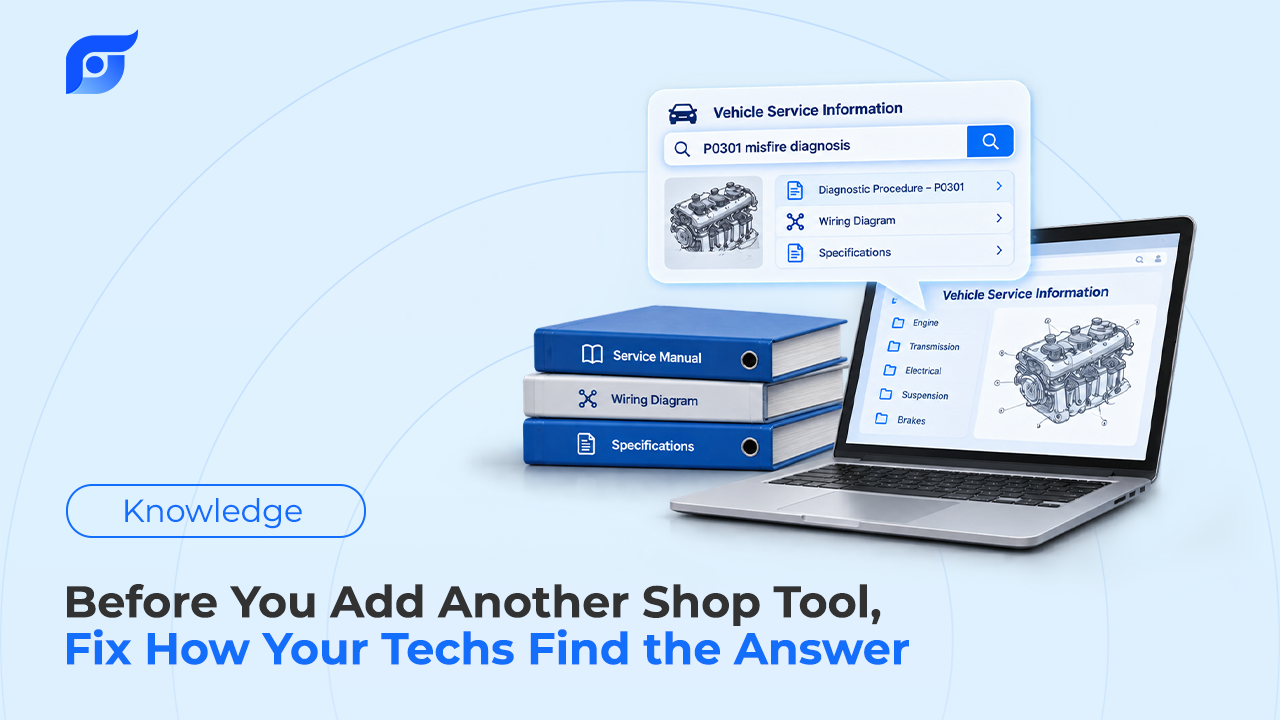
In Jayda you ask the way you’d ask a tech at the counter, for example “2022 Silverado 1500 2.7L battery specification,” and the answer comes from MOTOR-sourced OEM data for that vehicle with the source shown, so you can open the document behind the answer. Battery, coolant and tire lookups sit alongside torque values, wiring diagrams and bulletins in OEM procedures for the exact vehicle. When a document isn’t in the database, Jayda says so and doesn’t offer a near match. For what a winter morning of these lookups looks like in a shop, see the cold-morning queue.
This page summarizes owner’s manuals, federal guidance and industry sources and is not a substitute for the documents for your vehicle. Specs change by model year, engine and equipment, so confirm each value against the owner’s manual, the door placard or the current OEM procedure before you act on it. To see a spec come back with its source for your own vehicle, see how it works.