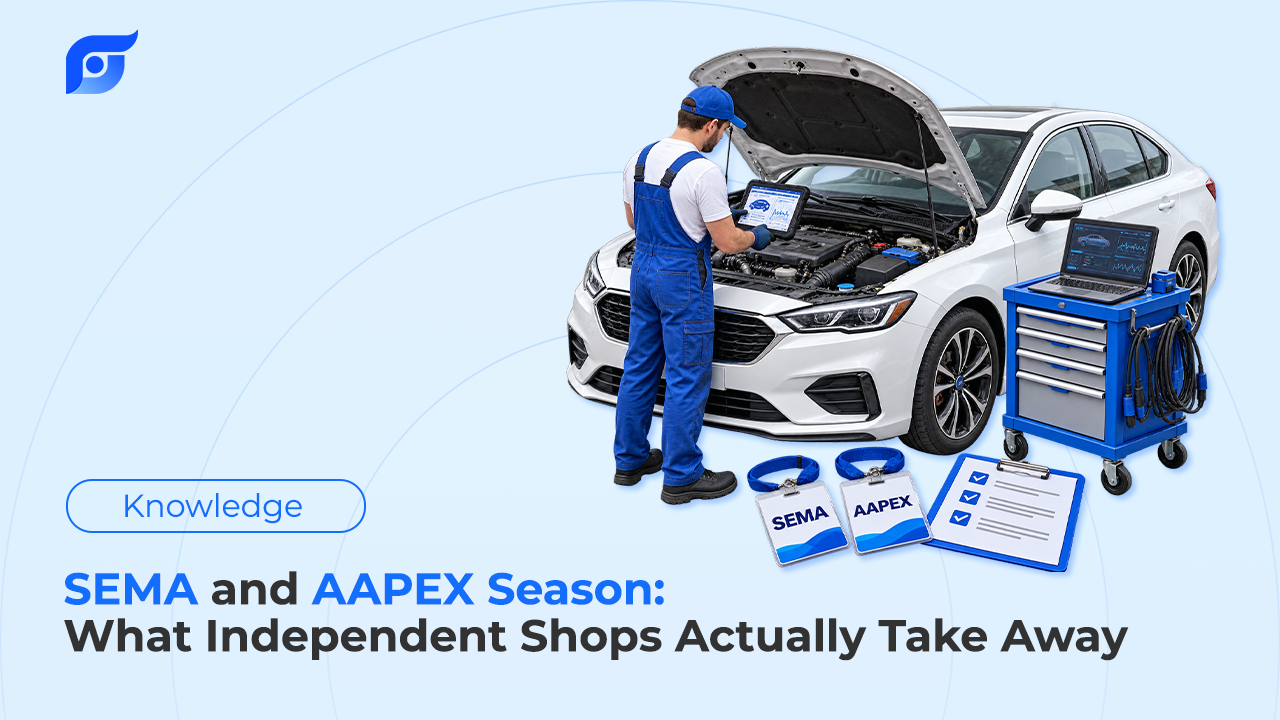
Two shows run in Las Vegas in the same week, and they are not the same event. One is built around products and vehicles; the other is where a service shop finds training, diagnostic equipment, and the software its technicians will use every day. For an independent shop owner with a bay rate to protect, the useful question isn’t what was on display. It’s which decisions you can make better when you get home.
Quick Answer: In 2026, the SEMA Show runs November 3–6 at the Las Vegas Convention Center, built around automotive performance and accessory products with 99+ free education sessions, and AAPEX runs November 3–5 at the Venetian Expo and Caesars Forum, built around replacement parts and service-side training. The part of AAPEX most relevant to a repair shop is Joe’s Garage, described as “an experience devoted to service and repair excellence” with 6 real-life service bays; its Bay 3 hands-on sessions are $150 each with limited seats, covering EVs, Teslas, and advanced diagnostics, while demo bays cover ADAS positioning and calibration, alignment, scan tools, and HVAC service. Three things actually travel home: training you booked, equipment you tested against your own car mix, and a purchase discipline that keeps a show-floor demo from becoming a 12-month subscription. Test any repair-information tool with your own VINs before you sign anything.
Two Shows, Two Different Reasons to Go
| SEMA Show 2026 | AAPEX 2026 | |
|---|---|---|
| Dates | November 3–6 | November 3–5 |
| Venue | Las Vegas Convention Center | Venetian Expo and Caesars Forum |
| Centre of gravity | Performance and accessory products, vehicle builds, product trends | Replacement parts, service equipment, shop software, technician training |
| Education | 99+ free education sessions led by industry professionals | Joe’s Garage training bays, plus conference programming |
Both run under the same industry week, and a single badge covers both halls, which is why they blur together in recaps. For a repair shop, the practical split is simple: SEMA is where you see what customers will ask you to install, and AAPEX is where you evaluate what your technicians will use to do the work.
What’s on the Floor for a Service Shop
Joe’s Garage is the clearest example of AAPEX programming aimed at repair work rather than retail. AAPEX describes it as a place to see “REAL vehicles being serviced” across six bays, with training aimed at “techs and shop owners who want to walk away with real, applicable skills.”
- Paid deep-dives. Bay 3 sessions are listed at $150 per session with limited seats, covering EVs, Teslas, and advanced diagnostics.
- Equipment demos. The published demo topics include ADAS positioning and calibration, wheel alignment, tire servicing, diagnostic and scan tools, preventative maintenance, and HVAC service equipment.
- Vendor sessions in the bays. Scheduled bay sessions cover diagnostic tools and ADAS calibration from several equipment makers.
One note on the EV content, because it decides what a session can actually qualify you to do. Training is useful, but work behind the orange high-voltage cabling requires ASE L3 (Light Duty Hybrid/Electric Vehicle Specialist) certification or equivalent OEM training, a verified zero-energy state, and insulated Class 0 gloves. A conference session is a starting point toward that, not a substitute for it.
Takeaway 1: The Constraint Is Usually Information Access, Not Tool Count
Shops come home with tool lists. The bottleneck in most bays is narrower: a technician stops mid-job to find a spec, a wiring diagram, or a procedure, and the minutes go into navigating rather than reading. That pattern is examined in where technicians’ lookup time actually goes and the hidden cost of searching before every repair order.
Before the show, run a one-week tally at each bay: what was looked up, where the tech went for it, and how long until the right page was open. Walk the floor with that sheet. It turns “this looks impressive” into “this addresses the thing that actually slows us down,” and it gives you a baseline to measure against afterward.
Takeaway 2: ADAS and EV Work Run on Documents, Not Recall
The calibration equipment on the floor is the visible half of ADAS work. The other half is knowing when a calibration is required for the vehicle in your bay, and that requirement is written per manufacturer and per system.
Ford’s own ADAS job aid, for example, lists lane keeping camera calibration as required when a windshield, camera, or image processing module is replaced, when the windshield is removed for structural repairs affecting its position, on a change in tire size, after suspension repair or alignment, and after front air bag deployment. Honda’s aiming job aid takes a different position on wheel alignment, saying camera and radar calibration is not required after an alignment unless the service information says otherwise. Two brands, two answers, same repair.
That is why equipment and OEM repair information are a single purchasing decision rather than two. A calibration rig you can’t aim per the manufacturer’s stated conditions is a liability, and the conditions live in the procedure — which is also the difference between an OEM procedure and an aftermarket summary of one.
Takeaway 3: A Show-Floor Demo Is the Most Expensive Way to Evaluate Software
Demos run on vehicles the vendor chose, with questions the vendor rehearsed. Your shop runs on the car mix that happens to come through the door. The gap between those two is where a 12-month agreement turns into a tool nobody opens.
Five questions to ask at the booth, with a laptop open to your own vehicles:
- Show me my vehicle. Hand over three VINs from last week’s tickets, including the oldest and the rarest. Coverage claims are averages; your car mix is not.
- Where did this answer come from? You should be able to open the manufacturer’s document behind a result, not just see a citation label.
- What happens when the document doesn’t exist? Ask for something that can’t exist — a spec for a system that vehicle doesn’t have. A retrieval tool says it didn’t find one; a generating tool produces prose.
- Does it carry bulletins, and does it show supersession? A bulletin is only useful in its current version for the build it names.
- What does a technician have to learn? If the demo needs the vendor to drive, your newest tech will not use it in month two.
Question 3 matters more than it sounds. A tool that always produces an answer, including for vehicles it has no data for, is composing rather than retrieving — the failure mode behind why AI should search repair information rather than generate it.
A 30-Day Post-Show Checklist
- Week 1 — Sort the pile. Split what you collected into three lists: solves a problem we measured, interesting but unmeasured, and no. Only the first list continues.
- Week 2 — Test with your own vehicles. For each surviving candidate, run five real jobs from last month. Confirm coverage for your actual makes, including any brand your mix leans on.
- Week 3 — Put it in a technician’s hands. Not the lead tech alone; the newest tech too. Record whether they reach for it unprompted on live repair orders.
- Week 4 — Re-run the lookup tally and compare find-time per lookup against your pre-show baseline. Then decide, with the contract terms in front of you.
Terms deserve the same scrutiny as features: what the agreement length is, what happens at renewal, how many seats are included, and whether the price assumes every seat is filled.
Where Jayda Fits
Jayda answers one part of the post-show list: the repair information itself. A technician asks the way they’d ask another tech, and Jayda returns the matching OEM document with its source shown. The data is licensed from MOTOR Information Systems, a Hearst company operating since 1903, covering 43 manufacturers from 1985 to 2026. Coverage isn’t uniform — Toyota, Lexus, and Scion data is pending — so the VIN test above applies here as much as to any booth.
Jayda’s AI searches and retrieves manufacturer content; it does not write repair steps, and when a document isn’t in the database it says so rather than offering a near match, which is the reasoning behind never generating OEM repair procedures. Pro Tech, the individual plan, includes a 3-day free trial with 5 questions; the Business plan runs at $149/month on a 12-month agreement for up to 10 technicians, with a 7-day trial activated through the Jayda team rather than self-serve signup.
For the full evaluation framework, including data licensing, coverage, and how answers are delivered, see how to choose OEM repair software. The shows are worth attending. What makes them pay is testing what you saw against the vehicles you actually fix.