
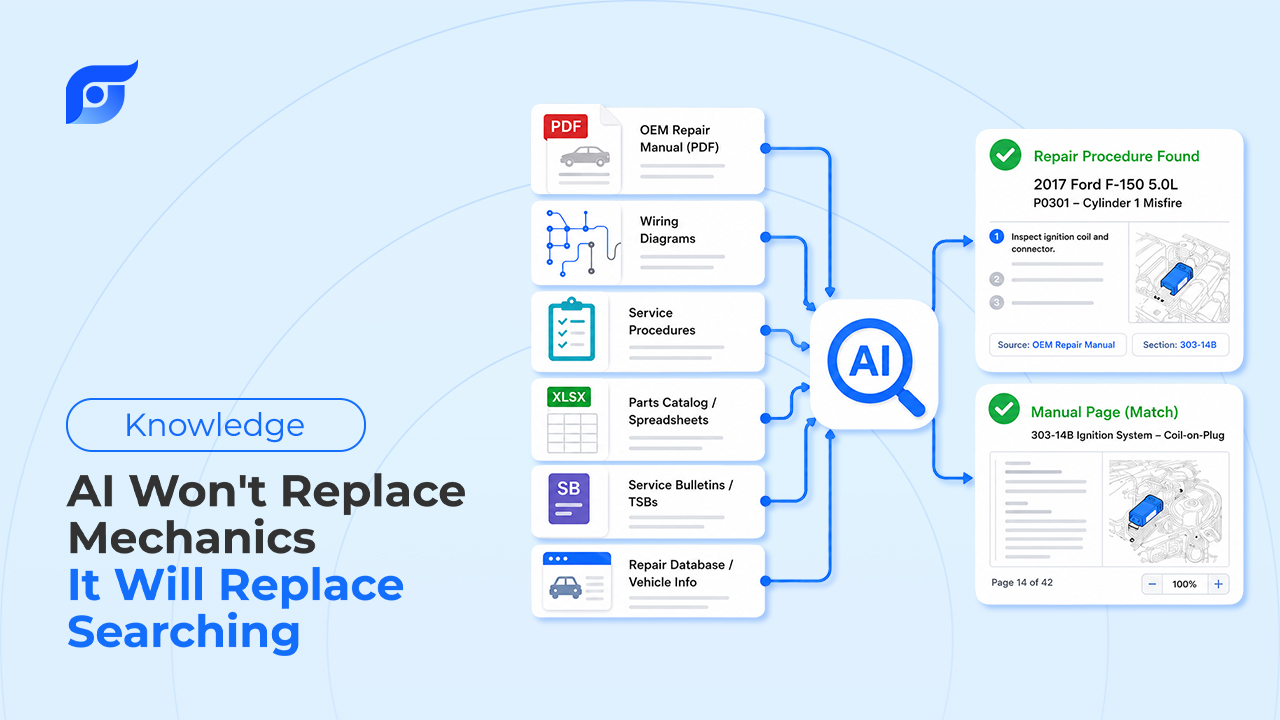
Quick answer: AI is not replacing the diagnostic judgment, hands-on skill, or experience of a mechanic — those aren’t information-retrieval tasks. What AI is replacing is the time technicians spend searching for OEM repair information: navigating menus, scrolling PDFs, cross-checking forums. Jayda is built specifically for that second problem — its AI searches licensed OEM data and cites the source; it never diagnoses the vehicle or replaces the technician’s judgment.
Key takeaways:
- Diagnosis is a physical, sensory skill (sound, feel, experience) — not a lookup task, and not what AI tools are built to automate.
- The actual time cost in a modern repair bay is search: 15–45 minutes per repair order commonly lost to menu navigation and cross-referencing documents.
- Some AI tools (e.g., ALLDATA’s Diagnostic Intelligence, Mastertech.ai) are moving toward AI that interprets symptoms and ranks likely causes — a different, higher-risk model than AI that retrieves OEM documentation.
- Jayda’s AI only retrieves and cites licensed OEM content from MOTOR Information Systems — it does not rank causes, interpret symptoms, or generate repair steps.
- The technician still owns the diagnosis and the decision to proceed, every time.
Why Does It Feel Like AI Threatens a Mechanic’s Job?
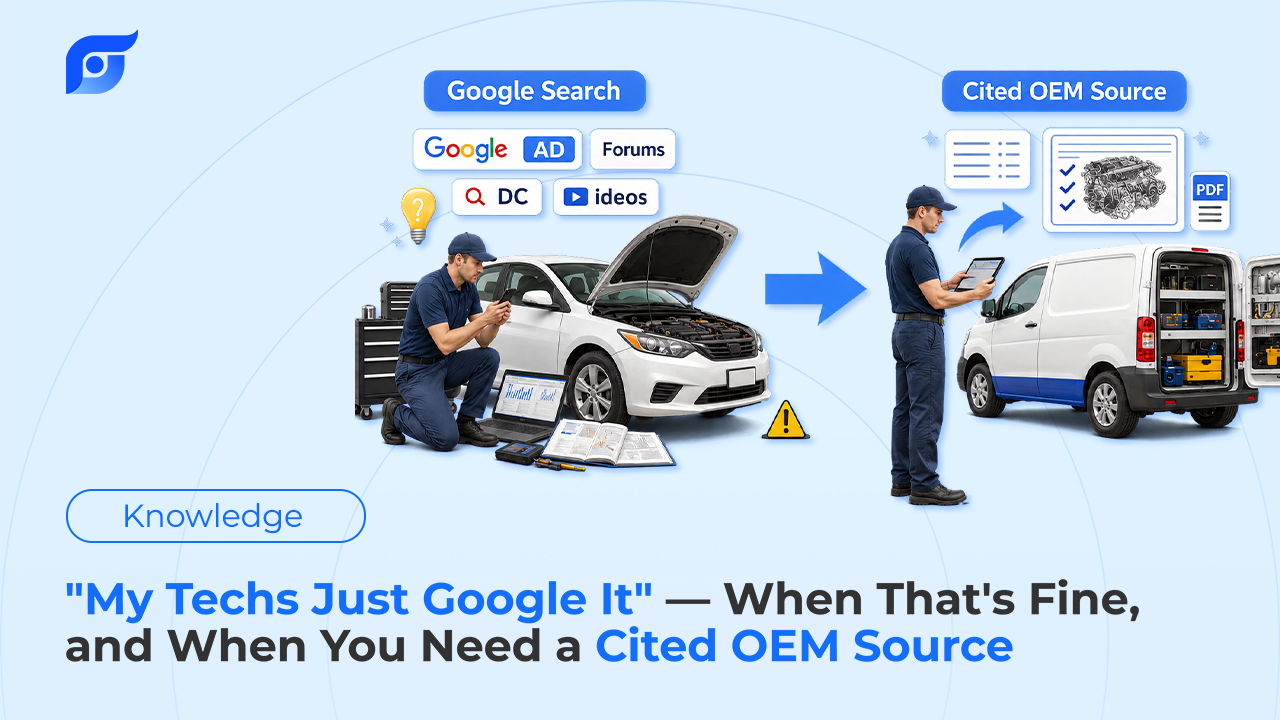
Modern vehicles carry more sensors, modules, and electronic complexity than any generation before them — which should mean more time at the vehicle, not less. Instead, a growing share of a technician’s shift goes somewhere else: a search box, a manufacturer portal, a forum thread, a 200-page PDF, trying to confirm a hunch before touching a wrench.
That’s the part of the job AI is actually positioned to change. Not the diagnosis. Not the hands. The search. Jayda exists specifically to close that gap — it’s built to answer the question “where’s the OEM source for this?” in seconds, not to answer “what’s wrong with this car?”
What’s the Difference Between an AI That Diagnoses and an AI That Searches?
An AI that diagnoses interprets symptoms and returns its best guess at a cause — plausible, but not sourced. An AI that searches retrieves the manufacturer’s own procedure or test steps and shows exactly where that answer came from.
Some products entering this space are building toward the first model — ALLDATA’s Diagnostic Intelligence layer and newer entrants like Mastertech.ai both add AI that interprets diagnostic data and suggests likely causes. That’s a legitimate product direction, but it’s a different one than retrieval, and the difference matters: an interpretation can’t be verified against a source; a retrieval can.
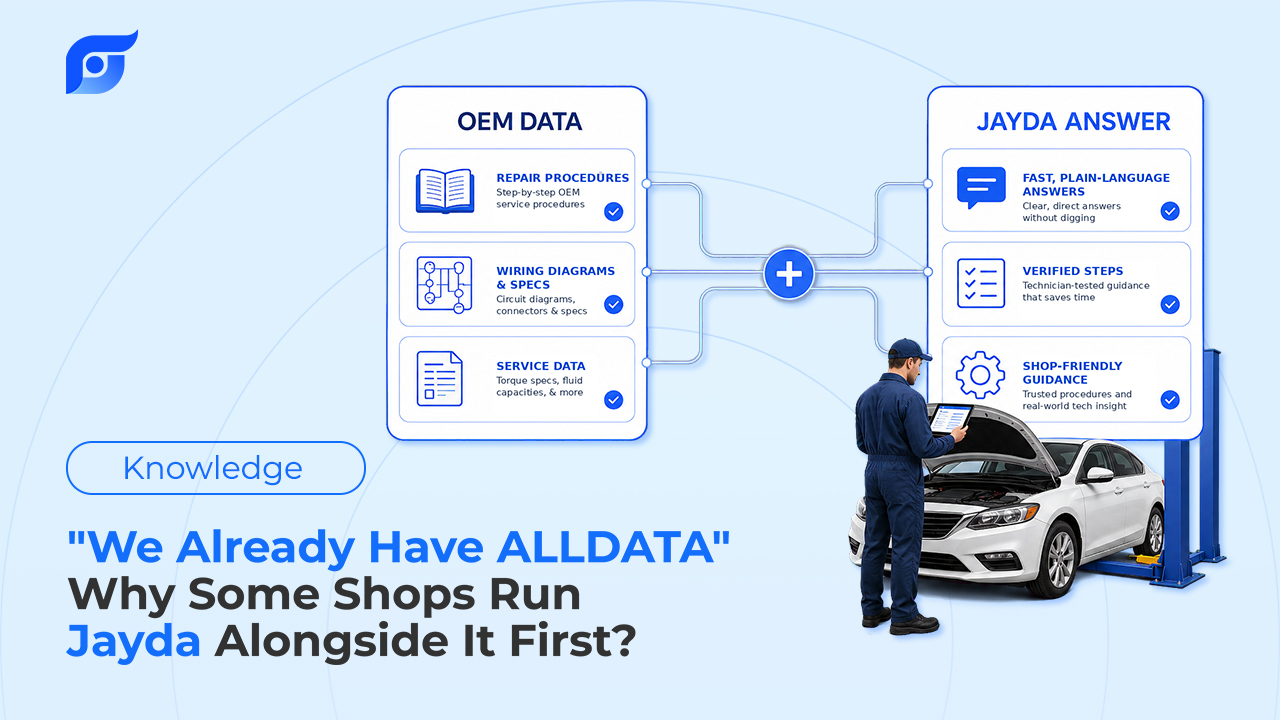
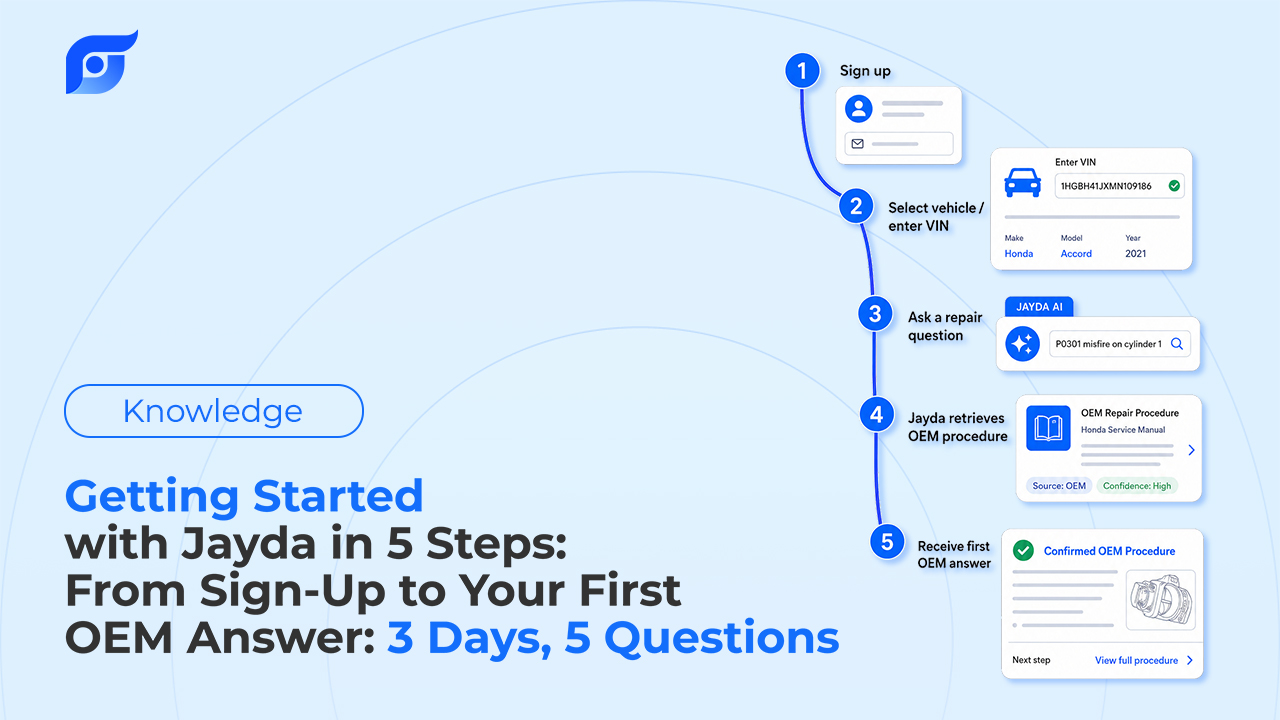
Jayda is built on the second model only. Ask something like “why is my P0335 setting,” and Jayda matches the query to the exact vehicle and returns the OEM-defined code definition, test conditions, and wiring diagram — cited to the manufacturer document it came from. It doesn’t rank probable causes. It doesn’t interpret the symptom for you. You’re the expert. Jayda finds the data.
How Much Time Does Searching for Repair Information Actually Cost?
More than most shops track, because it’s absorbed in small pieces rather than showing up as one line item. Locating a component without a diagram can cost 15–30 minutes of physical searching. Cross-referencing a part number and its supersession history by hand adds another 10-plus minutes per repair. Tracing a single circuit through a nested menu instead of pulling it directly can turn a 30-second lookup into a 45-minute one. Across a full repair order, technicians commonly lose 15–45 minutes to navigation before the actual repair even starts.
Jayda’s role in that math is narrow and specific: collapse the navigation step. Type the question the way you’d say it out loud, get the cited OEM answer back, typically in under 30 seconds — not because the AI is smarter about the vehicle, but because it isn’t making you browse a library to find what already exists in it.
Does Using AI for Repair Lookup Mean Fewer Jobs for Technicians?
No — it means more billable hours for the technicians already doing the work. If one tech recovers even 10 minutes a day that would otherwise go to searching, that’s billable time back at whatever the shop’s labor rate is, every day, compounding. For a shop owner, the same shift shows up as a team-wide question: how much non-billable research time is the whole crew absorbing, and how consistent is that lookup between a technician with ten years of experience and one three months in?
Jayda’s pitch to a shop owner is exactly that framing: reduce non-billable research time across the team, without changing headcount or asking anyone to work faster by hand.
How Can You Tell If an AI Repair Tool Respects the Technician’s Job?
Four questions cut through the marketing on any tool claiming “AI-powered,” including Jayda itself:
| Question | What it reveals |
|---|---|
| Does it diagnose for you, or find the source? | A ranked list of “likely causes” is interpreting. A cited OEM procedure is retrieving. Only one keeps the judgment call with you. |
| Does it show its source? | Every result should cite the document, manufacturer, and model year — not just present an answer with no way to check it. |
| Does it say “not found” instead of guessing? | A tool that always has an answer, even for rare trims and edge cases, is filling gaps with something other than OEM data. |
| Does it match the exact vehicle, or the closest one it has? | “Similar vehicle” is a guess, not a spec. |
Jayda is built to answer all four the same way: source-bound retrieval, visible citation, an honest “not found” when the data isn’t there, and exact vehicle context down to VIN when available.
Frequently Asked Questions
Will AI replace auto mechanics? No. Diagnosis, hands-on repair, and professional judgment are sensory and experience-based skills, not information-retrieval tasks — they aren’t what AI tools like Jayda are built to automate. What’s changing is how technicians reach OEM documentation: from navigating menus and PDFs to asking a direct question and getting a cited answer back in seconds.
What is the difference between AI that diagnoses a car and AI that searches for repair information? AI that diagnoses interprets symptoms and suggests a likely cause, without a way to verify it against a source. AI that searches, like Jayda, retrieves the manufacturer’s own procedure, spec, or test steps and shows exactly which OEM document it came from.
How much time do technicians lose searching for repair information? Individual lookups range from 30 seconds to 45 minutes depending on how buried the information is in the source system. Across a full repair order, that typically totals 15–45 minutes lost to navigation rather than diagnosis or repair.
Does Jayda diagnose vehicles or just find information? Jayda only finds information. It retrieves the OEM procedure, spec, diagram, or DTC test steps for the exact vehicle and cites the source. It does not rank probable causes, interpret symptoms, or make the repair decision — that stays with the technician.
Is AI-generated repair information reliable? Not on its own. Generated content is reconstructed from patterns in training data, not retrieved from a manufacturer document, so it can sound correct while describing the wrong vehicle, trim, or model year. Jayda avoids this by only retrieving licensed OEM content and citing it — never generating or paraphrasing repair steps.
The Bottom Line
The job hasn’t changed. What’s changing is how much of the shift goes to finding the page versus doing the work. Jayda’s AI searches licensed OEM data from MOTOR Information Systems and shows the source — it doesn’t diagnose, and it doesn’t guess.
Start a Free Trial (Starter and Pro Tech — 3 days, self-serve) or Contact Us to set up a Business trial for your team.