
A repair answer is only as trustworthy as the place it came from. When a technician asks Jayda for a torque spec or a wiring diagram, the useful question is not how the answer was found but whose data it is, how it got there, and what happened to it on the way. For Jayda, that source is MOTOR Information Systems. This page explains who MOTOR is, what data Jayda licenses from it, which parts come from the manufacturer and which are MOTOR’s own work, and what Jayda’s AI is and is not allowed to do with it.
Quick Answer: MOTOR Information Systems is an automotive data company launched by Hearst in 1903 and headquartered in Troy, Michigan. Jayda licenses its repair data from MOTOR, covering 43 manufacturers from 1985 to 2026. That data includes OEM repair procedures, specifications and torques, wiring diagrams, component locations, diagnostic trouble codes, TSBs, recalls, maintenance schedules, fluids and capacities, and OEM parts data. Labor times are the exception: they are MOTOR’s own Estimated Work Times, built from OEM procedures, not manufacturer warranty times. Jayda’s AI searches this data and returns the matching document with its source; it does not write, summarize, or edit repair content, and when a procedure isn’t in the database, Jayda says so.
Who Is MOTOR Information Systems?
MOTOR started as a publication, not a software company. William Randolph Hearst launched a monthly automobile newsletter called MOTOR in 1903, and it grew into a trade magazine and then into one of the longest-running sources of repair and labor data in the North American aftermarket. MOTOR is still a Hearst company today.
| Year | Milestone (per MOTOR’s published history) |
|---|---|
| 1903 | Hearst launches MOTOR as a monthly automobile newsletter |
| 1930 | First MoToR’s Master Manual published — the book that became the MOTOR Labor Time Guide |
| 1937 | First Factory Shop Manual, a 448-page compilation of repair data |
| 1954 | First MOTOR Body Shop Flat Rates and Parts Manual |
| 1961 | MOTOR Magazine shifts its focus to the aftermarket and independent repair facilities |
| 1965 | Foreign brands added to the Flat Rates & Parts Manuals |
| 1985 | MOTOR establishes its data licensing business |
The 1985 date is the one that matters for Jayda. MOTOR’s licensing business is what lets a platform like Jayda deliver MOTOR data inside its own product, and 1985 is also where Jayda’s vehicle coverage begins. The same data foundation reaches shops through other channels: Fullbay integrates MOTOR labor times and wiring diagrams into its shop management software, and EBSCO’s Auto Repair Source, available through many public libraries, is powered by MOTOR. The format has moved from print manuals to licensed databases, and how OEM repair data is evolving now depends as much on how it is accessed as on what it contains.
How Does OEM Data Get From the Manufacturer to Jayda?
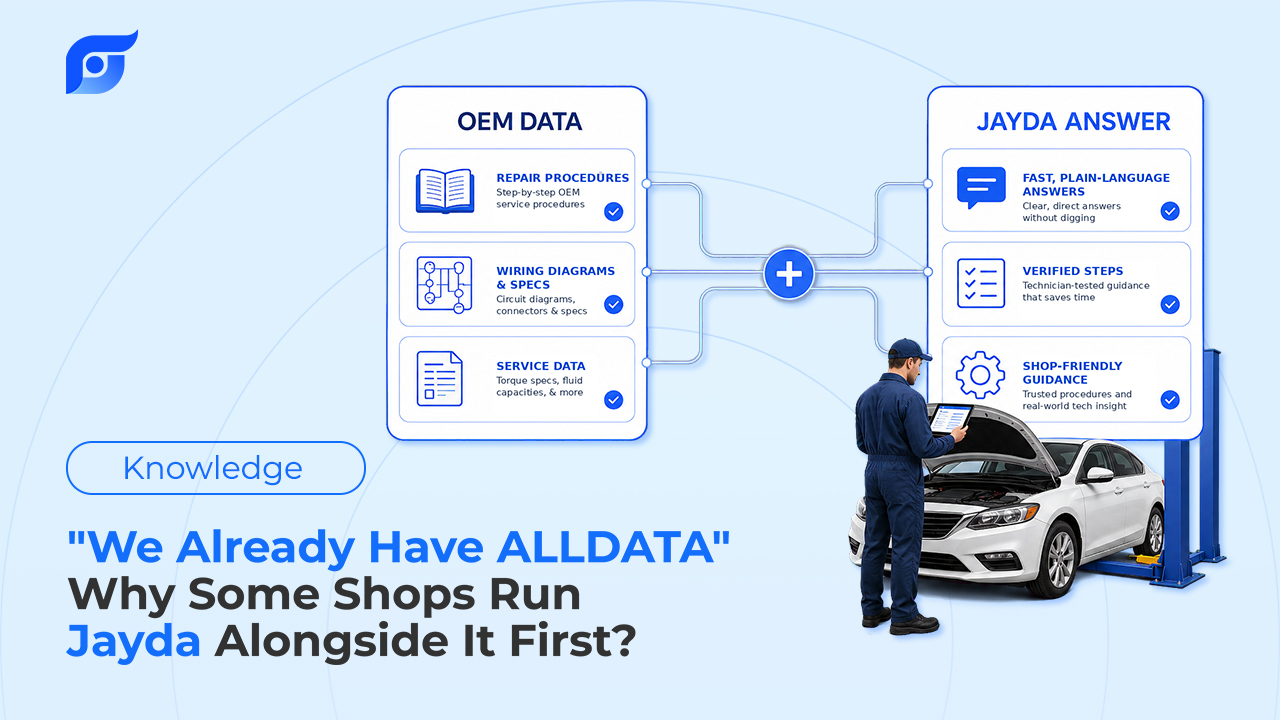
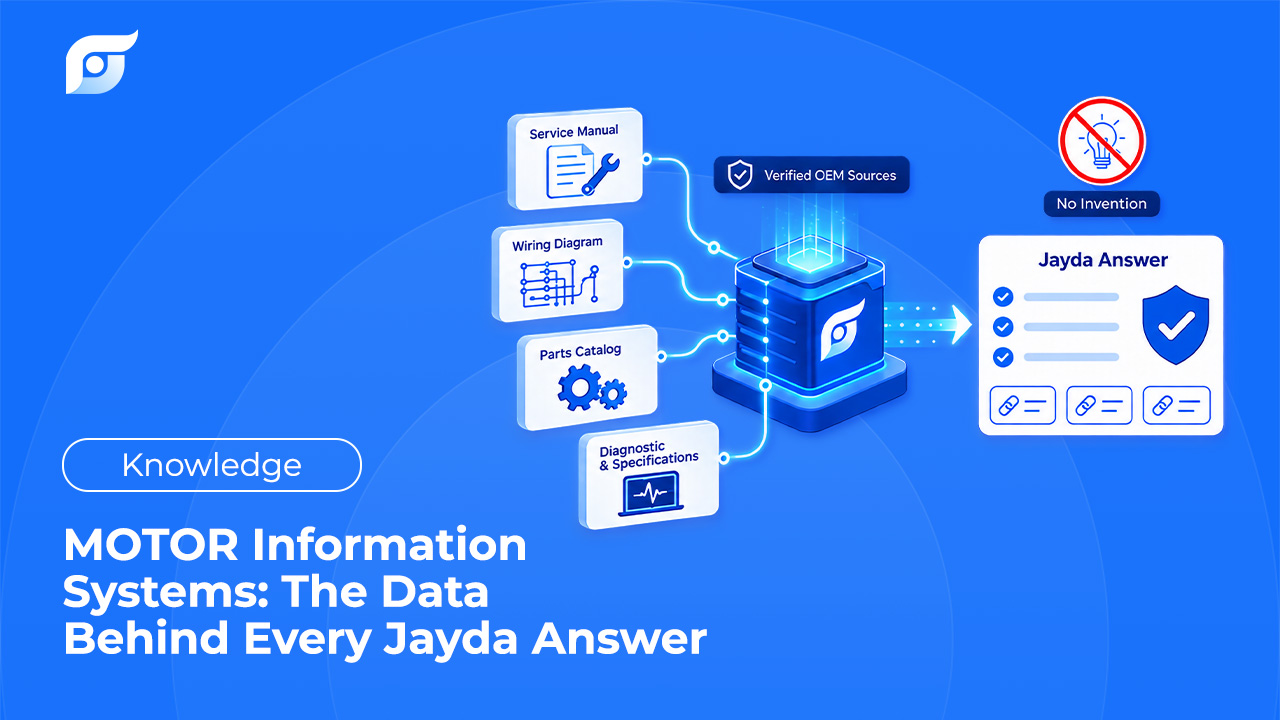
Manufacturers publish service information for their own vehicles. MOTOR licenses that information, organizes it, and describes its service procedures as “verified directly with OEMs” and classified or coded to industry standards. Jayda, in turn, licenses the data from MOTOR. The chain has three links, and each one is a license rather than a copy-and-paste:
- The manufacturer writes the procedure, the spec, the wiring diagram, or the bulletin.
- MOTOR licenses it, structures it by vehicle, and updates its database as OEMs release new models or service changes.
- Jayda licenses the data from MOTOR and makes it searchable by question.
The license chain is visible in Jayda’s own Terms of Service, which carry copyright notices from manufacturers including General Motors, Ford, Honda, Hyundai, Nissan, and Subaru. Several include license agreement numbers, and some carry conditions: Subaru’s notice, for example, limits use of its data to the North American market. That is what separates OEM repair information from content someone assembled from memory or forum threads — it has a documented owner and a documented path to the screen.
One point on terminology: Jayda is a MOTOR data licensee. MOTOR licenses its database to many platforms, and nothing about that arrangement means MOTOR endorses any one product built on it.
What Data Does Jayda Get Through MOTOR?
Jayda’s 12 data features all come through MOTOR, but they do not all come from the same author. Most are manufacturer content; one is MOTOR’s own editorial work.
| Data feature | Who authors it |
|---|---|
| OEM repair procedures | Manufacturer |
| Specifications & torques | Manufacturer |
| Wiring diagrams | Manufacturer |
| Component locations | Manufacturer |
| Diagnostic trouble codes (DTCs) | Manufacturer |
| Technical service bulletins (TSBs) | Manufacturer |
| Recalls | Manufacturer safety campaigns |
| Maintenance schedules | Manufacturer |
| Fluids & capacities | Manufacturer |
| OEM parts data | Manufacturer part numbers and specifications |
| Part vector illustrations | Manufacturer parts diagrams |
| Labor time estimates | MOTOR (Estimated Work Times) |
Some of these earn their value on specific kinds of work. OEM wiring diagrams carry the connector views and circuit routing that electrical diagnosis depends on, and component location diagrams answer the question that comes before any test: where is the part on this exact vehicle. Bulletins need their own distinction, because a TSB and a recall are different documents with different consequences for who pays for the repair.
Labor times are the one category MOTOR writes itself
MOTOR Estimated Work Times are not copied from the manufacturer. According to MOTOR, the estimation methodology starts with “a comprehensive, step-by-step evaluation of OEM procedures”, and it does not use or rely on OEM warranty times, because warranty times are built with different considerations than independent repair work. MOTOR states that each member of its labor editing team averages more than 25 years of practical repair experience, and its times distinguish standard from severe-duty applications where applicable.
The manufacturer notices point the same direction. Jaguar’s and Land Rover’s copyright notices in Jayda’s Terms both state that the recommended repair times are designed for aftermarket repairs. So when Jayda shows a labor time, it is MOTOR’s documented estimate for an independent shop, which is exactly what an estimate needs to be. If your team is still settling what labor times are and why they matter, that distinction is the place to start.
What Does Jayda’s AI Do With MOTOR Data — and What Doesn’t It Do?
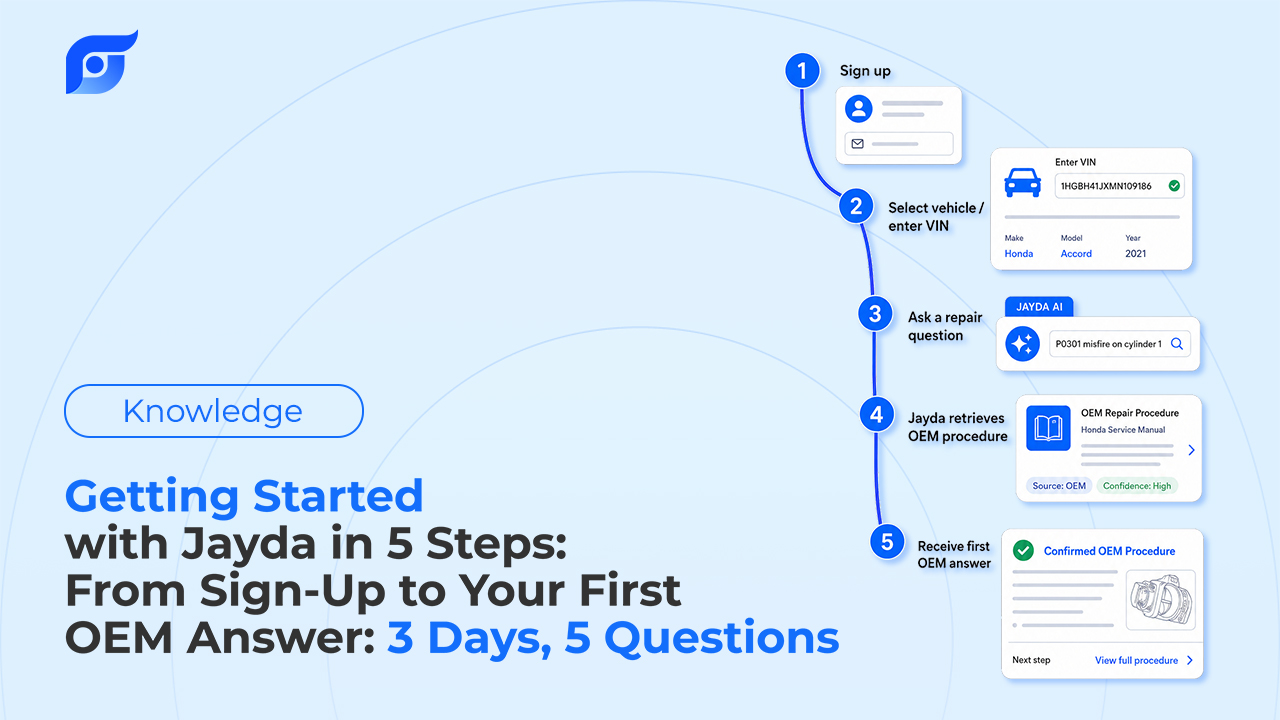
Jayda’s AI searches MOTOR data and retrieves the matching document; it does not write repair steps. The AI’s job is to understand the question — “2018 F-150 cam phaser replacement procedure” — and match it to the right document for that exact vehicle. What the technician reads is the manufacturer’s content.
- No generated repair content. The AI does not write, rewrite, paraphrase, summarize, or interpret repair procedures, in whole or in part.
- No edits. Procedures, specs, diagrams, TSBs, DTCs, and maintenance schedules are presented as published, with nothing added.
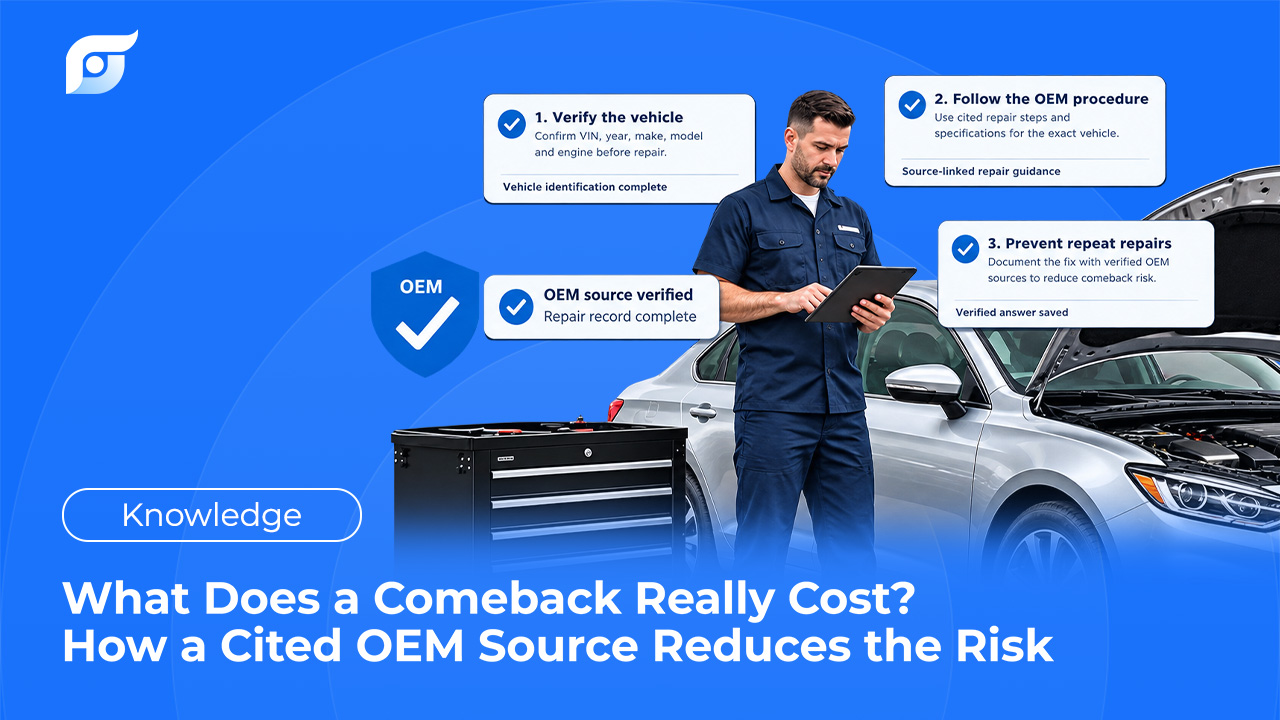
- Source attribution on every result. Results show the source document name, the manufacturer, the model year, and the last update date when available.
- No fallback answers. When a procedure isn’t in the database, Jayda says so. There is no “general knowledge” substitute and no “based on a similar vehicle” approximation.
That last rule costs something: sometimes the honest result is no result. It is still the right trade, because a confident torque value for the wrong engine is worse than a clear “not found.” The reasoning behind Jayda’s decision never to generate repair procedures comes down to that: licensed MOTOR data has a verifiable owner, and AI-written text does not.
How Is the Licensed Data Protected?
Licensed OEM data comes with obligations, and Jayda’s data protection commitments are part of what keeps that license in place:
- No AI training on MOTOR or OEM data, guaranteed by contract. The third-party AI models Jayda uses operate under zero-training agreements, so licensed data never enters a model training pipeline.
- Per-user daily request limits that prevent bulk extraction of the database.
- Individual user credentials with traceable access logs; shared logins are prohibited by the Terms of Service.
- Readable PDF output only — no raw data export.
- Redistribution of OEM content is prohibited and can result in immediate account termination.
For a shop, these rules are also a signal. A platform that protects the data it licenses is a platform that intends to keep licensing it.
What Does “43 Manufacturers, 1985–2026” Actually Cover?
Jayda’s MOTOR-sourced coverage spans 43 manufacturers, domestic and import, for cars, SUVs, vans, and light trucks from 1985 through 2026. Broken down to the level a technician actually searches at, that is more than 63,000 specific vehicle configurations, each a distinct year, make, model, submodel, and engine combination.
Coverage is broad, not uniform. Depth varies by manufacturer and model year, and a newer or low-volume model may have fewer documents than a high-volume one. The practical approach is to run the VINs your shop sees most before relying on any platform for them. And when a specific document isn’t there, Jayda’s honest-boundary rule applies: the result says so.
That coverage is also the dividing line between this data and aftermarket repair guides. An aftermarket guide is typically rewritten by its publisher and often generalized across a range of vehicles. MOTOR-sourced OEM data keeps the manufacturer’s procedure for the specific configuration, and Jayda’s job is to get you to that page with one question instead of a menu path.