
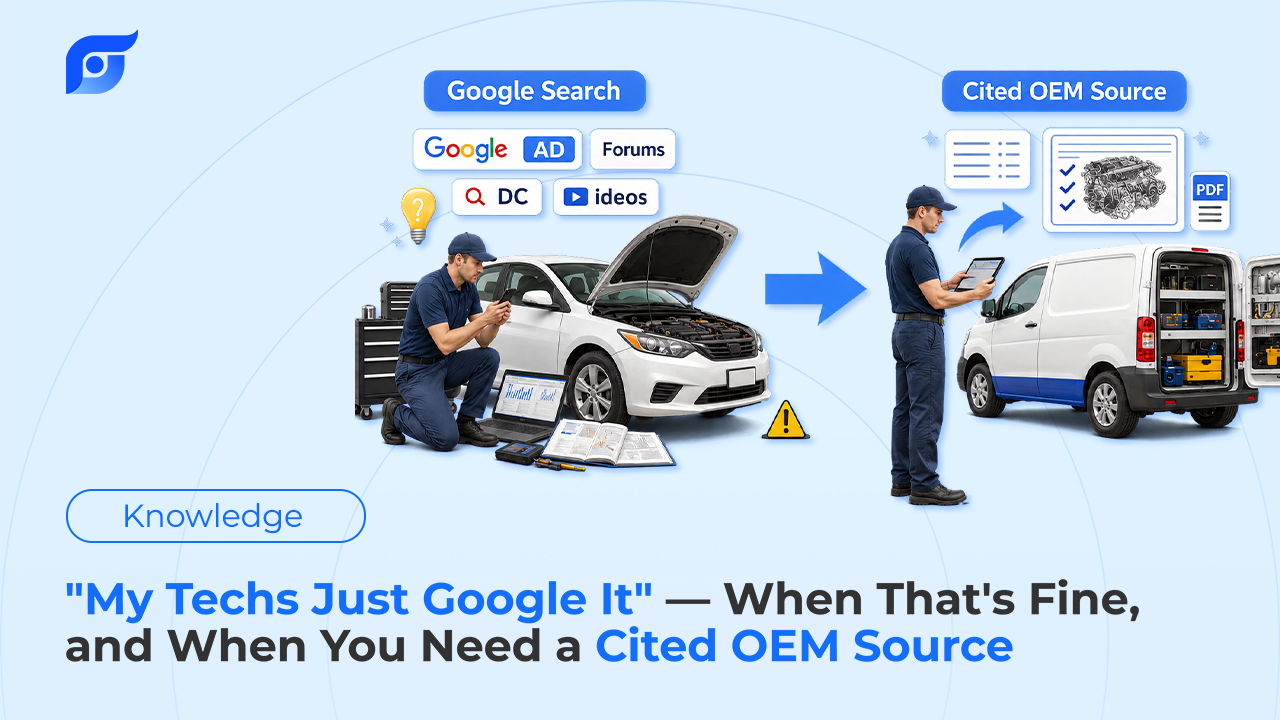
A shop owner walks past bay three and sees a phone propped against the fender, playing a video of someone doing the same job on a different trim year. The tech isn’t goofing off. He’s four minutes into a job he’s done before, he needs to confirm the routing on a bracket, and the phone got him there faster than the desktop in the corner would have.
Most owners have a quiet reaction to that, and it usually isn’t “great.” But the instinct to shut it down is the wrong move, and so is pretending it doesn’t matter. The useful question is narrower: which lookups can end at a search result, and which ones have to end at a document you can open?
Why Good Technicians Reach for Google First
Start with the part that’s easy to get wrong. A tech who searches instead of opening the official database isn’t being lazy — he’s optimizing for exactly what you pay him to optimize for: time to the answer.
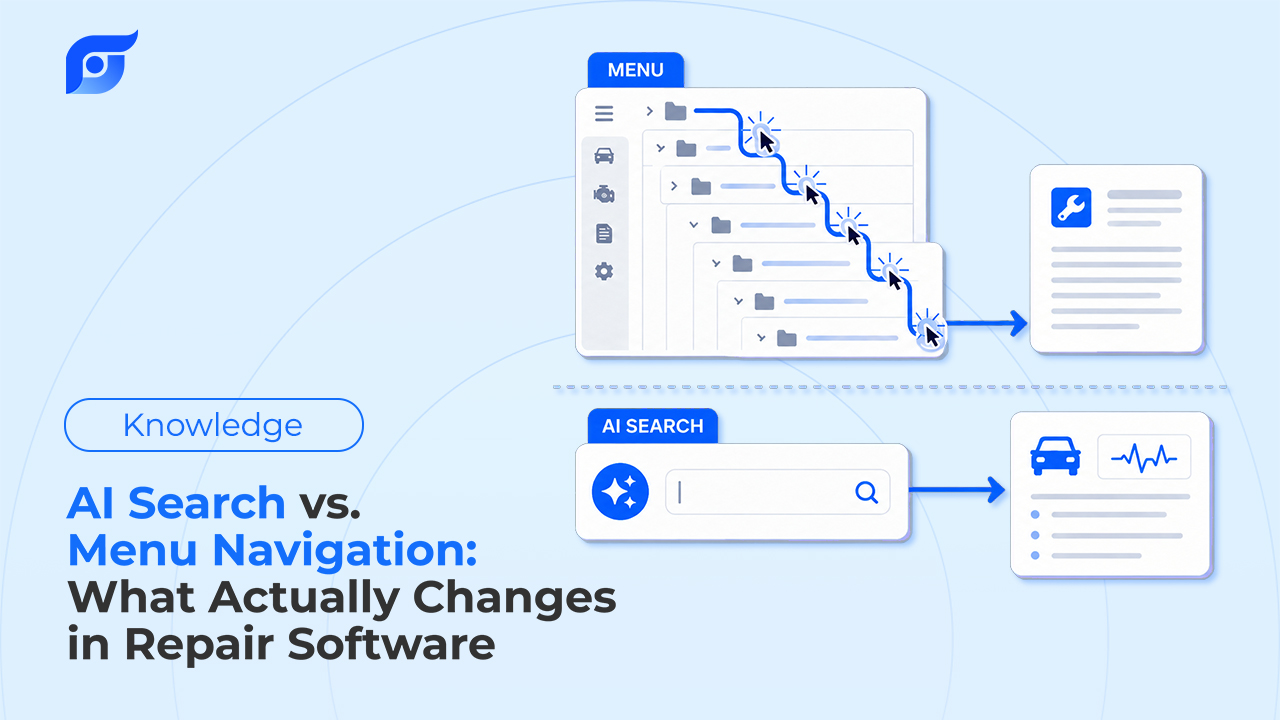
Navigation-first repair tools were built around browsing a library. Select year, select make, select model, select system, narrow the subsystem, open the document, scroll. That’s a reasonable design for a desk. It’s a poor design for a person with one hand on a scan tool and a car on the lift behind him. The friction shows up consistently in how technicians describe the tools they already have:
“The search function doesn’t always pull up what you need right away, so you may have to try different keywords.” — Mike A., Manager, Automotive shop
“Sometimes some of the paths you follow lead you further from the answers you’re looking for.” — Austin F., Engineering technician
None of that is a knock on a specific product. It’s what happens when the interaction model is browsing rather than answering. A phone answers. So the phone wins — not because the tech doesn’t respect the source, but because the source is three minutes away and the answer is fifteen seconds away.
Any policy that ignores this loses. You can’t win a friction problem with a rule.
The Real Question Isn’t Google. It’s Whether the Answer Can Be Cited.
Reframe it away from the tool and toward the output.
Some lookups exist to orient you — to tell you what a job involves before you quote it, whether there’s a trick to a clip that snaps in a direction you wouldn’t expect, whether other people have seen a symptom behave the same way. Orientation is judgment fuel. It doesn’t end up on paper. If it’s wrong, you find out in the next two minutes and adjust.
Other lookups become the source of record — the number you torque to, the wire color you cut, the sequence you follow, the coverage you tell a customer they do or don’t have. These end up on the repair order, on the invoice, or on a fastener that holds a wheel on. If one of those is wrong, you find out later, and later is expensive.
The dividing line isn’t Google versus not-Google. It’s whether the answer needs to trace back to the manufacturer.
A Decision Line Your Shop Can Actually Use
| Lookup type | Internet search is reasonable | Needs a cited OEM source |
|---|---|---|
| Understanding what a job involves before quoting | ✅ | |
| Trim/clip/panel access tricks, tool tips | ✅ | |
| Whether a symptom is commonly reported | ✅ | |
| Torque values and tightening sequences | ✅ | |
| Wiring diagrams, wire colors, connector pinouts, ground points | ✅ | |
| DTC test procedures and test specifications | ✅ | |
| Fluid type, viscosity, spec approval, and capacity | ✅ | |
| ADAS calibration requirements and procedures | ✅ | |
| EV / high-voltage service and disable procedures | ✅ | |
| TSB applicability, warranty extensions, open recalls | ✅ | |
| Part numbers and supersessions | ✅ | |
| Labor times that go on a customer quote | ✅ |
One sentence version, and it’s the one worth putting on the wall: if it ends up on the repair order, on the invoice, or on a torque wrench, it needs a source you can open.
Two of those rows deserve their own note. High-voltage work has no orientation tier at all — a video of someone servicing a pack on a different platform is not a starting point, it’s a hazard, and the disable procedure comes from the manufacturer or the job doesn’t start. And fluid specs quietly cost more than they look like they should: the wrong transmission or coolant spec pulled from a forum thread is one of the cleaner ways to hand a manufacturer a reason to deny a warranty claim on a repair your shop performed.
What Unverified Fixes Actually Cost a Shop
The cost rarely arrives as one dramatic failure. It arrives as a pattern.
Comebacks from the almost-right vehicle. A forum thread about a 2019 is not a document about the 2021 in your bay, and the difference is usually a mid-cycle change nobody mentions in the thread. The repair gets done, the symptom returns, and the second visit comes out of your labor, not the customer’s.
Money left on the table on covered work. Manufacturers issue bulletins and warranty extensions constantly, and they don’t surface in a general search the way a popular DIY video does. There are documented cases where a repair a shop was about to quote at full price was substantially covered by a manufacturer extension — GM’s AFM lifter bulletin on 2020 Silverados is one commonly cited example. A tech who searched instead of checking the bulletin doesn’t just cost the shop the check; he costs the customer a repair they were owed.
Warranty exposure. Doing the work is only half of a claim. Being able to show the procedure you followed is the other half.
Inconsistency you can’t see on a report. Two techs on the same job type, sourcing from two different places, producing two different standards of work — and no way to know which is which until one of them comes back.
None of these show up as a line item called “bad lookup.” They show up as a slightly worse month, repeatedly.
Why “Just Use the Official Database” Isn’t the Fix
Most shops already pay for OEM repair information. The problem was never access — it was the architecture of access. If the sanctioned path takes ten clicks and the unsanctioned one takes ten seconds, the rule loses to the stopwatch every single time, and it loses hardest on the busiest days when the stakes are highest.
That’s why “remind the techs” doesn’t hold. Policy fails against friction. The only version of this that sticks is making the citable path also the fast path — so following the standard isn’t a tax the tech pays for being conscientious.
That’s the actual shift happening across OEM repair information right now: from navigating a database to asking a question and getting the sourced answer back.
How Jayda Closes the Gap Between Fast and Citable
Jayda’s whole design is aimed at that one problem: the OEM answer. Not the search.
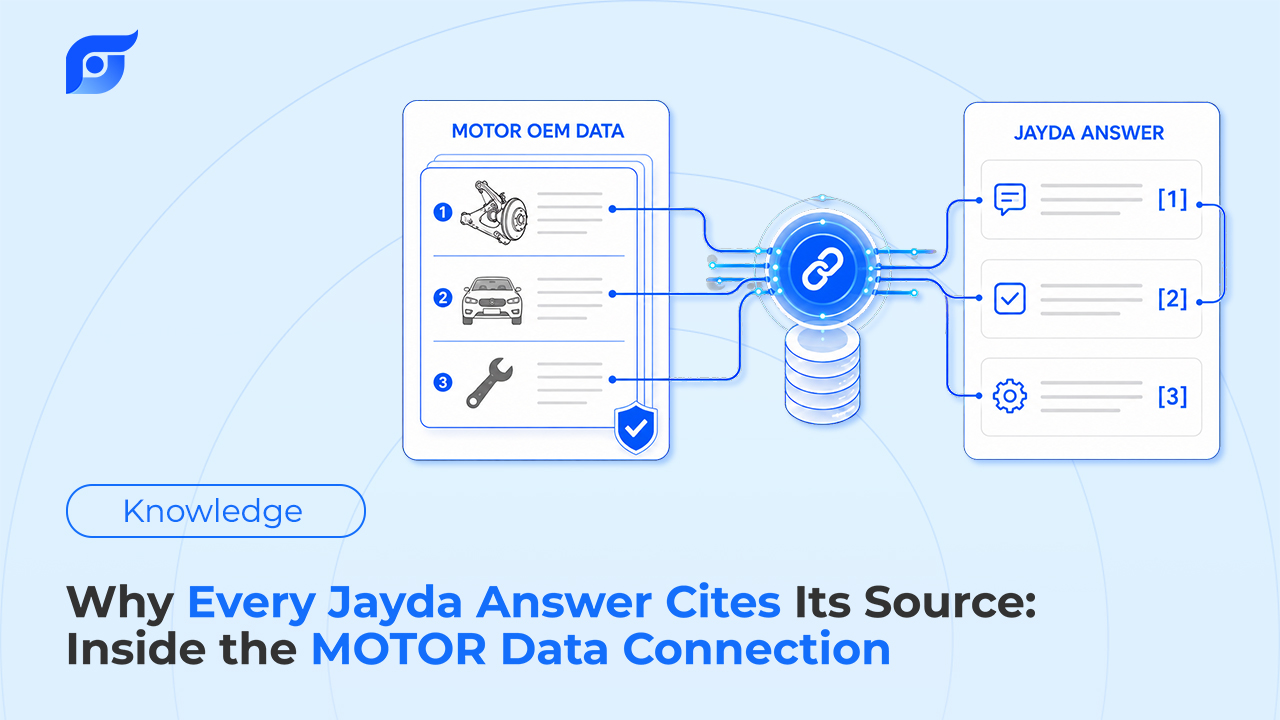
A tech types the question the way he’d say it out loud — “F-150 10-speed shudder TSB”, “axle nut torque spec, 2021 Camry” — and gets the manufacturer’s answer for that exact vehicle, with the source shown: the source document, the manufacturer, the model year, and the last update date, drawn from licensed MOTOR data and presented unedited. That’s the part that matters to you as an owner. The tech gets the speed he was already chasing; you get an answer that traces to a manufacturer.
Just as important is what Jayda doesn’t do. Its AI retrieves OEM content — it does not write repair steps, summarize a procedure in its own words, or diagnose the vehicle. And when a procedure isn’t in the database, it says so instead of approximating from a similar vehicle. No result is not a failure state; it’s the product refusing to put something on your repair order that didn’t come from the manufacturer. For a lookup that ends up as your shop’s source of record, that boundary is the entire point.
The technician’s judgment doesn’t move. He still reads the wiring diagram, still decides whether the spec fits what he’s looking at, still owns the call. Jayda finds the source; the person in the bay decides what to do with it.
If you run a shop, contact us for a trial and see what your team’s lookups actually look like across a week. If you’re a technician working solo, start a free trial and check it against the next job you’d have searched for.
How to Set the Standard Without Writing a Rule Nobody Follows
Five steps, in the order that actually works:
- Name the classes, not the tools. Write down which lookups are source-of-record in your shop — torque, wiring, DTC procedures, fluids, ADAS, HV, TSB/recall, labor times on a quote. Everything else is orientation, and orientation is the tech’s call.
- Make the citable path the fastest path. Until it’s faster than a phone, the rest of this list is decoration.
- Ask for the source on the classes that matter. Not a paper trail for everything — the document reference on the handful of jobs where being wrong is expensive.
- Onboard new techs to a source, not to a coworker’s habit. A three-month tech copies whatever the shop’s fastest lookup happens to be. Decide what that is before he decides for you.
- Review comebacks by where the information came from. Add one question to the post-mortem: what was this sourced from? The pattern shows up within a quarter.
Key Takeaways & Frequently Asked Questions
Should I ban phones or YouTube in the shop? No — and shops that try it usually end up with the same behavior, just less visible. Ban the sourcing, not the device: internet content is fine for orienting yourself on a job, and not acceptable as the source for a spec, a procedure, a diagram, or a coverage claim. That distinction is enforceable. A device ban isn’t.
But forum and video info is often correct. Isn’t this overkill? Often correct is a fair description, and it’s also the problem. “Usually right” is a standard you can’t put on an invoice or defend in a warranty claim, and the failure cases cluster exactly where they hurt most — mid-cycle trim changes, updated procedures superseded by a bulletin, and specs that changed between model years without changing the part’s appearance.
Can an AI tool make up a torque spec? A tool built to generate content can. A source-bound tool works differently: it matches the question to manufacturer documentation and shows where the answer came from, rather than writing or paraphrasing it. The practical test for any tool your shop is evaluating is simple — ask it to show you the document behind the answer.
What happens when the procedure isn’t in the database? Jayda says so. There’s no “based on a similar vehicle” fallback and no general-knowledge substitute. A tool that always produces an answer, including for rare trims and edge cases, is filling gaps with something other than OEM data — and that’s the answer most likely to end up on a repair order it shouldn’t.
Does this mean replacing the subscription we already have? Not on day one. Most shops start with Jayda beside what they already use, at the point of need on a specific vehicle, and let the workflow decide from there. Whether it earns a permanent spot is a question your bay answers, not a decision you have to make up front.
How do I get technicians to actually adopt it? Don’t introduce it as a compliance tool. Introduce it as the faster lookup, because that’s what it has to be to survive contact with a busy Tuesday. Techs adopt what saves them time; the citation is what makes it safe for you. Both things are true at once, and that’s the whole reason this works where a policy memo doesn’t.