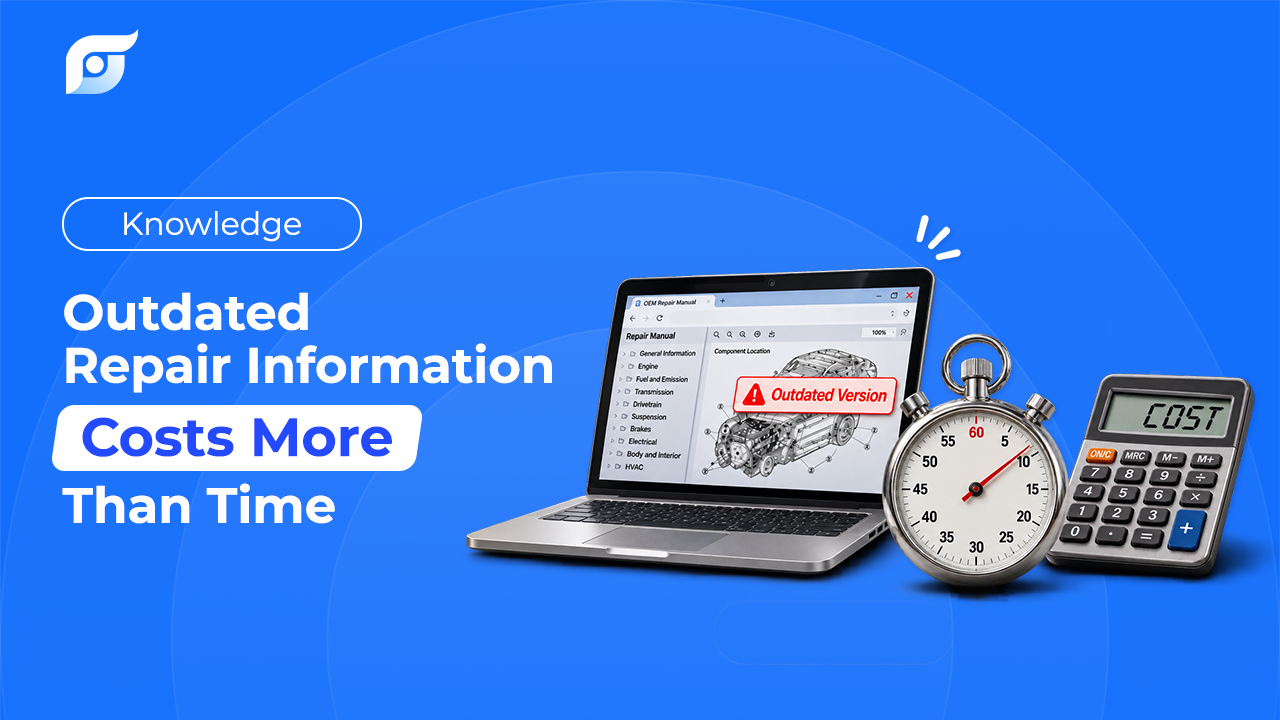
Every shop has a folder of saved procedures, a binder of printouts, or a bookmarked forum thread that “has the spec.” Pulling from it feels efficient, because it skips a lookup. The trouble is that OEM repair information is revised constantly, and an old document doesn’t announce that it’s old. The minutes saved by reusing it are visible on the repair order. The cost of being wrong shows up later — as a comeback, a lost customer, or in the worst cases, a courtroom.
Quick Answer: Outdated repair information costs more than the lookup time it saves because the failure lands after the job is closed, when it’s most expensive. OEM documents change far more often than most shops assume: OEConnection reported in May 2026 that its RepairLogic platform recorded over 7 million updates to OEM documents in a single quarter, including roughly one million new procedures. A stale document typically fails in one of four ways — a superseded bulletin, a revised fastener rule, a changed reflash or calibration prerequisite, or a requirement triggered by an event rather than a symptom. Identifix estimates a single misdiagnosis often costs two to three times the visible parts cost once tech hours, bay time, and comebacks are counted, and a customer lost to a comeback takes their lifetime value with them. At the far end, a Dallas County jury awarded about $42 million in 2017 in a case where a body shop did not follow Honda’s published roof repair procedure. The fix is a currency check before the work starts: confirm the document is current, matches the exact build, and hasn’t been superseded.
Why Is a Saved Procedure a Risk Now?
Saving a document and reusing it assumes the document stays put. OEConnection’s figure of more than 7 million OEM document updates in one quarter comes from its own platform data, so treat it as a vendor number rather than an industry census — but even discounted heavily, it describes a reference library that moves every week.
Updates aren’t limited to corrections of typos — the same OEConnection count included roughly one million brand-new procedures in that quarter. A printout from last year can be a genuine manufacturer document and still describe a sequence the manufacturer has since withdrawn. That’s the core problem with stale information: an outdated OEM procedure looks exactly as authoritative as a current one. Nothing on the page tells you it has been revised.
This is also where the difference between a manufacturer’s procedure and a summary of one gets sharper. A summary or a saved copy freezes the information at the moment someone captured it. The source keeps moving.
Four Ways an Old Document Fails a Current Job
1. The bulletin was superseded
Ford’s 10R80 harsh-shift bulletin 22-2139 is a real document. Ford’s bulletin 23-2123, dated 13 April 2023, states: “This bulletin supersedes 22-2139.” And 23-2123 now carries its own banner on Ford’s service site: “THIS TSB HAS BEEN SUPERSEDED OR DEACTIVATED.” That’s two layers of revision on one complaint. Anyone working from a saved copy or a bulletin number quoted in a thread could follow a procedure Ford had already revised. A TSB is only useful if it’s the current one, and the supersession line near the top of the document is the fastest way to confirm that.
2. The fastener rule changed
Whether a bolt can be reused is part of the specification, not something printed on the part. Federal-Mogul Motorparts’ head bolt guidance states that there is no way to visually tell whether a bolt is torque-to-yield — the only reliable indicator is the torque specification itself. A value carried over from an older manual tells you nothing about whether it still matches the bolt in the engine, which is why the current OEM document, not memory, has to decide.
3. The reflash or calibration has new prerequisites
Software updates live inside bulletins, so they get revised along with them — and the conditions around a reflash matter as much as the reflash. The same Ford bulletin, 23-2123, tells the technician to “Reprogram the transmission strategy download into the PCM/TCM” only when none of the listed DTCs are present. When those DTCs are present, the bulletin sends the job down a different path: “Overhaul the main control valve body.” A note that just says “reflash fixes it” drops the condition that decides which repair the vehicle actually gets.
4. The requirement is triggered by an event, not a symptom
Some requirements never produce a fault code. For Ford’s lane keeping camera, I-CAR lists a change in tire size, suspension repair or alignment, front airbag deployment, and windshield replacement as calibration triggers. If the procedure you’re working from predates a calibration requirement, nothing on the vehicle will remind you that it exists — the car may leave the bay with every light off and a system that isn’t aimed correctly.
What Does a Comeback Caused by Old Information Actually Cost?
The parts on a comeback are the smallest line. Identifix breaks the monthly cost of misdiagnosis into four terms a shop can fill in from its own management system:
- Wrong parts: average wrong-part cost × restocking percentage
- Extra tech time: average extra hours × hourly labor rate
- Comebacks: comeback rate × average comeback repair cost
- Lost bay time: hours a bay is tied up × average repair order value
By Identifix’s estimate, a single misdiagnosis often costs two to three times its visible parts cost, and conservative totals land between $2,000 and $6,000 per month for a mid-size shop. Those are vendor estimates, so the formula is more useful than the range — plug in your own numbers.
The term that formula undercounts is the customer. Identifix’s example: if a shop’s average customer lifetime value is $3,000, a comeback that drives that customer away costs $3,000 in future revenue — far more than the parts on the redo.
Sources vary on how often comebacks happen. CCC data for the year ending September 2020 found customers brought back about 10.1% of vehicles to direct repair program collision shops, but there’s no comparable industry-wide figure for mechanical repair. Your own rate — customers who came back divided by total customers — is the number that matters, and it’s worth splitting by cause. Comebacks traced to the information used, rather than to parts or workmanship, are the ones a currency check prevents.
The Ceiling: When the Published Procedure Becomes the Standard of Care
One of the most widely cited cases in the industry isn’t about an outdated document, but it shows what the published OEM procedure means once something goes wrong. In 2017, a Dallas County jury awarded about $42 million to a couple trapped in a burning 2010 Honda Fit. During a 2012 hail repair, the shop adhesive-bonded a replacement roof where Honda’s procedure called for welding it — tack welds at the corners, then spot welds and MIG plug welds — and the jury held the shop responsible for 75% of the harm, roughly $31.5 million. The argument that OEM procedures are suggestions did not hold up.
The lesson for mechanical and collision work alike: when a repair is questioned, the manufacturer’s current procedure is the yardstick, and the document you actually worked from becomes the evidence. A printout of a superseded procedure is a hard thing to defend, even if you followed it perfectly. That’s the practical case for treating OEM repair information as a live source rather than a file you keep.
Why the Time Math Is Misleading
Shops are right to care about lookup time. Minutes spent hunting through menus and portals add up across every RO, and the hidden cost of searching before every repair order is real money. But the response to slow lookups is often to skip them — reuse the saved copy, trust the number from last time, ask whoever did the job before.
That trade swaps a small, visible, certain cost for a large, invisible, occasional one. The lookup appears on every job. A comeback from a superseded procedure appears once in a while, gets filed as a parts or workmanship problem, and never gets traced back to the document. Think of it like insurance in reverse: skipping the lookup is a premium you don’t pay most of the time, until the one job where the claim is yours to cover.
The fix isn’t to search harder. It’s to make the current document as fast to get as the saved one, so the trade stops being tempting. That’s why the time technicians lose looking for repair information and the risk of stale information are the same problem viewed from two ends.
A Currency Check Before the Work Starts
- Pull the document fresh for this job. Not from a saved folder, not from a photo on someone’s phone. Saved copies are for reference; the job gets the current version.
- Check for supersession. On bulletins it’s usually one line near the top. If the document supersedes another, confirm you’re holding the newest one — and if it’s been superseded itself, find what replaced it.
- Match the exact build. Year, engine, transmission, submodel, and build date where the document is scoped that way. Two vehicles with the same badge can fall on opposite sides of a cutoff.
- Take the conditions with the number. Fastener reuse rules, sequence, thread condition, required parts that ride along with a reflash. A spec without its conditions is half a spec.
- Look for event-triggered steps. Calibrations, relearns, and resets that the repair itself sets off — the ones no warning light will remind you about. Check whether a TSB or a recall already covers the complaint before you diagnose from scratch.
Where Jayda Fits
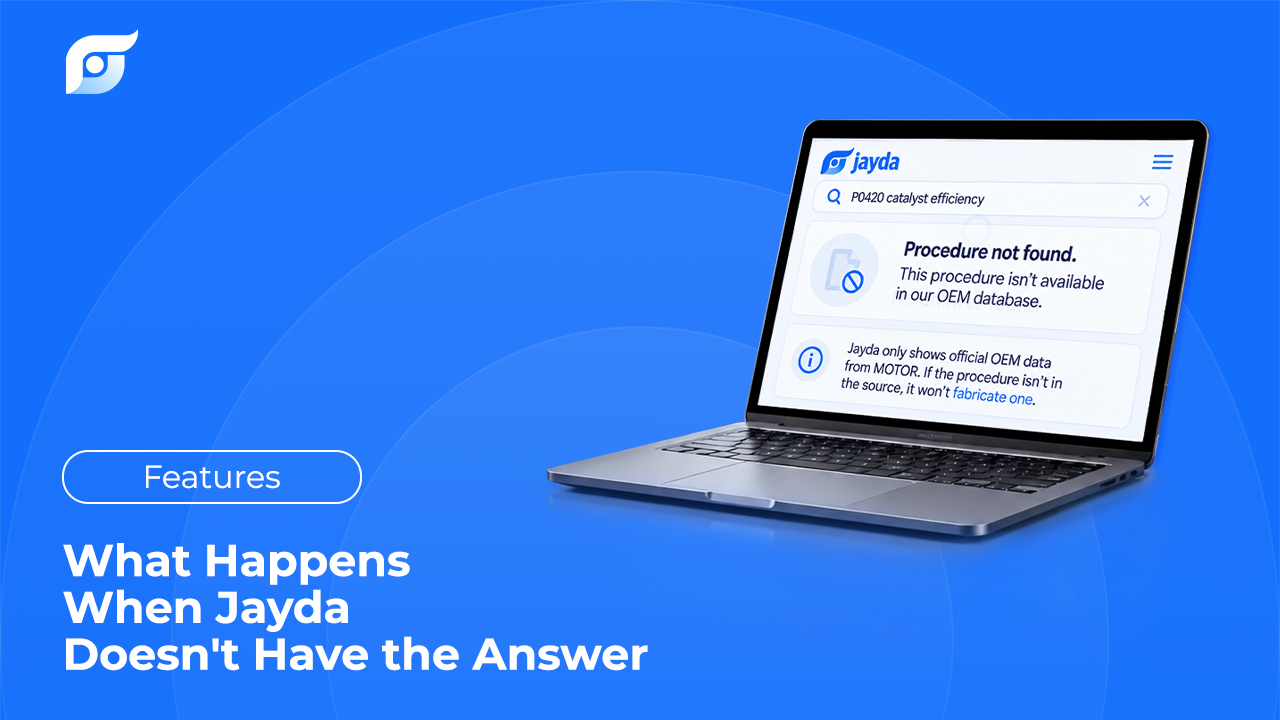
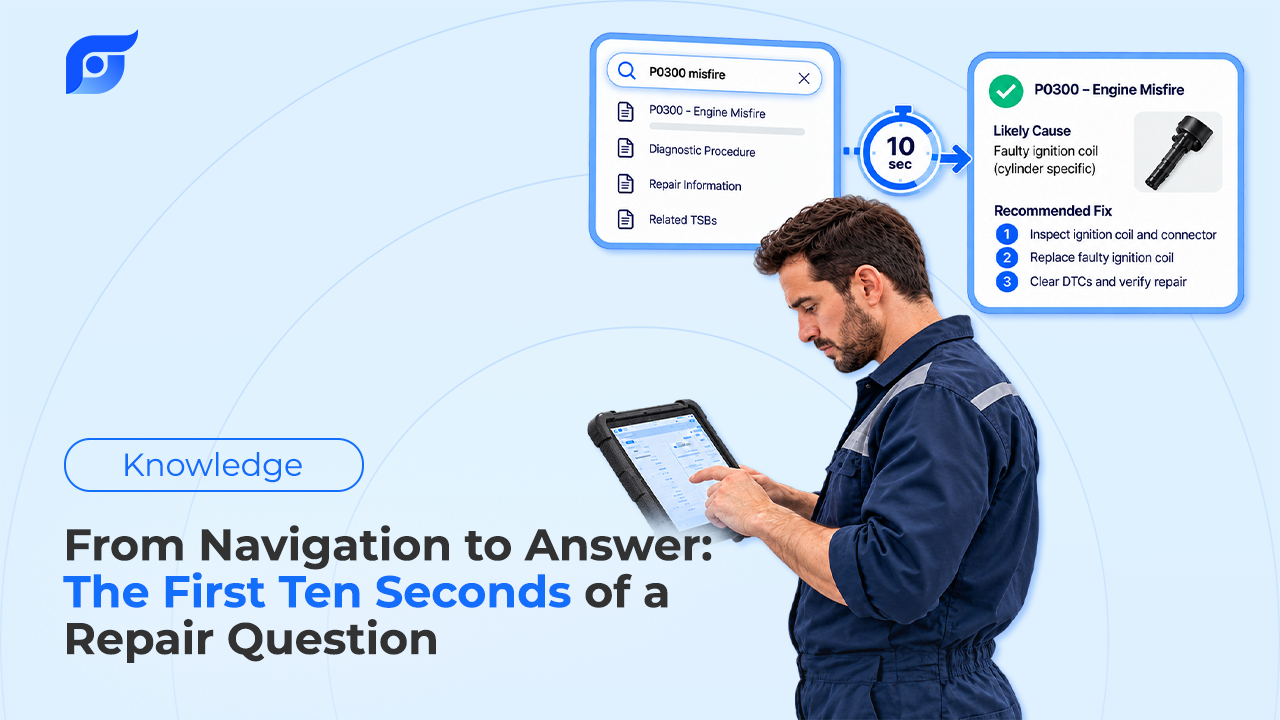
Jayda’s job is the retrieval step in that check. You ask for what you need on the vehicle in the bay — “2019 F-150 10R80 harsh shift TSB” — and Jayda returns MOTOR-sourced OEM data for that exact vehicle, with the source shown so you can open it and read the scope yourself. When nothing in the database matches, Jayda says so instead of filling the gap with something plausible, which is the reasoning behind searching repair information rather than generating it.
Deciding whether the document applies, and what to do with it, stays with the technician. Retrieval is the part that should take seconds. Judgment is the part that should never be skipped — and it’s why the tech stays at the center of the repair.