
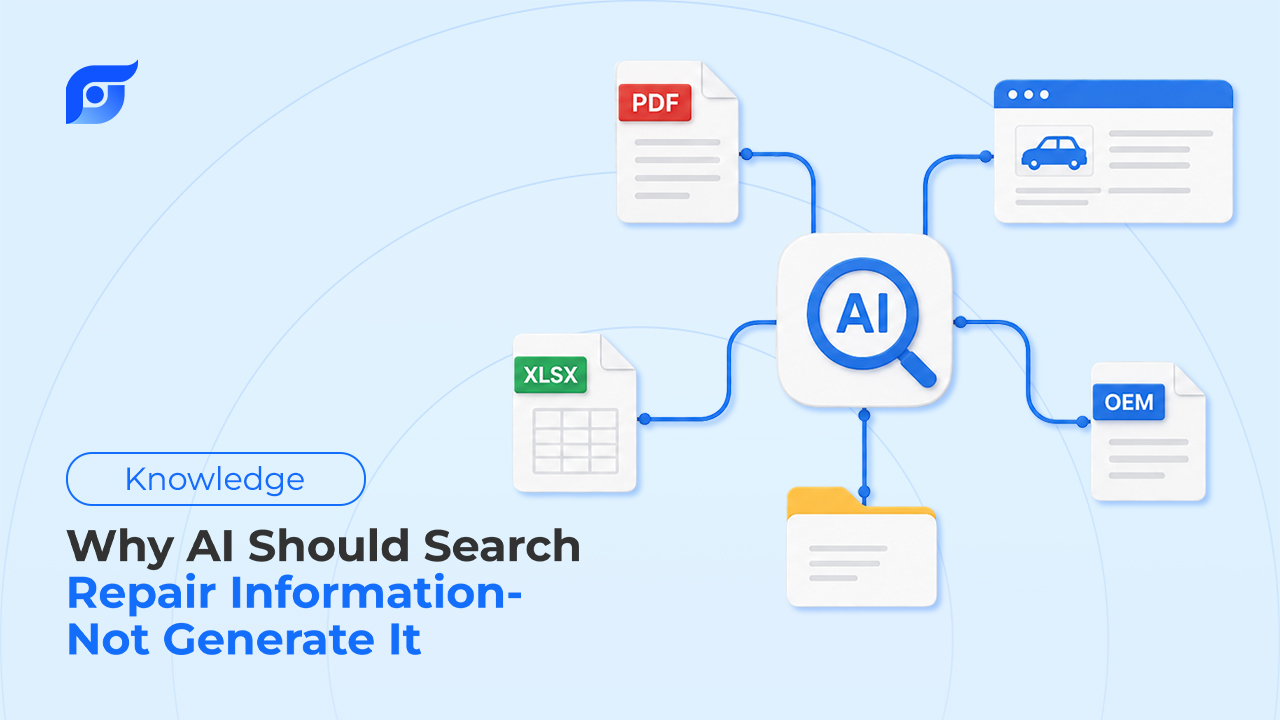
Ask a general-purpose AI model for a torque spec, and it will answer. It will sound confident. It may even be right — for a different engine, a different trim, or a different model year. The model isn’t checking a manual. It’s predicting the most statistically likely next words based on everything it read during training, blended, averaged, and confidently restated as fact.
That distinction — a tool that searches verified information versus a tool that generates plausible-sounding information — is the single most important design decision in applying AI to automotive repair. Get it backwards, and you’re not saving time. You’re introducing risk into every repair order.
Who This Actually Matters To
This isn’t an abstract AI-ethics question. It shows up differently depending on where you sit in the shop.
For a technician standing at the vehicle, it’s the difference between finding the OEM procedure and finding something that sounds like the OEM procedure. You’re the one torquing the fastener or reconnecting the harness — you carry the outcome, not the tool that gave you the number.
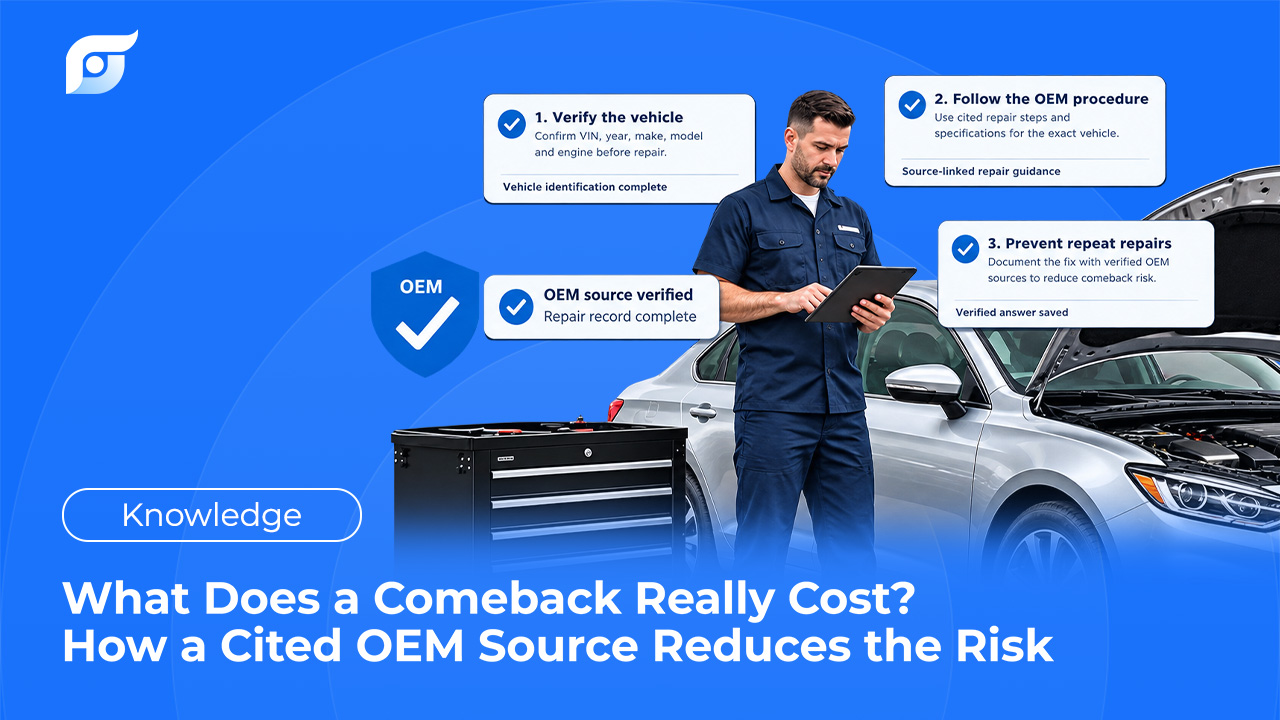
For a shop owner, it’s a liability and reputation question. A comeback caused by a bad spec costs the billable hours twice — once to do the job, once to redo it — and it costs trust with the customer, who doesn’t distinguish “the AI got it wrong” from “the shop got it wrong.”
For an IT or operations lead evaluating tools for a repair software platform or multi-location shop group, it’s a procurement question: does this AI vendor treat repair content as something to look up, or something to improvise? That answer determines whether the tool is safe to put in front of every tech on the team, or just a novelty a few people try once.
All three groups are asking a version of the same thing: can I trust what this AI just told me, and can I check it before I act on it?
The Problem With Letting AI Write the Procedure
Large language models are built to continue a sentence, not to consult an engineer’s spec sheet. When you ask one for a repair procedure, it isn’t retrieving a document — it’s reconstructing an answer from patterns in its training data. Most of the time, that reconstruction sounds right. That’s exactly the problem: fluent and correct are not the same thing, and in a repair bay there’s no way to tell them apart just by reading the output.
The stakes are higher here than in most AI use cases. A generated answer with a wrong wiring color, a wrong connector pinout, or a torque spec pulled from the wrong variant doesn’t just produce an awkward paragraph — it produces a comeback, a damaged part, or a fastener torqued to a number that was never OEM-approved for that vehicle in the first place. One-time-use bolts get reused because a generic answer never flagged them. Special tool requirements get skipped because the model never mentioned them. None of this shows up as an error message. It shows up three days later, on a lift, as a customer complaint.
This is why “AI makes things up” is the single most common objection technicians raise about AI in the shop — and it’s a fair one. The right response isn’t to insist the AI is accurate. It’s to change what the AI is allowed to do in the first place.
Search, Not Generate: How Jayda’s AI Actually Works
Jayda’s AI has one job: understand what you’re asking, then find the matching OEM procedure — not write one.
Here’s what that looks like end to end:
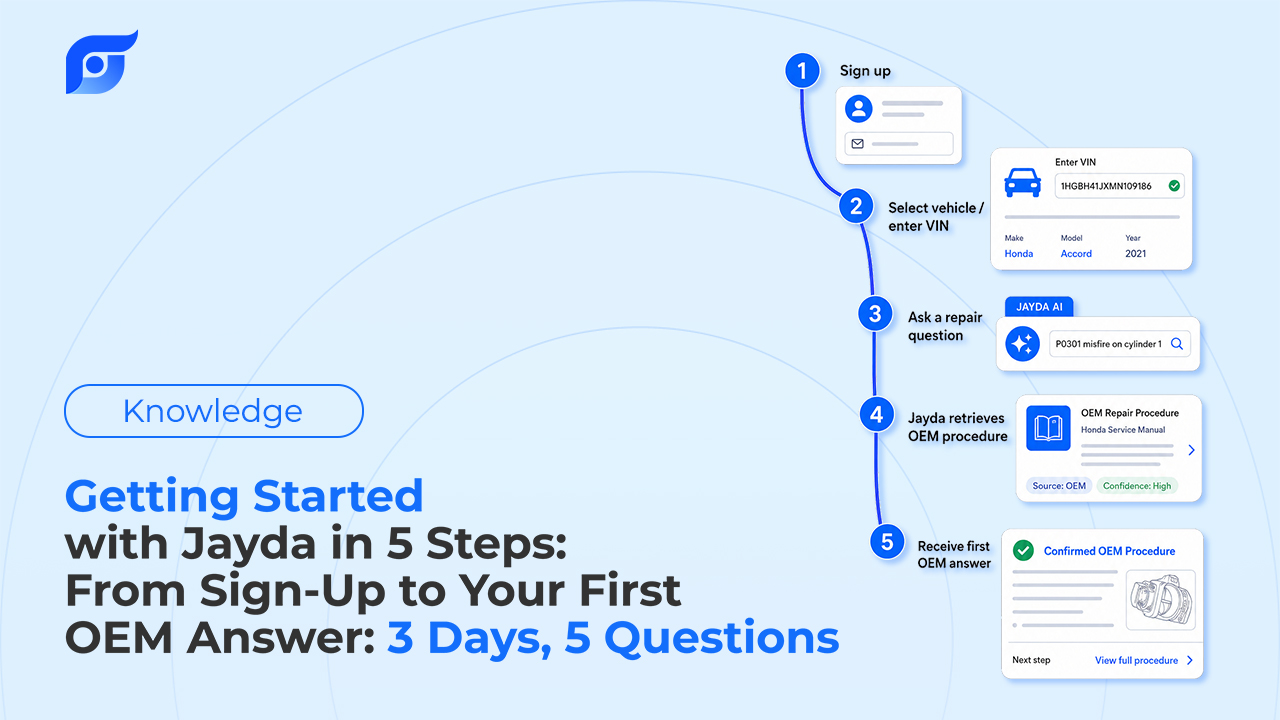
- Lock the vehicle. Year, make, model, engine, and VIN when available — so the answer is scoped to the exact configuration in front of you, not a generic version of the vehicle.
- Understand the question, however you ask it. You don’t need to know the OEM’s internal terminology. Type what you’d say out loud — “F-150 10-speed shudder TSB” or “why is my P0335 setting” — and Jayda matches it to the right procedure, code definition, or diagram.
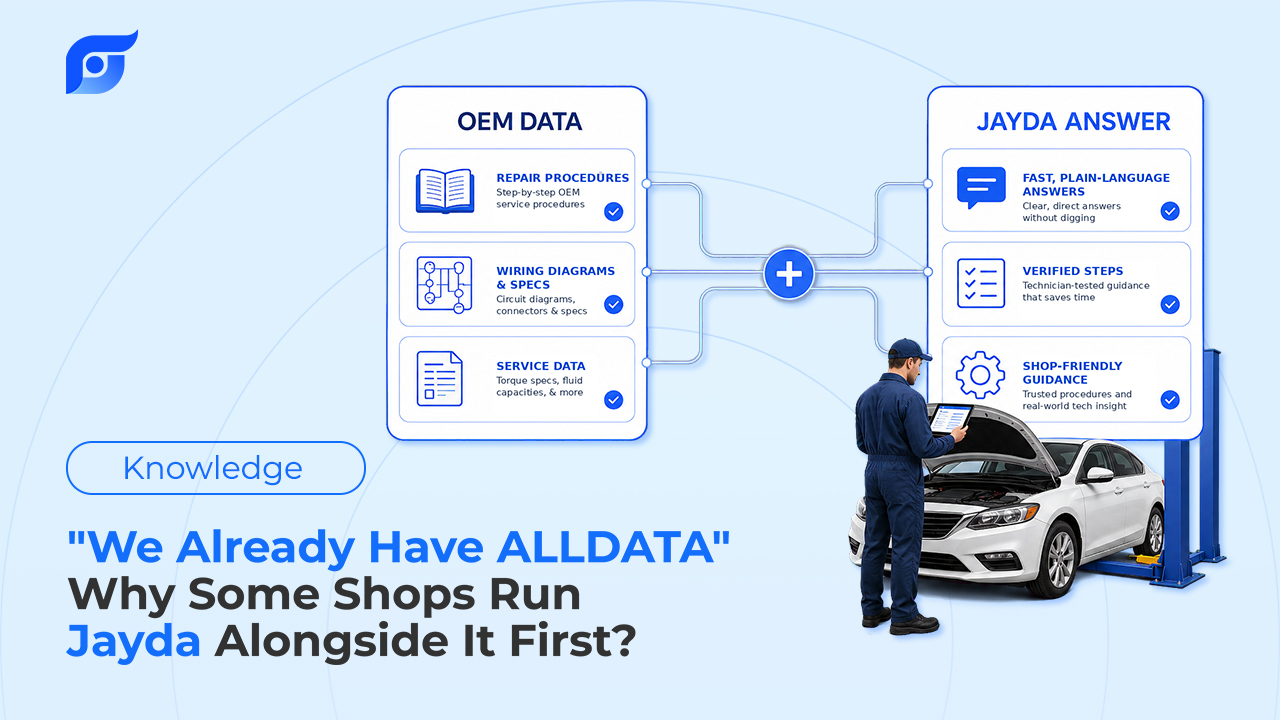
- Retrieve from licensed OEM content. The response is pulled from official manufacturer documentation via MOTOR Information Systems, not reconstructed from general web text.
- Show the source. Every answer carries its citation — document name, manufacturer, model year, and last-updated date — so you can verify it before you rely on it.
Nothing in that pipeline asks the AI to compose, summarize, or “fill in the gaps” of a repair procedure. If the procedure isn’t in the licensed OEM data, Jayda says so directly. No fallback to general knowledge. No “based on similar vehicles.” Silence is a better answer than a guess when the guess involves a lift and a customer’s vehicle.
That’s a different category of tool than a general AI mechanic. You’re the expert — Jayda finds the data.
What Menu Navigation Actually Costs
Even when the OEM data is right, a legacy database still requires you to find it — clicking through nested menus, cross-referencing model-year variants, scrolling a long PDF for one wiring diagram. That’s not a search problem. It’s an access problem, and it adds up in ways that are easy to underestimate one lookup at a time.
A few concrete examples from a typical repair workflow: locating a hidden sensor or module without a diagram can burn 15–30 minutes of physical searching. Cross-referencing an OEM part number and its supersession history manually costs another 10-plus minutes per repair. Tracing a circuit through a nested wiring-diagram menu instead of pulling it directly can turn a 30-second lookup into a 45-minute one. Across a full repair order, technicians routinely lose 15–45 minutes just navigating to information they already know exists somewhere in the system.
Jayda’s AI removes the navigation step. Instead of drilling into a category tree, you ask the question directly and the AI finds the exact diagram, spec, or procedure — typically in under 30 seconds. The time saved isn’t the headline benefit here (it’s proof the search-based model works), but it’s real: fewer non-billable minutes per RO, faster onboarding for a new tech who doesn’t yet know where anything lives in the old system, and less friction between diagnosing a problem and actually fixing it.
If you want to see what that adds up to across a week or a shop, run the numbers with Jayda’s ROI calculator — it’s built for exactly this comparison.
Why the Source Matters as Much as the Speed
Speed without a source is just a faster guess. What makes an AI search trustworthy in a repair context is what’s behind it:
- Official OEM data, not modified. Every procedure, spec, diagram, TSB, and DTC workflow in Jayda comes from MOTOR Information Systems — an automotive data provider operating since 1903 — and is presented 100% unmodified, exactly as the manufacturer published it. No AI embellishment, no rewriting.
- 12 OEM data categories in one place, covering the full repair workflow: component locations, DTCs, labor times, fluids and capacities, maintenance schedules, part diagrams, OEM part numbers, repair procedures, specifications, wiring diagrams, TSBs, and recalls.
- New OEM content within days of manufacturer release, so what you’re citing reflects the current bulletin, not last year’s.
- A citation on every answer — so verification is a habit, not an afterthought.
Why This Isn’t Just a Technician Problem
For anyone evaluating Jayda on behalf of a shop or a platform — not just using it at the bench — the same search-not-generate principle extends to how the data itself is handled. OEM content licensed through MOTOR is never used to train AI models; that’s a contractual commitment, not a policy statement. Daily request limits per user help prevent bulk data extraction. Individual user credentials come with retrievable access logs. Exports are limited to readable PDFs, not raw data dumps. Even the underlying AI infrastructure runs under a zero-training agreement, so partner data never enters a model training pipeline.
None of this is visible from the technician’s chair, but it’s exactly what an IT lead or platform partner is checking for before they’ll put an AI tool in front of an entire team: does the vendor treat licensed content with the same discipline they’re asking you to trust it with?
FAQ
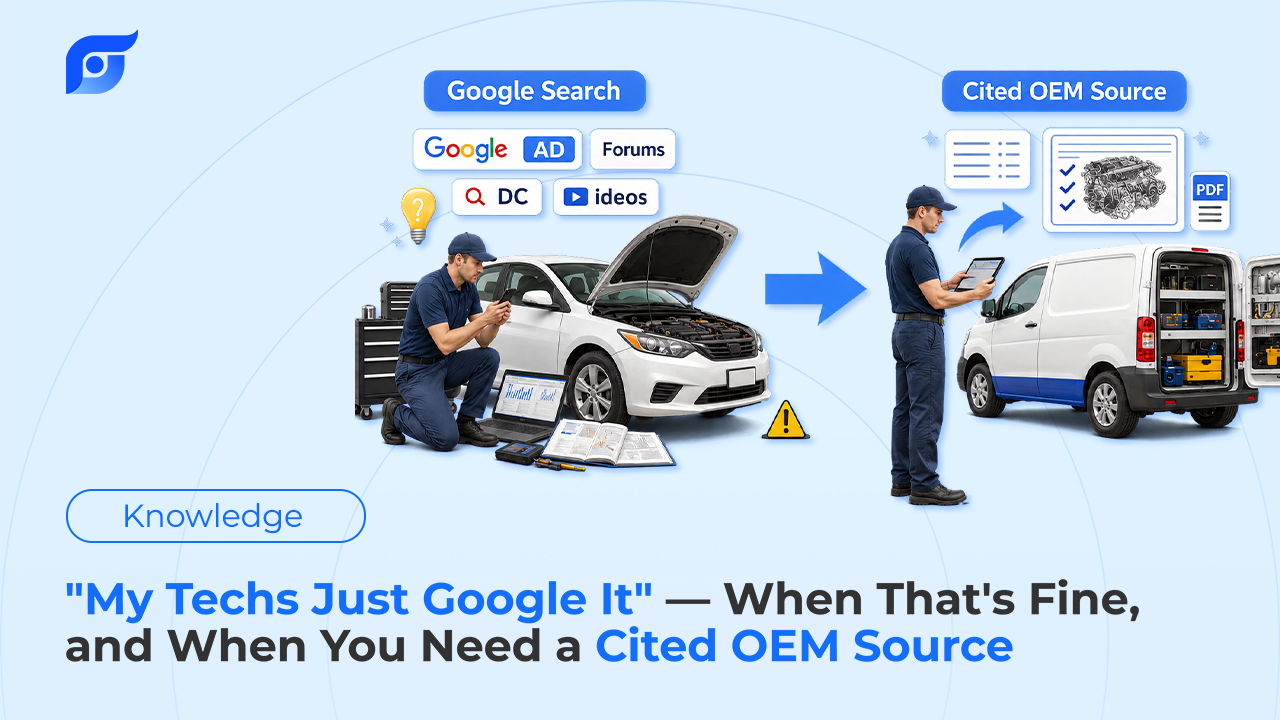
How do I avoid AI making up a repair spec? Use an AI tool that’s restricted to searching licensed OEM data and showing its source — not one that generates an answer from general training data. Before you rely on any AI-provided spec, check that it cites the manufacturer document, model year, and update date.
What’s the difference between AI search and generative AI in a repair context? Generative AI predicts a plausible-sounding answer from patterns in its training data. AI search retrieves an existing document — an OEM procedure, spec, or diagram — and returns it with its source. One is reconstructed; the other is verified.
Does Jayda diagnose the vehicle for me? No. Jayda finds the OEM procedure, spec, diagram, or DTC workflow for the exact vehicle. The diagnosis and the repair decision stay with the technician.
What happens if Jayda can’t find a procedure? It tells you directly, instead of offering a general-knowledge approximation or a guess based on a similar vehicle.
Is OEM data used to train Jayda’s AI models? No. MOTOR/OEM data is contractually excluded from AI model training, and the underlying AI infrastructure operates under a zero-training agreement.
Ask Once. Know the OEM Procedure.
The question isn’t whether AI belongs in the shop. It’s what you’re letting it do. Search and cite official data — good. Generate and hope — no. Jayda is built on the first model only.
Start a Free Trial (Starter and Pro Tech — 3 days, self-serve, no credit card required to explore) or Contact Us to set up a Business trial for your team.