
The rapid adoption of artificial intelligence is reshaping automotive repair information. Yet AI platforms are not built on the same foundation. Some retrieve official OEM repair procedures from licensed databases, while others generate technical content with language models. This article examines why that architectural difference matters and how it impacts repair accuracy, liability, and confidence in the repair process.
AI Repair Procedures: Why the Difference Between Retrieval and Generation Matters
Artificial intelligence is changing how technicians access repair information. Instead of navigating nested menus or searching through hundreds of pages of service manuals, today’s AI-powered repair tools allow users to ask questions in natural language and receive answers within seconds.
This shift has made repair information more accessible than ever. However, it has also introduced an important distinction that many technicians, shop owners, and vehicle owners may not recognize.
Not every AI repair tool produces its answers the same way.
Some systems retrieve official OEM repair procedures from licensed databases. Others generate repair instructions using large language models (LLMs). Although the results may look nearly identical on screen, the underlying source of the information is fundamentally different.
That distinction affects more than convenience. It directly influences repair accuracy, traceability, liability, and ultimately vehicle safety.
This article explains how AI repair procedures are delivered, what AI hallucinations mean in automotive repair, and why Jayda is intentionally designed to retrieve official OEM repair data rather than generate repair instructions.
What Are AI Repair Procedures?
The term AI repair procedures generally refers to repair instructions delivered through an AI-powered interface. Instead of requiring users to browse service manuals manually, AI allows technicians to ask questions conversationally, such as:
- What is the torque specification for a 2019 Ford F-150 cam phaser?
- How do I replace the water pump on a 2020 Toyota Camry?
- Show the wiring diagram for the ABS module on a 2021 Chevrolet Silverado.
The experience feels similar regardless of which platform is used. A user enters a question, and an answer appears within seconds.
Behind that simple interaction, however, are two fundamentally different architectures.
Some platforms retrieve existing manufacturer documentation from licensed databases.
Others generate new repair instructions using an AI model.
To the user, both answers may appear equally professional. Both may include technical terminology, step-by-step instructions, and structured formatting.
The critical question is not how the answer looks.
The critical question is who wrote it.
How AI Repair Tools Work
Most AI repair platforms fall into one of two categories.
Retrieval-Based AI
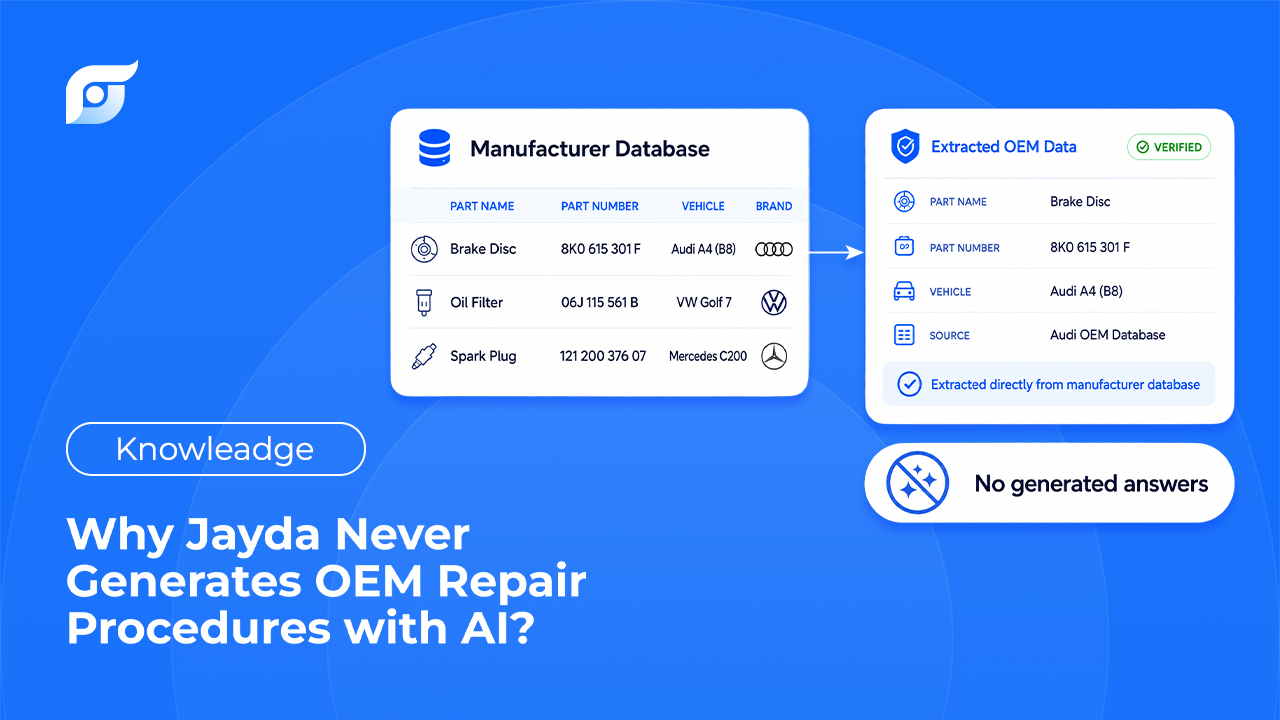
A retrieval-based system uses AI to understand the user’s question, identify the correct vehicle configuration, search licensed repair documentation, and retrieve the appropriate manufacturer procedure.
In this architecture, AI functions as an intelligent search layer.
The repair content itself is never written by AI. Instead, it comes directly from existing OEM documentation.
The workflow typically looks like this:
- The technician enters a repair question.
- AI interprets the user’s intent.
- The system identifies the correct vehicle configuration.
- The platform searches licensed OEM documentation.
- The original repair procedure is returned exactly as published.
The AI improves search efficiency without modifying the repair information.
Generative AI
A generative AI system works differently.
Rather than retrieving an existing document, the language model predicts what the repair procedure should look like based on patterns learned during training.
Large language models do not verify repair information against manufacturer publications by default. Instead, they generate the most statistically probable sequence of words that follows the user’s prompt.
This capability allows AI to produce remarkably fluent technical explanations.
However, fluency should not be confused with verification.
Unless the platform explicitly retrieves licensed OEM documentation, the repair procedure displayed on screen may have been written entirely by the model.
Retrieval vs. Generation
Although both approaches can appear similar, they operate on completely different principles.
| Retrieval-Based AI | Generative AI |
| Retrieves existing OEM documentation | Generates new text |
| Displays manufacturer-authored procedures | Produces model-authored content |
| Original wording remains intact | AI determines wording |
| Source attribution available | Source may be unclear or unavailable |
| Returns “not found” if documentation is unavailable | Often attempts to answer regardless |
| Maintains document traceability | May combine information from multiple sources |
For automotive repair, these differences have practical consequences.
When technicians perform safety-critical repairs, they rely on procedures that can be traced directly to the manufacturer.
Retrieval preserves that chain of trust.
Generation introduces another author into the process—the AI model itself.
Why Most AI Repair Procedures Look Equally Credible
One reason this distinction is often overlooked is that modern language models produce highly polished technical writing.
A generated repair procedure typically includes:
- Professional formatting
- Correct automotive terminology
- Sequential repair steps
- Safety warnings
- Torque specifications
- Diagnostic recommendations
On the surface, it looks indistinguishable from an authentic service manual.
For example, imagine two repair platforms displaying instructions for replacing a steering rack.
One platform retrieves the manufacturer’s original procedure.
The other generates a new procedure based on its training data.
Both documents may contain numbered steps.
Both may reference torque values.
Both may appear equally authoritative.
Without source attribution, the technician has no practical way to determine which document originated from the manufacturer.
As language models continue to improve, this distinction becomes even harder to recognize.
The quality of the writing is no longer a reliable indicator of the quality of the information.
What Is AI Hallucination in Automotive Repair?
An AI hallucination occurs when a language model generates information that is convincing but factually incorrect.
Hallucinations are not software bugs in the traditional sense. They are a characteristic of probabilistic language generation.
The model predicts what is likely to come next based on statistical patterns rather than verifying information against an authoritative source.
In many applications, hallucinations are relatively harmless.
An incorrect historical date or an inaccurate movie recommendation is inconvenient but unlikely to cause significant consequences.
Automotive repair presents a very different environment.
Repair procedures are expected to be technically precise.
Small inaccuracies can change the outcome of an entire repair.
Examples of automotive hallucinations could include:
- An incorrect torque specification.
- A missing one-time-use fastener replacement requirement.
- A skipped battery disconnect procedure.
- An incorrect wiring connector identification.
- A fluid specification copied from a similar engine rather than the correct variant.
- An omitted ADAS calibration step.
- A diagnostic flowchart missing a required verification step.
- A repair sequence intended for a different model year.
Each mistake may appear minor in isolation.
Collectively, they can affect repair quality, increase comeback rates, or create safety risks.
Why Hallucinations Are Especially Dangerous in Automotive Repair
Automotive repair differs from many other industries because it involves systems that directly affect vehicle operation and occupant safety.
A repair procedure is not simply instructional content.
It is technical documentation intended to produce a specific engineering outcome.
Consider a few examples.
A wheel bearing torque specification that is even slightly incorrect may reduce component life or affect bearing preload.
An omitted steering angle sensor calibration can interfere with advanced driver assistance systems.
An incorrect brake bleeding sequence may leave air trapped inside the hydraulic system.
A missing warning about a one-time-use fastener may result in component failure after reassembly.
None of these errors are likely to be obvious while reading the procedure.
The document may appear complete.
The language may sound professional.
The formatting may resemble an official service manual.
The problem is not that AI-generated procedures look suspicious.
The problem is that they often look entirely legitimate.
By the time an error becomes apparent—whether through a comeback repair, a damaged component, or a safety issue—the technician may have no indication that the original information was generated rather than retrieved from an official manufacturer source.
For professional repair shops, this introduces additional considerations beyond repair accuracy.
Every repair performed represents a potential liability.
When technicians rely on repair information, they need confidence that the procedure reflects the manufacturer’s published guidance rather than an AI-generated interpretation.
That is why the source of repair information matters just as much as the speed at which it is delivered.
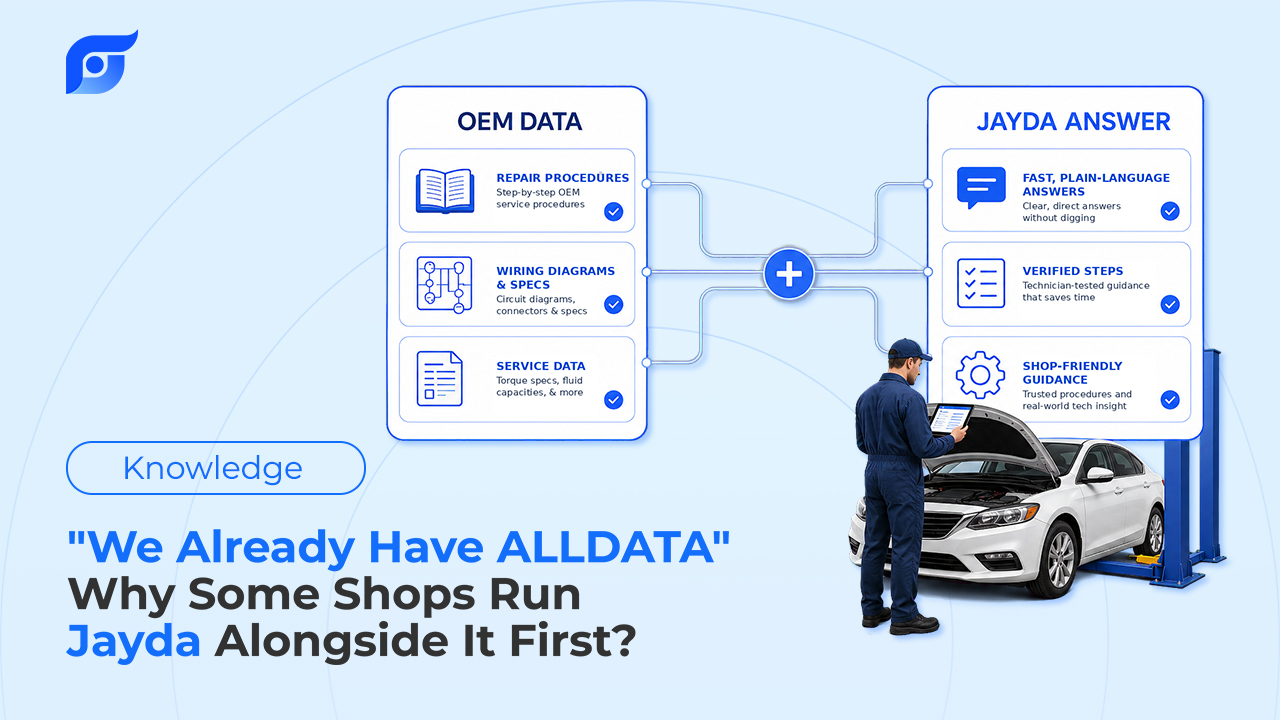
How Jayda Retrieves OEM Repair Data Instead of Generating It
Jayda was designed around a simple principle:
AI should make official repair information easier to find—not rewrite it.
Instead of generating repair procedures, Jayda uses artificial intelligence only to understand user intent and locate the correct OEM documentation.
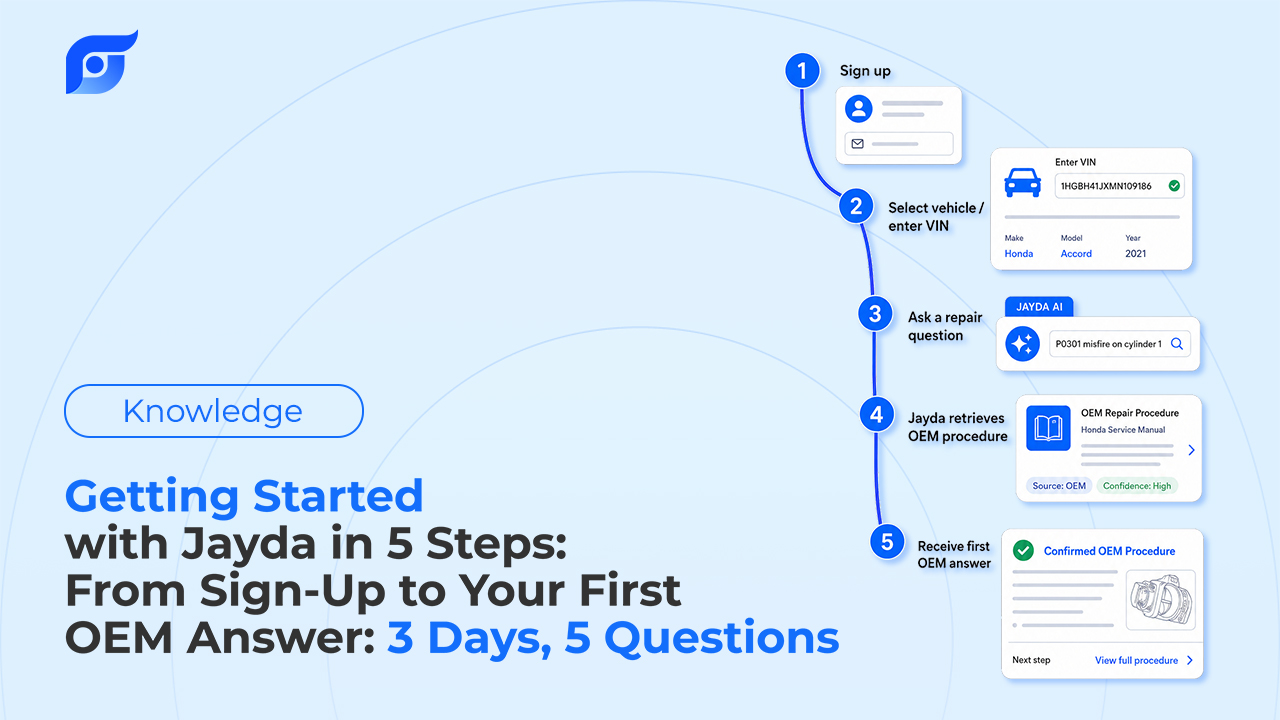
The workflow is intentionally straightforward.
Step 1: Understand the Repair Request
A technician enters a question such as:
2019 Ford F-150 5.0L cam phaser replacement torque specs
Jayda’s AI first analyzes the request to identify the relevant vehicle information, including:
- Model year
- Manufacturer
- Model
- Engine configuration
- Repair operation
- Requested information type (procedure, specification, wiring diagram, TSB, etc.)
Rather than searching for individual keywords, the AI understands the complete repair intent.
Step 2: Match the Correct OEM Documentation
Once the request is understood, Jayda searches licensed OEM repair documentation supplied through MOTOR Information Systems.
The AI identifies the document that matches the specific vehicle configuration and repair operation.
If multiple procedures exist for different engines, drivetrains, or production dates, Jayda searches for the procedure that matches the user’s request rather than returning every possible result.
Step 3: Retrieve the Original Procedure
After locating the correct document, Jayda retrieves the original OEM content.
No additional writing occurs.
The repair procedure displayed to the user remains exactly as published by the manufacturer.
That includes:
- Repair steps
- Torque specifications
- Safety warnings
- Required special tools
- Inspection procedures
- Notes and cautions
- Diagnostic sequences
The AI does not rewrite, summarize, simplify, or reorganize the content.
Step 4: Display Source Information
Every result includes source attribution so users know exactly where the information originated.
Depending on the document, this includes:
- Source document
- Manufacturer
- Applicable model year
- Document revision or update date (when available)
Instead of asking technicians to trust AI, Jayda allows them to verify the source directly.
Why Jayda Never Generates Repair Procedures
Many AI products are designed with one primary objective:
Always produce an answer.
If documentation cannot be found, the model attempts to generate the most likely response using its training data.
That approach works well for many everyday tasks.
It is not appropriate for manufacturer repair procedures.
Jayda follows a different philosophy.
Artificial intelligence is used to improve search, not to become another author of technical documentation.
That distinction affects every aspect of the platform.
Jayda never:
- Writes repair procedures
- Rewrites OEM instructions
- Summarizes manufacturer documentation
- Combines information from multiple repair manuals
- Adds missing repair steps
- Generates torque specifications
- Creates replacement safety warnings
- Interprets diagnostic procedures
Every repair instruction originates from licensed OEM documentation.
This design choice reflects an important principle:
If the manufacturer did not publish the procedure, Jayda does not create one.
That philosophy protects the integrity of the repair information while preserving the original engineering intent behind every procedure.
Why “Not Found” Is Better Than a Wrong Answer
One of the defining characteristics of retrieval-based AI is that it can admit when information is unavailable.
If Jayda cannot locate a matching OEM procedure, it simply reports that no result was found.
There is no fallback to general automotive knowledge.
There is no approximation based on similar vehicles.
There is no attempt to fill missing information using AI-generated text.
For users accustomed to conversational AI, this behavior may initially seem restrictive.
In reality, it is one of the platform’s most important safety features.
Imagine a repair involving two nearly identical engine variants.
One version requires replacing a one-time-use bolt during reassembly.
The other does not.
A generative AI system may attempt to infer the missing information from similar procedures.
Jayda does not.
If the required OEM documentation is unavailable for the specific vehicle configuration, the platform avoids presenting potentially incorrect instructions.
In automotive repair, uncertainty should not be hidden behind confident language.
Sometimes the most accurate answer is:
No matching OEM procedure was found.
That response encourages technicians to continue verifying information rather than assuming the displayed answer is complete.
The Honest Boundaries Policy
Every technology has limitations.
The difference is how those limitations are communicated.
Many AI systems are designed to minimize uncertainty by providing an answer whenever possible.
Jayda takes the opposite approach.
Its responsibility is not to answer every question.
Its responsibility is to provide verified OEM repair information when that information exists.
When no matching procedure can be retrieved, Jayda communicates that clearly.
There is:
- No generated alternative.
- No estimated procedure.
- No “best practice” assembled by AI.
- No content synthesized from multiple sources.
This approach reflects an important principle in automotive repair:
When safety is involved, uncertainty should never be disguised as certainty.
Professional technicians already understand this mindset.
When service information cannot be verified, experienced technicians continue researching rather than relying on assumptions.
Jayda follows the same discipline.
Why This Matters for Professional Repair Shops
Repair information affects more than individual repairs.
It also affects business operations.
Independent repair facilities and dealership service departments depend on accurate documentation to reduce diagnostic time, improve first-time fix rates, and minimize costly comebacks.
Incorrect procedures can lead to:
- Repeat repairs
- Warranty disputes
- Damaged components
- Additional labor costs
- Customer dissatisfaction
- Increased liability exposure
The financial impact of a single incorrect repair can exceed the cost of an information system subscription many times over.
Because of this, repair facilities generally evaluate information providers using three questions:
- Is the information accurate?
- Can it be traced to the manufacturer?
- Can technicians rely on it consistently?
Retrieval-based AI helps answer these questions because it preserves the original source rather than replacing it.
Why DIY Vehicle Owners Should Care
The same principles apply outside professional repair shops.
Today’s DIY enthusiasts have access to more information than ever before.
Forums, social media, and AI assistants can all provide useful discussions about common repairs.
However, discussions are not the same as manufacturer documentation.
A forum may explain how one owner completed a repair.
An AI assistant may describe a commonly accepted process.
Neither necessarily reflects the official procedure published for a specific vehicle configuration.
For routine maintenance, these differences may have little impact.
For complex repairs involving engines, transmissions, suspension systems, steering components, airbags, or advanced driver assistance systems, manufacturer documentation becomes significantly more important.
Jayda gives independent vehicle owners access to the same official OEM repair information used by professional repair facilities without changing the content itself.
The Data Behind Every Result: MOTOR Information Systems
The reliability of any repair platform ultimately depends on the quality of its underlying data.
Jayda retrieves its repair procedures from MOTOR Information Systems, one of the automotive industry’s longest-established providers of repair information.
Founded in 1903 and owned by Hearst, MOTOR has supplied licensed automotive service information for more than a century. Its database supports professional repair environments across North America and is also used by widely recognized industry platforms and diagnostic tools.
The available OEM content includes:
- Factory repair procedures
- Diagnostic Trouble Codes (DTCs)
- Technical Service Bulletins (TSBs)
- Wiring diagrams
- Torque specifications
- Fluid capacities
- Maintenance schedules
- Labor time estimates
- Component locations
- OEM parts information
- ADAS calibration procedures
- Recall information
Because MOTOR continuously incorporates manufacturer updates, revised OEM procedures become available shortly after they are released by the vehicle manufacturer.
This ensures technicians access current repair information rather than outdated documentation.
Equally important, the OEM content remains licensed—not scraped, rewritten, or reconstructed from public sources.
OEM Data Is Never Used to Train Jayda’s AI
Another important distinction concerns how repair data is handled.
Some users assume that if AI can search repair procedures, those procedures must also be used to train the underlying language model.
That is not how Jayda operates.
The licensed OEM documentation retrieved through MOTOR Information Systems is not used to train AI models.
Instead:
- AI interprets user intent.
- Licensed OEM documents remain separate from the language model.
- The retrieval process accesses those documents without incorporating them into model training.
- The original manufacturer content is delivered directly to the user.
This architecture helps protect both intellectual property and data integrity while ensuring that OEM documentation remains unchanged throughout the retrieval process.
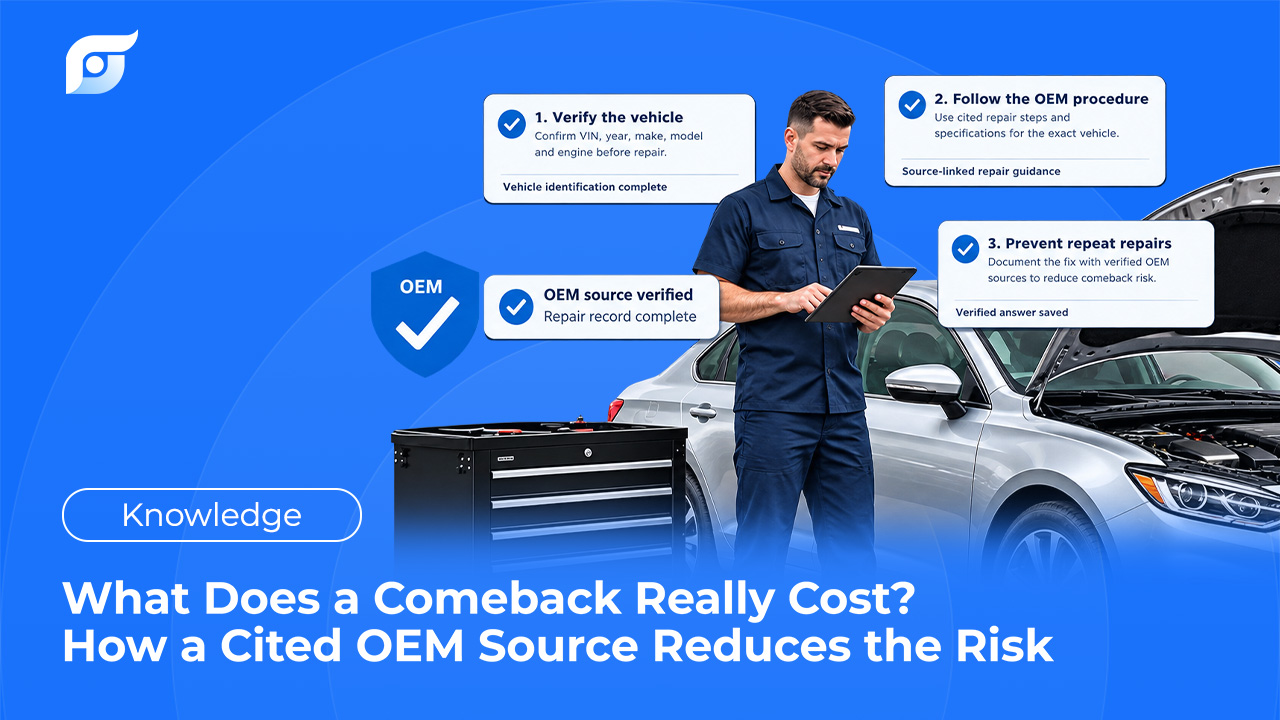
Why Source Attribution Matters
Every repair procedure has a history.
It was researched, validated, reviewed, approved, and ultimately published by the vehicle manufacturer. That publication provides more than technical guidance—it establishes accountability.
When technicians use OEM documentation, they know exactly where the information originated.
When they use AI-generated repair instructions, that chain of accountability becomes less clear.
For professional repair facilities, source attribution provides several practical advantages.
It allows technicians to:
- Verify that the procedure originated from the manufacturer.
- Confirm the document applies to the correct vehicle configuration.
- Reference the original publication during complex repairs.
- Support repair decisions when discussing work with customers.
- Maintain confidence that the repair followed documented OEM guidance.
Without source attribution, technicians are left trusting the output rather than verifying the source.
That distinction becomes increasingly important as AI-generated technical writing becomes more sophisticated.
What Source Attribution Looks Like in Jayda
Every OEM repair procedure retrieved through Jayda is accompanied by information that identifies where the content originated.
Depending on the document, users can view information such as:
- Manufacturer
- Source document
- Applicable model year
- Procedure title
- Document revision or update information
This transparency allows technicians to distinguish between manufacturer-authored documentation and AI-generated content.
The objective is simple.
Users should never have to wonder whether they are reading an official repair procedure or a model-generated interpretation.
Questions Every Shop Should Ask Before Choosing an AI Repair Tool
Artificial intelligence is becoming a standard feature in automotive software.
That alone does not indicate how repair information is produced.
Before adopting an AI-powered repair platform, repair shops should ask several important questions.
Does the AI Generate Repair Procedures?
This is the most important question.
If repair instructions are generated by the language model, they should be evaluated differently than manufacturer-authored documentation.
A retrieval-based system should clearly explain that the repair procedure comes directly from OEM documentation.
Can Every Result Be Traced to Its Original Source?
Professional repair information should always be traceable.
If a platform cannot identify where a repair procedure originated, technicians have little way to verify its authenticity.
What Happens When Information Cannot Be Found?
Some systems always attempt to answer.
Others acknowledge when documentation is unavailable.
For safety-critical repairs, returning “not found” is often more responsible than generating a probable answer.
Does the Platform Modify OEM Procedures?
Even small changes can alter technical meaning.
Ask whether the platform:
- rewrites procedures,
- summarizes repair steps,
- removes warnings,
- simplifies technical language,
- or combines information from multiple documents.
Any modification introduces another layer between the manufacturer and the technician.
Is the Data Updated as Manufacturers Publish Revisions?
Vehicle manufacturers continuously release:
- Technical Service Bulletins
- revised repair procedures
- updated specifications
- recall information
- calibration changes
Repair information should reflect those updates rather than relying on static documentation.
Is the AI Trained on OEM Repair Content?
Many users assume that because an AI system discusses repair procedures, OEM documentation must have been used during training.
That is not always the case.
Understanding how repair data interacts with the AI model helps users evaluate both intellectual property protections and data integrity.
Why This Challenge Will Become More Difficult
Some people assume AI hallucinations will disappear as language models become more advanced.
The opposite is more likely.
Early AI systems often produced awkward or obviously incorrect technical writing.
Modern language models generate documentation that closely resembles professionally written service manuals.
Future models will become even better.
They will produce:
- more natural technical language,
- more consistent formatting,
- more convincing explanations,
- and increasingly realistic repair documentation.
Ironically, these improvements make hallucinations harder—not easier—to detect.
The problem is no longer poor writing quality.
The problem is that excellent writing can still describe an incorrect repair procedure.
As generative AI continues to improve, technicians will have fewer visual clues that distinguish manufacturer documentation from AI-generated content.
This is one reason retrieval-based systems become increasingly valuable over time.
Instead of asking technicians to judge whether a document “sounds correct,” retrieval allows them to verify that it is the manufacturer’s published procedure.
Retrieval Will Continue to Matter
Artificial intelligence will continue transforming automotive repair.
Natural language search, faster document retrieval, and conversational interfaces can significantly reduce the time technicians spend searching for information.
These are meaningful improvements.
However, faster access should not change the origin of repair information.
The role of AI should be to remove friction between technicians and official documentation—not replace that documentation with generated content.
That philosophy becomes even more important as repair procedures become increasingly complex.
Modern vehicles include:
- Advanced Driver Assistance Systems (ADAS)
- high-voltage electric vehicle systems
- sophisticated network communications
- software-controlled powertrains
- complex safety systems
- over-the-air software updates
These technologies demand greater precision than ever before.
In this environment, the value of manufacturer-authored repair information continues to increase.
AI Retrieval vs. AI Generation: A Practical Comparison
Although retrieval-based AI and generative AI may appear similar from the user’s perspective, they are built on fundamentally different approaches to delivering repair information. One retrieves manufacturer-authored documentation from licensed sources, while the other generates new content based on statistical language patterns. Understanding these differences helps technicians, shop owners, and vehicle owners evaluate the reliability, traceability, and accuracy of the repair information they use.
The table below summarizes the key distinctions between the two approaches.
| Category | Retrieval-Based AI (Jayda) | Generative AI |
| Source of repair procedures | Official or authorized OEM documentation | AI-generated text |
| Original wording | Preserved | Rewritten by the model |
| Source attribution | Available | Often unavailable or limited |
| Repair instructions | Manufacturer-authored | Model-authored |
| Behavior when information is unavailable | Returns no result | Typically attempts to generate an answer |
| Risk of hallucination | Limited to retrieval accuracy | Inherent to language generation |
| Traceability | Directly linked to OEM documentation | May not be verifiable |
For safety-critical repairs, these differences are not merely technical—they influence how confidently technicians can rely on the information presented.
Frequently Asked Questions
What are AI repair procedures?
AI repair procedures are repair instructions delivered through an AI-powered interface. Depending on the platform, those instructions may either be retrieved from official OEM documentation or generated by a language model.
What is AI hallucination in automotive repair?
An AI hallucination occurs when a language model generates information that appears technically correct but is inaccurate or unsupported by manufacturer documentation. In automotive repair, hallucinations may involve incorrect torque specifications, diagnostic steps, repair sequences, or calibration procedures.
Does Jayda generate repair procedures?
No.
Jayda uses AI to understand repair requests and retrieve licensed OEM repair documentation. The repair procedures themselves are not generated, rewritten, summarized, or modified by AI.
What is OEM repair data?
OEM repair data consists of official service information published by vehicle manufacturers. It includes repair procedures, wiring diagrams, diagnostic information, torque specifications, Technical Service Bulletins (TSBs), maintenance schedules, and other engineering documentation intended for servicing specific vehicles.
Why is OEM repair information more reliable than AI-generated content?
OEM repair information is developed, validated, and published by the vehicle manufacturer. AI-generated content is created by predicting likely text rather than reproducing official documentation. Manufacturer-authored procedures provide traceability and engineering accountability that generated content cannot replicate.
What happens if Jayda cannot find a repair procedure?
If no matching OEM documentation is available, Jayda reports that no result was found rather than generating a replacement procedure. This approach helps prevent unsupported repair instructions from being presented as authoritative information.
Can generative AI replace OEM service manuals?
Generative AI can improve information discovery and answer general automotive questions, but it should not be considered a replacement for official OEM service documentation when performing safety-critical repairs that require manufacturer-approved procedures.
Conclusion
Artificial intelligence is changing how repair information is accessed, but it should not change who authored that information.
There is a fundamental difference between using AI to find an official repair procedure and using AI to write one.
As language models become more capable, generated repair content will become increasingly difficult to distinguish from authentic OEM documentation. The quality of the writing will continue to improve, but writing quality alone does not guarantee technical accuracy or manufacturer validation.
For professional technicians, independent repair shops, fleet operators, and serious DIY vehicle owners, the reliability of repair information depends on its source as much as its speed.
Jayda was built around that principle from the beginning.
Instead of asking users to trust AI-generated repair instructions, Jayda uses artificial intelligence only where it adds value: understanding repair intent, identifying the correct vehicle, and retrieving the appropriate OEM documentation from licensed MOTOR Information Systems content.
The repair procedure itself remains exactly as the manufacturer published it.
No rewriting.
No summarization.
No interpretation.
Just official OEM repair information delivered in seconds.
Official OEM Data. Found in Seconds.
Whether you’re diagnosing a complex electrical fault, verifying a torque specification, or searching for the latest OEM repair procedure, the quality of your repair starts with the quality of your information.
Try Jayda today and experience AI that retrieves official OEM repair data instead of generating repair instructions.