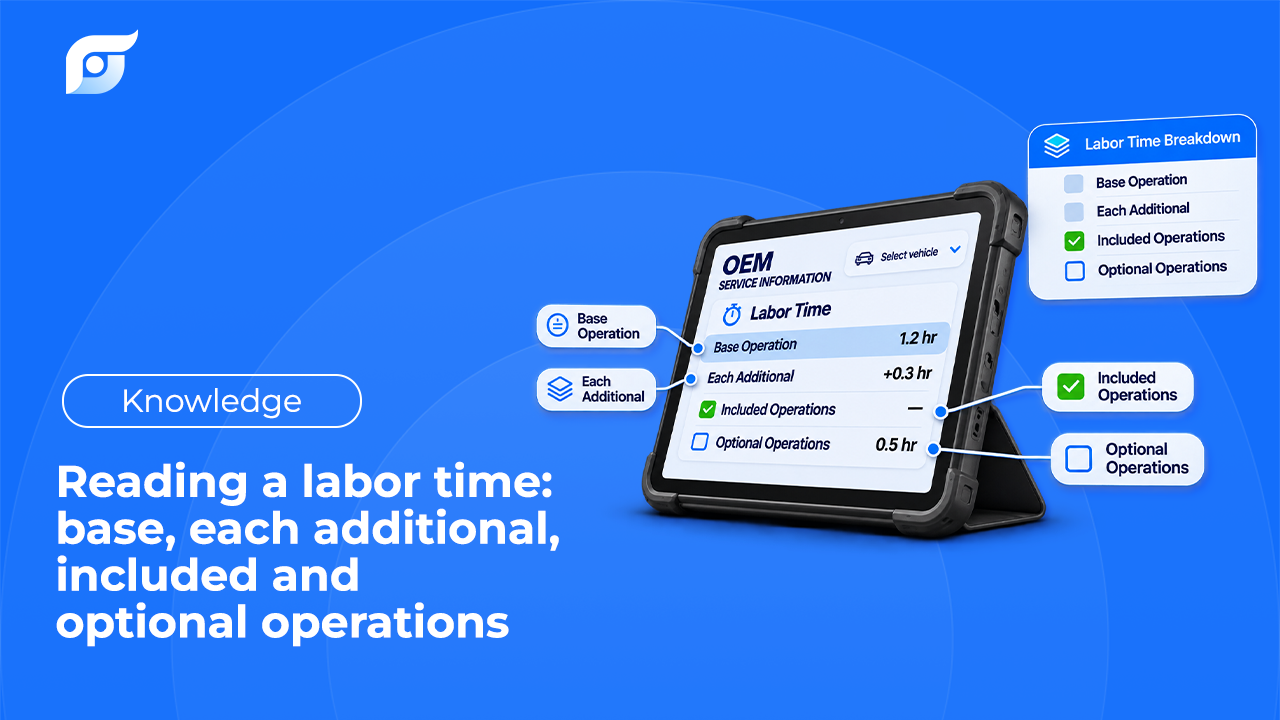
A labor time looks like one number, and most quoting mistakes come from treating it that way. The line in a labor guide carries a base time, sometimes a second time for each additional unit, a note saying what the time covers and what it leaves out, and a list of related operations with their own times. Read all four and the quote neither misses work nor bills the same work twice.
Quick Answer: A labor-time line has four parts to read before quoting. The base time is the estimated time to perform the operation once, in hours and tenths of an hour. The additional time, usually labeled “Each Additional,” is the time for every further instance of the same part, so two units are quoted as base plus one additional, not two times base. Some lines also give an “All” or “Both Sides” time, which is a separate figure for doing every instance and is not added on top of base and additional. The includes / does not include note states what is already inside the number, such as removing components for access, and what is not, such as bleeding, diagnosis or a road test. Optional operations are related jobs listed with their own times, such as rotor replacement on a brake pad line, and they are added only when the work is done. The time applies to one vehicle configuration, so the year, model, engine and drivetrain have to match the vehicle in the bay.
What One Labor-Time Line Actually Tells You
MOTOR’s developer documentation defines an estimated work time as the hours, in tenths, needed to perform an operation under normal circumstances. “Under normal circumstances” carries weight: the published number does not know about the seized bolt on the car in front of you. Around that number, a MOTOR labor record carries several other fields, and each one answers a different question at the counter:
| Part of the line | What it says | What it means for the quote |
|---|---|---|
| Operation | The action and the component, such as “Brake Pads R&R,” with a position such as Front | R&R (remove and replace) is a different operation from overhaul or reface, with a different time |
| Base time | MOTOR’s estimated time to perform the operation | The starting figure for one instance of the job |
| Additional time | The estimated time for additional instances of the part, labeled “Each Additional” | Added once per extra unit |
| All time | The time for all instances of the part, labeled “All,” “Both” or “Both Sides” | Used in place of base plus additional, never on top of it |
| Notes | “Includes” and “Does not include” text | Tells you which steps need their own line |
| Required skill | A skill level for the operation, such as General | Tells you who in the shop the time assumes is doing the work |
| Optional operations | Related operations and their times | Added only when that work is performed |
The field definitions in the second column are MOTOR’s own, from its Estimated Work Times API reference. The number itself is MOTOR’s too: its labor times are written by its editors from a step-by-step evaluation of OEM procedures, which is covered in where MOTOR’s labor times come from. If the term is new to your front counter, start with what OEM labor times are and why they matter.
Base Time vs. Each Additional: Doing Both Sides
The base time covers one instance of an operation, and the “Each Additional” time covers every further instance of the same part done in the same visit. The additional time is lower than the base because the setup is already done. The vehicle is on the lift, the wheels are off, the access panels are out, and the tools are at hand. The second unit only costs the work that is unique to it.
That gives a simple rule for quantity:
- One unit: base time.
- Two or more units: base time, plus the additional time for each unit after the first.
- Every unit, where the line gives an “All” or “Both Sides” time: that single figure.
The three times describe the same job at different quantities. They are not three steps to add together, and a quote that carries base, additional and all on separate lines has billed the job more than once. MOTOR’s content guide for its labor data also notes that an “All” time usually does not equal the base time plus the logical number of additional units. So when a line publishes an “All” figure, use that figure and don’t rebuild it from the other two.
Doubling the base is the common error in the other direction. One published labor-guide entry for valve guide seals on a Honda V6 lists roughly 10 hours for one bank and 17.1 hours for both sides. Quoting two times the single-bank figure would overstate the job by about three hours, because the second bank shares teardown with the first.
Included vs. Optional Operations: What’s Already in the Number
The note on a labor line draws the boundary of the time. On the brake pad record used in the worked lookup below, MOTOR’s note reads: “Includes: The removal of component and all necessary components for access, and cleaning component. Does not include: Brake Hydraulic System Bleed. System diagnosis and testing, or a vehicle road test.”
Each half of that note changes the quote:
- Included operations are already paid for. If the time includes removing whatever is in the way, a separate line for removing the wheels or the caliper to reach the pads charges the customer twice for the same step.
- “Does not include” items need their own line when they’re performed. A bleed, diagnostic time and a road test are real work with real time, and none of it is in the pad figure.
- Optional operations sit beside the main one. MOTOR’s usage tips for its mechanic labor guide say to note the base labor time and any related operations, and warn that work such as resurfacing or caliper hardware replacement may be listed separately and should be included to avoid underbilling.
Shop conditions are a third category that no note covers. Published introductions to MOTOR’s printed labor guides say additional time may be needed when corrosion, rust, carbon build-up or broken studs cause difficulties. That time is the shop’s call to add and explain, since it’s not in the published number. The same goes for the other lines that get forgotten on a repair quote, from diagnosis to shop supplies.
Why the Engine and Drivetrain Change the Number
A labor time is published for a vehicle configuration, not for a model name. The record in the next section is tied to a year, make, model, trim, engine and transmission, and the same operation on the same model with a different engine is a different record. The reason is access. What has to come off to reach a water pump, a starter or an exhaust manifold depends on which engine is in the bay and what’s packaged around it, and drivetrain layout changes the work on axles, driveshafts and transmission service in the same way.
Two habits follow from that. Identify the vehicle down to the engine before you look anything up, the way Jayda confirms year, make, model and engine before it answers. And don’t carry a time over from last week’s job on “the same truck” unless the engine and drivetrain were the same too. MOTOR’s times also distinguish standard from severe-duty applications where they apply, which is one more reason the configuration has to be right before the number means anything.
A Worked Lookup on One Vehicle
The vehicle is a 2022 Chevrolet Silverado 1500 Custom with the 2.7L turbocharged four-cylinder (L3B). The question typed into Jayda was “front brake pads labor time.” The answer came back from MOTOR’s Estimated Work Times record for that configuration, “Brake Pads R&R (Front),” with the source shown. The values below are from that record as retrieved in October 2026.
| Line | Type | Time |
|---|---|---|
| Brake Pads R&R, front | Main operation | 1.0 hour base |
| Brake Line R&R | Optional operation | 0.1 hour each |
| Disc Brake Caliper R&R | Optional operation | 0.2 hour each |
| Brake Rotor R&R | Optional operation | 0.2 hour each |
| Disc Brake Caliper Overhaul | Optional operation | 0.3 hour each |
| Brake Rotor Reface | Optional operation | 0.4 hour each |
Reading it the way the sections above describe:
- The base stands alone. The operation is front pads, and the record gives a single base of 1.0 hour for the front position with no additional or all time. There is nothing to multiply.
- The optional lines are “each.” A pad job that also replaces both front rotors is 1.0 hour plus 0.2 hour for each rotor, or 1.4 hours. Refacing both rotors would be 1.0 plus 0.4 twice, or 1.8 hours. The optional times are small because the pad job already has the caliper off and the rotor exposed.
- The note sets what’s missing. Access and cleaning are inside the 1.0 hour. A hydraulic bleed, diagnosis and a road test are outside it. If a caliper or brake line is replaced, the system has been opened, and the bleed becomes a line of its own.
- The skill level is General. MOTOR describes that level as work for a person with a thorough working knowledge of the component, using simpler measuring devices.
The labor time tells you how long the job is expected to take. It doesn’t tell you how to do it. The caliper bracket torque and whether the hardware is reusable come from the OEM procedure for the same vehicle, as in the OEM torque value for brake caliper bracket bolts. Both lookups belong to the same set of OEM procedures for the exact vehicle, and you can open the source behind any answer to read the note yourself. If a labor record isn’t in the data for a vehicle, Jayda says so.
From the labor-time answer, + Add to Estimate carries the line into a quote, where the shop can still edit the time. That flow is covered in Estimates in Jayda: from the OEM labor time to the quote.
A published labor time is an estimate for a job done under normal conditions on the configuration named, and the shop decides what goes on the quote. Times are revised, so confirm the current record for the vehicle you’re working on before you quote from it. To see a labor time come back with its source for a vehicle on your schedule, see how it works.