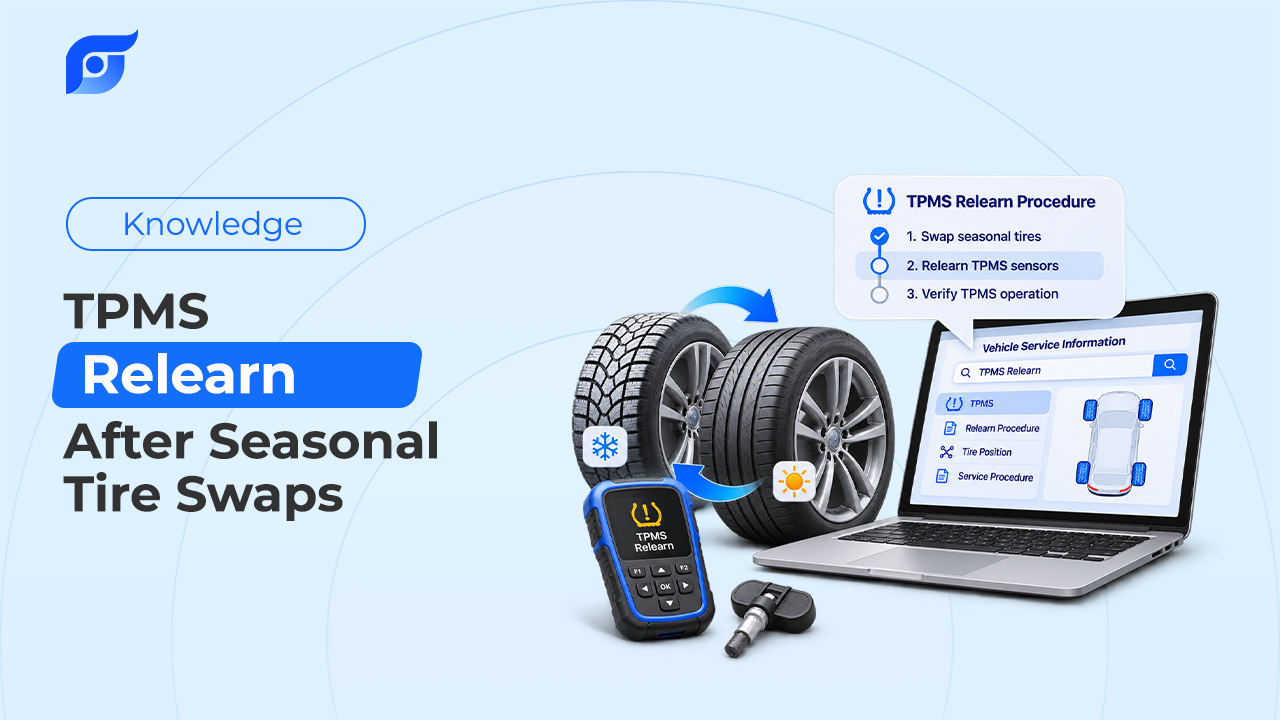
Swapping to winter wheels changes what the tire pressure monitoring system is listening for. A second set of wheels usually carries a second set of sensors with different IDs, and even the same four sensors end up at different corners after a rotation. Some vehicles sort that out on the first drive. Others keep reporting the old set, or the wrong corner, until someone runs a relearn. Which case applies, and the exact steps, is written in the manufacturer’s procedure for that vehicle.
Quick Answer: A TPMS relearn tells the vehicle which sensor IDs are on the car and, on many models, which wheel position each one is in. It is needed after a seasonal swap when the second set of wheels has its own sensors with different IDs, or when the same sensors move to different positions. Vehicles use one of three relearn methods: auto relearn (the vehicle learns the sensors while being driven), stationary relearn (the vehicle is put into a learn mode and each sensor is triggered in a set order, usually with a TPMS tool), and OBD relearn (a TPMS tool writes the sensor IDs to the vehicle through the OBD-II port). A relearn is generally not needed when the second set uses sensors cloned to the original IDs and mounted in the same positions, and vehicles with indirect TPMS have no wheel sensors and need a reset through the vehicle’s menu or button instead. A TPMS lamp that flashes for 60–90 seconds and then stays on signals a system malfunction, such as sensors the vehicle doesn’t recognize, not low pressure. The method differs by make, model and year, so the OEM procedure for the exact vehicle is the reference.
Three Relearn Methods and Why They Differ
Each direct-TPMS sensor broadcasts a unique ID along with its pressure reading. The vehicle only acts on IDs it has stored, which is how it ignores the car in the next lane. A TPMS relearn is the process of storing a new set of sensor IDs in the vehicle, and on many vehicles assigning each ID to a wheel position. Manufacturers solved that in three ways:
| Method | What happens | Tool needed | Where sources say it’s common |
|---|---|---|---|
| Auto relearn | The vehicle picks up the sensor IDs while it is driven | Usually none | Chrysler, Fiat, VW, Audi, BMW, Mercedes-Benz, Porsche, Land Rover, Jaguar |
| Stationary relearn | The vehicle is put into learn mode, then each sensor is triggered in a fixed order without driving | Usually a TPMS activation tool; some older vehicles use a pressure change or a key and pedal sequence | GM, Ford, Nissan |
| OBD relearn | A TPMS tool reads each sensor, then writes the IDs to the vehicle’s control module through the OBD-II port | A TPMS tool with OBD capability | Many Japanese- and Korean-made vehicles, plus some Chrysler, Fiat, Land Rover and Jaguar models |
The make lists above come from Autel, which builds TPMS tools, and they describe tendencies, not rules. The same brand appears in more than one row because the method changes by model and year, and some vehicles combine two methods. A stationary or OBD relearn may still need a drive afterward before the readings update.
Published figures on how common each method is don’t agree. One breakdown cited in the tire trade press puts direct-TPMS vehicles at 38% auto relearn, 35% stationary and 27% OBD. Tire Review separately reports that only about one-third of vehicles are auto relearn. Either way, a shop can’t assume that driving the car will sort it out on most of what comes through the door during the winter changeover.
When the swap doesn’t need a relearn
- Cloned sensors. Programmable aftermarket sensors can be written with the IDs of the original set. Autel states that its sensors need no relearn when cloned with the original sensor ID and installed in the same position. The vehicle sees the same four IDs all year.
- Indirect TPMS. These systems infer pressure from wheel-speed data and have no sensors in the wheels. There are no IDs to learn, but the system needs a reset or calibration after the tires change, done through the vehicle’s menu or button as the owner’s manual describes.
Symptoms of a relearn that didn’t happen
Federal Motor Vehicle Safety Standard No. 138 requires the system to warn the driver when a tire is 25% or more below the manufacturer’s recommended cold inflation pressure, and to show a separate malfunction indication when the system itself can’t do its job. In the bay, that separates two complaints:
- Lamp flashes for 60–90 seconds, then stays on: a system malfunction. After a wheel swap, the usual suspects are sensors the vehicle hasn’t learned, wheels with no sensors, or a failed sensor.
- Lamp on solid from the start: low pressure. Set all four tires to the door placard pressure with the tires cold before going further. The winter tire pressure for the exact vehicle comes from the placard, not the sidewall.
- Pressures display, but at the wrong corners: the IDs are learned and the positions aren’t. Owners on F-150 forums describe dash readouts that stayed wrong after a swap until a manual relearn was run.
Running winter wheels with no sensors is a separate question. In its 2005 final rule, NHTSA said it does not consider it appropriate to disable the malfunction indicator when aftermarket tires and rims that are incompatible with the TPMS are installed, and Tire Review reads that as a prohibition on shops for the life of the vehicle. State rules can add to this, so a shop should confirm what applies locally. With no sensors fitted, the malfunction lamp stays on all winter and the car has no low-pressure warning.
Two Worked Lookups
Start with the vehicle identified by VIN, since the relearn method can change within a model line from one year to the next. It’s the same reason Jayda confirms year, make, model and engine before it answers. The two examples below are both stationary relearns, and they still differ in almost every detail.
GM: the TPMS sensor matching process
GM owner’s manuals call the stationary relearn the TPMS sensor matching process. Across published manual excerpts, the structure is consistent:
- Order: driver’s side front, passenger front, passenger rear, driver’s side rear.
- Confirmation: a single horn chirp confirms each position has been learned. In a 2006 Cadillac manual, a double chirp after the last tire signals that matching mode has ended.
- Time limits: one manual gives two minutes to match the first position and five minutes for all four, and says the process stops and must be restarted if it runs over.
The details move by year. A 2007 Cadillac STS manual gives one minute for the first tire instead of two. One excerpt says the chirp should sound within 15 seconds, and a Cadillac manual says it may take up to 30. The trigger changes too: older GM manuals have the technician raise or lower the tire’s pressure for about five seconds or until the horn chirps, while newer procedures use a TPMS relearn tool held against the sidewall near the valve stem. Trade sources add a field tip. If the tool reads the sensor but the horn doesn’t chirp, another component may be blocking the signal, and rolling the wheel so the valve stem sits in a different position can fix it.
Ford: the TPMS reset procedure
Ford owner’s manuals for F-150 and Super Duty trucks describe a system reset procedure that trains the sensors one at a time:
- Order: the F-150 manual starts at the left front tire and proceeds clockwise.
- Time limit: the manual says not to wait more than two minutes between resetting each sensor. Past that, the system times out and the whole procedure is repeated on all four wheels.
- Horn signal: in the F-250 manual, a double horn chirp means the procedure needs to be repeated. On GM, a double chirp can mean the process finished. Same sound, opposite meaning.
- Spacing: the manual says to perform the reset at least three feet (one meter) away from another Ford vehicle going through the same procedure. That matters in a shop running two bays of changeovers.
The steps that enter reset mode vary by model and year, and the owner reports conflict with any single rule. Some F-150 and Explorer owners describe newer trucks recognizing a second set of sensors within about five to seven miles of driving, while others on the same forums had readouts that never corrected until a manual relearn. Treat those posts as a sign of which method may apply, then confirm it in Ford’s procedure for that model year. It’s the line between a search result that’s fine and one that needs a cited OEM source.
Both lookups end at a document you can cite. In Jayda you type what you’d say out loud, for example “2018 Silverado 1500 TPMS relearn procedure,” and the answer comes from MOTOR-sourced OEM data for that vehicle with the source shown, so you can check the answer against its source. That’s what OEM procedures for the exact vehicle are for. When the document isn’t in the database, Jayda says so instead of offering a near match. Manufacturers also revise TPMS service steps through technical service bulletins, so check for one on the vehicle before the rush starts.
Sensor and Valve-Stem Torque Come From the OEM Spec
A seasonal swap of complete wheel assemblies never touches the sensors. Moving tires between rims does, and that is where small fasteners cause slow leaks. Trade sources on TPMS service report that clamp-in sensor base-nut torque runs from about 35 in.-lbs. to as much as 80 in.-lbs. depending on the sensor, which is too wide a spread to tighten by feel. They also warn that over-torquing the nut can separate the sensor from the valve stem.
- New seals and nuts on a reused clamp-in sensor. Trade guidance is to install new seals and a new valve stem nut any time a clamp-in sensor is reused or replaced. TPMS service kits supply the base gasket, nut, valve core and cap for that reason.
- Valve cores have their own, much lower value. One service kit’s valve core torque tool is set at 4 in.-lbs.
- Sensor batteries are not serviceable. Aftermarket sensor makers list battery life at roughly 3 to 6 years, so a set of winter wheels that has been through several seasons can show up with a dead sensor that no relearn will fix.
The value for the vehicle in the bay is in the OEM service information, alongside whether a part is reusable.
After the Swap: Lug Nut Torque and Re-Check
The relearn is one step of the job. The wheels still have to go on to spec:
- Support the vehicle on jack stands. A jack lifts the vehicle and a stand holds it. Use the lift points in the owner’s or service manual, and don’t work beside a vehicle held up by a jack alone.
- Torque the lug nuts with a torque wrench to the OEM value, in a star pattern, with the wheel seated. Lug nut torque differs by vehicle and sometimes by wheel type, so look it up; don’t carry a number over from the last car.
- Re-check the torque after the first miles. Wheel retailers’ fitment guidance says most manufacturers recommend re-torquing after 50 to 100 miles of driving. Continental’s guidance is shorter, at about 30 miles (50 km). Use the interval the vehicle or wheel manufacturer gives, and tell the customer when to come back.
- Set pressures cold, then confirm the TPMS. Every corner reading, in the right position, with the lamp off.
If you’re doing this at home and aren’t sure of the lift points, the torque value or the relearn method, a tire shop with a TPMS tool can finish the job.
What the relearn does to the quote
Published prices for a standalone relearn vary. RepairPal’s estimate, updated January 2026, is $49–$71. Other consumer guides list $20–$50, and one puts it at $50–$150 depending on the system. Shops often include it when they sell and install the sensors. A handheld relearn tool is listed at about $159–$189 in a November 2026 price check, which is why some owners with two sets of wheels buy their own. For a shop, the relearn belongs on the estimate as its own line, priced from OEM labor times where the manufacturer publishes one. It’s one of the lines that get forgotten on a repair quote during a busy changeover.
This page summarizes owner’s manuals, federal documents and trade sources and is not a substitute for them. Relearn steps, time limits and torque values change by model year, so confirm against the current OEM procedure for the vehicle you’re working on. If you want to see a cited procedure come back for a vehicle on your schedule this week, see how it works.