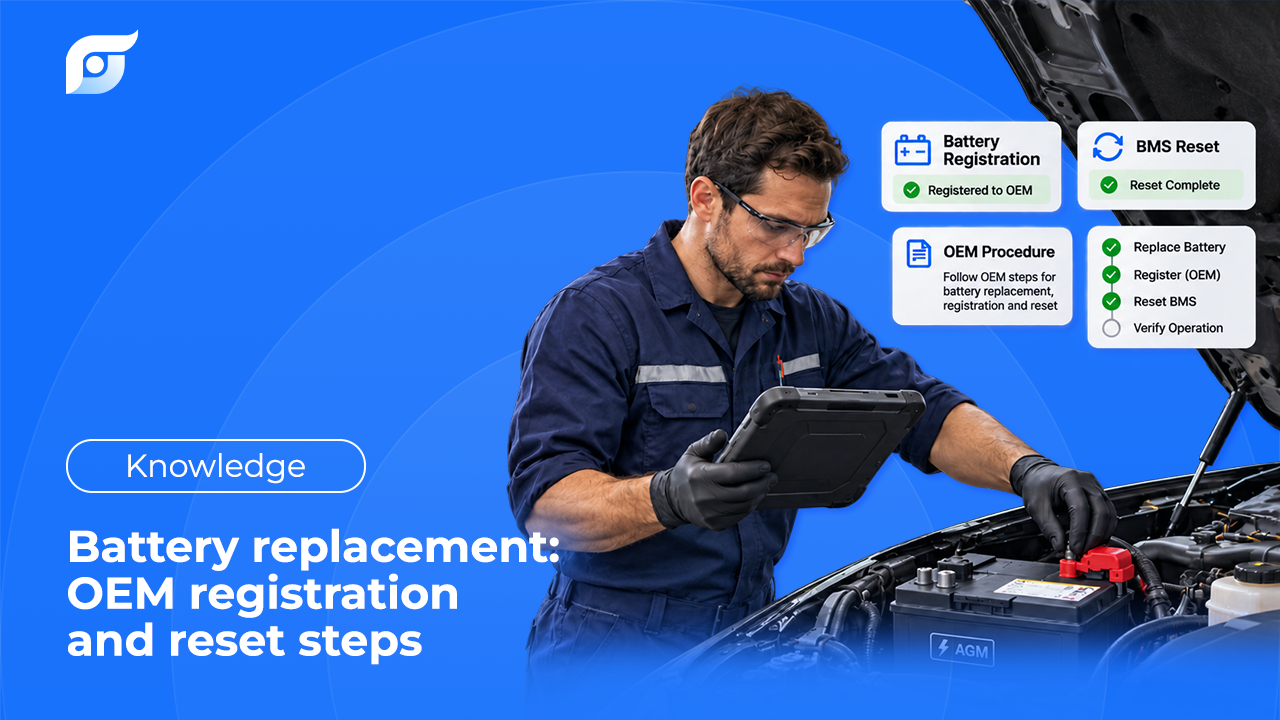
On a growing share of vehicles, a battery swap does not end when the hold-down is tight. Cars with an intelligent battery sensor or a battery management system need to be told a new battery is in, and many cars lose learned settings when the 12V supply drops. Whether the car in your bay needs either step, and how, is written in the manufacturer’s battery replacement procedure for that exact vehicle. This page shows what those steps are, where to find them, and what two manufacturers actually say.
Quick Answer: A vehicle needs battery registration (also called adaptation, coding, or a BMS reset) when it uses an intelligent battery sensor or battery management system that adjusts charging to the battery’s age and condition. Midtronics lists BMW, Mini, Volkswagen, Audi, Mercedes-Benz, Porsche and Volvo among the brands that require it, and some hybrid and EV 12V batteries need it too. Skipping it can leave the charging system working off the old battery’s data, and on Volkswagen vehicles with the J367 battery monitoring control module, a Volkswagen of America bulletin filed with NHTSA states that start/stop will be inoperative until the battery is adapted. Ford and Lincoln vehicles from 2011 on use a battery management system that resets on its own after about eight hours, or immediately through the Body Control Module with a scan tool. Separately, many vehicles need resets after any 12V disconnect, such as window auto-up limits and sunroof position. A generic OBD-II code reader usually cannot register a battery. The OEM battery removal and installation procedure for the exact vehicle says which steps apply.
Why Do Some Batteries Need Registering?
Older charging systems held a fixed voltage and didn’t care what battery sat under the hood. Current systems adjust the charge rate. On a BMW, the intelligent battery sensor (IBS) sits on the negative terminal and reports voltage, current, temperature and state of charge to the energy management system. That system tracks how the battery has aged and charges it accordingly.
Install a new battery without telling the car, and the energy management system keeps charging as if the old, worn battery were still there. Battery registration records that a new battery has been installed and clears the stored history, so the charging strategy starts over for a fresh battery. On BMW, registration also logs the mileage at replacement.
Registration problems tend to show up late. Midtronics, which builds battery service tools, describes the effects of skipping it as undercharging (which leads to sulfation), overcharging (heat and electrolyte loss), a start-stop system that won’t engage, and electrical faults that can include warning lights or a no-start. Its FAQ says an unregistered BMW battery can turn into a customer comeback within 12–18 months of the swap. By then, nobody connects the failure to the battery job, which makes it the kind of comeback that’s hard to trace. Owner reports on BMW forums also say skipping registration doesn’t always set a fault code, so a missing warning lamp proves nothing.
Registration vs. resets: two different jobs
The two terms get used interchangeably, but they solve different problems:
| Battery registration / adaptation | Post-disconnect resets and relearns | |
|---|---|---|
| Why it’s needed | The charging system adapts to battery age and must be told the battery is new | A module lost its learned position or settings when the 12V supply dropped |
| When it applies | A new battery is installed (reconnecting the same battery usually doesn’t require it) | Any disconnect or fully discharged battery, new battery or not |
| Typical examples | BMW IBS registration, VW J367 adaptation, Ford BMS reset | Power window auto-up limits, sunroof position, radio and clock settings |
| Tool needed | Usually a scan tool with the OEM’s battery service function | Often a switch sequence written in the owner’s or service manual |
Resets are written per vehicle. Land Rover’s service procedure resets each window by closing it fully, then holding the switch in the close position for about one second, and it says the reset is needed whenever the battery is disconnected, discharged, or the supply is interrupted. Kia’s owner’s manuals warn that if the sunroof isn’t reset after the battery is disconnected or discharged, it may not operate normally. Those are two brands. The sequence on the car in front of you can be different, which is why it’s looked up, not remembered.
How to Tell From the OEM Procedure
You can’t tell from the battery or from a general rule by brand. Equipment changes within a model line, so a start/stop-equipped trim can need adaptation while a base trim of the same model doesn’t. Start with the vehicle identified by VIN, down to engine and option content, the same way Jayda confirms year, make, model and engine before it answers. Then check three places in the OEM information:
- The battery removal and installation procedure. Read the end of it, not just the wrench steps. Post-installation steps are where the requirement is written: “register battery replacement” on BMW, “adapt battery” on Volkswagen, “battery monitor system reset” on Ford.
- The battery specification. Type (flooded, EFB or AGM), capacity and cold-cranking amps. On IBS-equipped cars, a change of battery type or capacity needs coding as well as registration. Going from flooded to AGM is the common case. The winter battery spec for the exact vehicle is the place to start.
- Bulletins for that vehicle. Manufacturers revise battery service steps through technical service bulletins, as Volkswagen did for J367-equipped cars below.
While you’re in the procedure, check where the battery and sensor actually are. Trunk, under-seat and under-floor batteries are common on the same vehicles that need registration. An OEM component location diagram answers that before you start pulling trim.
Forum posts are useful for knowing a step exists, but not for doing it. Owner-written sequences vary by model year and often skip conditions the OEM procedure states, which is the line between a search result that’s fine and one that needs a cited OEM source.
Two Worked Lookups
Volkswagen with the J367 battery monitoring control module
A Volkswagen of America technical bulletin filed with NHTSA (2022) states it directly: after replacing the battery on vehicles equipped with the J367 Battery Monitoring Control Module, the battery must be adapted to the vehicle, and if the adaptation is not completed, the start/stop function will be inoperative. Volkswagen’s workshop manual describes the same step from the other side: once the new battery is installed and parameterized, its technical data is sent to the J367 control unit.
What the documents add beyond “adapt it”:
- The serial number field. The bulletin notes the battery serial number field can be left blank, in which case it auto-fills with the next battery replacement sequence number.
- Where the adaptation lives varies by model. Forum and guide sources point to the gateway (address 19) on some cars and a separate energy management module (address 61) on others. The OEM procedure for the exact vehicle settles which.
- Coding values you find online conflict. Published guides disagree on the long-coding byte for AGM batteries (one lists hex 18, another hex 08), and owner reports describe odd battery-condition readings after entering arbitrary serial numbers. Coding values copied from a forum for a different control module version are a risk, not a shortcut.
The customer-facing symptom is the giveaway: a new battery, a car that runs fine, and start/stop that never engages. That’s an adaptation that didn’t happen, not a failed battery.
Ford and Lincoln, 2011 model year on
Snap-on’s diagnostics knowledge base states that starting with the 2011 model year, Ford and Lincoln vehicles use a battery management system (BMS), and it needs a reset after the battery is replaced, after the Body Control Module is replaced, or when the workshop manual calls for it. It describes two paths:
- Let it self-reset: the system resets on its own after the vehicle sits for about eight hours.
- Force it with a scan tool: in the Body Control Module, run the functional test Battery Monitor System Resets with the ignition on. It completes in seconds.
Sources describe the system’s job differently, and both descriptions matter. Snap-on’s example is load management: the BMS shuts off accessories such as the radio to protect charge, and those accessories can stay off until the system resets. Other repair sources describe the charging side: until the reset, the BMS keeps charging as if the old battery were still installed.
There is also a manual sequence in circulation. Owners on F-150, Bronco and Ranger forums describe an accessory-mode routine of flashing the high beams about five times and pressing the brake about three times, then watching for the battery lamp to flash. Reports differ by model: one 2019 Ranger owner only got it to work by pushing the high-beam stalk instead of pulling it. Treat that as a sign a manual method may exist for your vehicle, then confirm it in Ford’s owner’s manual or workshop procedure for that model year before relying on it.
Both lookups follow the same pattern. The requirement is real, the method is vehicle-specific, and the authoritative version is a document you can cite. That’s the job OEM procedures for the exact vehicle are built for. In Jayda you type what you’d say out loud, for example “2019 F-150 2.7L battery replacement procedure,” and the answer comes from MOTOR-sourced OEM data with the source shown. When the document isn’t in the database, Jayda says so rather than offering a near match.
Safety Before You Disconnect
A 12V battery can’t electrocute you the way a high-voltage system can, but a tool that bridges the terminals or touches the body from the positive post will arc and burn. The baseline before any battery job:
- Engine off, key out. Ignition off and the key removed before a terminal is touched.
- Safety glasses on. Battery acid and a shower of sparks from a dropped tool both go straight for the eyes.
- Terminal order per the OEM procedure. The common rule is negative off first and on last. Honda’s HR-V hybrid owner’s manual puts it plainly: always disconnect the negative cable first and reconnect it last. Removing the ground first means a wrench that touches the body while you loosen the positive can’t complete a circuit. Follow the specific procedure where it adds steps, such as waiting times or sensor handling.
- Handle the battery sensor as a part, not a clamp. On IBS-equipped vehicles the sensor is built into the negative terminal. Don’t pry on it or use it as a lifting point.
Hybrids and EVs: the 12V side only
Hybrids and EVs still carry a 12V auxiliary battery, and replacing it is generally low-voltage work done to the OEM procedure. Some of these vehicles also need registration or a system initialization after the 12V battery is reconnected, which the procedure will state.
The high-voltage system is a different job entirely. High-voltage battery packs and drive systems operate at roughly 144–800V DC, and contact with exposed conductors can be fatal. Anything behind the orange cabling (the pack, inverter, DC-DC converter or drive motor) requires a verified zero-energy state, insulated Class 0 gloves rated for the pack voltage, and the manufacturer’s de-energization sequence. That work requires ASE L3 (Light Duty Hybrid/Electric Vehicle Specialist) certification or equivalent OEM training. A 12V battery job never needs you to touch it, and a vehicle that has been in a flood, fire or collision should be handled per the OEM’s emergency response guidance before anyone starts any repair.
When to Send It to a Specialist
Most battery swaps that need registration are short jobs with the right tool. Send the job out, or sublet the registration, when:
- Your scan tool doesn’t support the OEM’s battery service function for that make. A generic OBD-II code reader generally can’t do it. BMW registration typically means a BMW-capable tool such as ISTA or an aftermarket tool that specifically supports it.
- The battery type or capacity is changing and your tool can register but can’t code.
- The procedure calls for an online or dealer-level programming session your shop doesn’t have access to.
- The car won’t start, or electrical faults continue, after the procedure is done. That’s now a diagnosis, not a battery swap, and the OEM wiring diagram is where it starts.
- Any work would touch the high-voltage system, or the vehicle is post-flood or post-collision.
What registration does to the quote
Published prices vary widely, and most come from consumer cost guides, not shop data. One 2026 BMW guide puts a 12V AGM replacement at $300–$500 at an independent shop and $450–$700 at a dealer with programming. A separate guide lists registration alone at $50–$150 on top of labor. Some guides also warn the opposite problem: registration is a short scan-tool routine, not hours of programming. Put it on the estimate as its own line, priced from OEM labor times instead of a flat guess. That way the customer sees why this battery costs more than the last one, and the shop isn’t absorbing the step for free.
This page summarizes published manufacturer documents and repair sources and is not a substitute for them. Registration and reset steps change by model year and by bulletin revision, so confirm against the current OEM procedure for the vehicle you’re working on. Pro Tech starts with a 3-day free trial with 3 questions. A card is required to start, and the battery procedure for your next job is a good first question to ask.