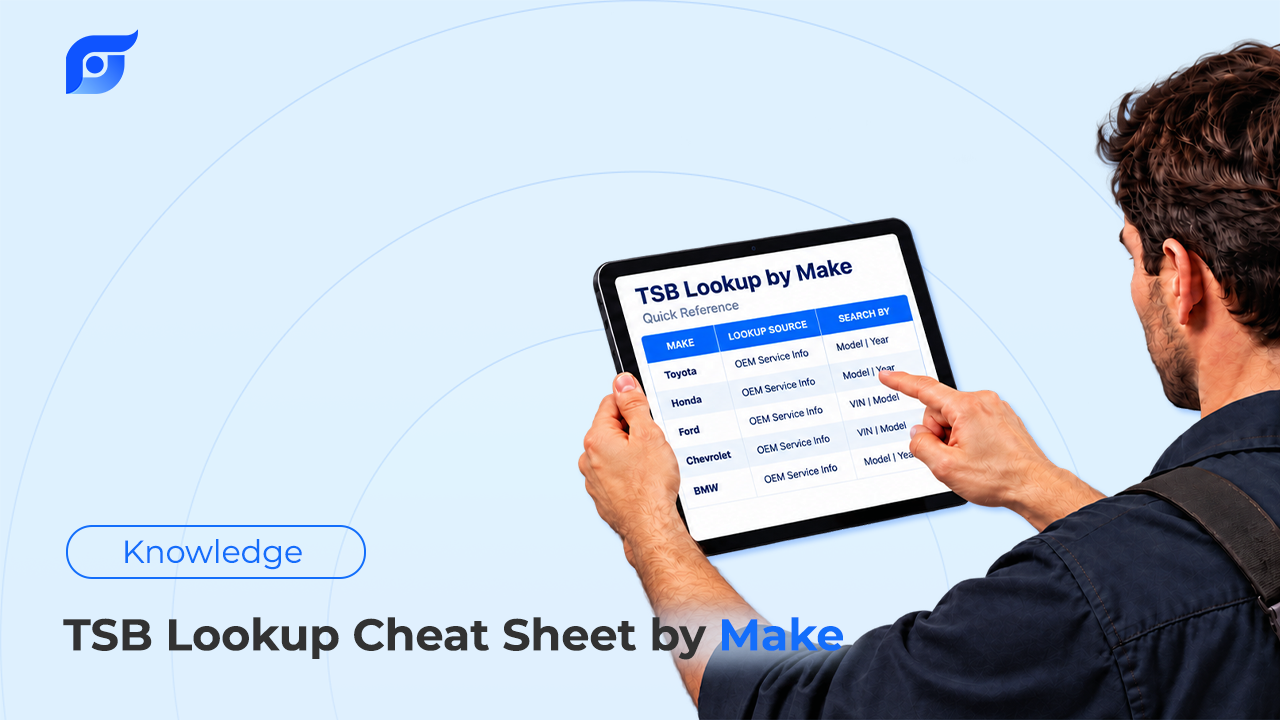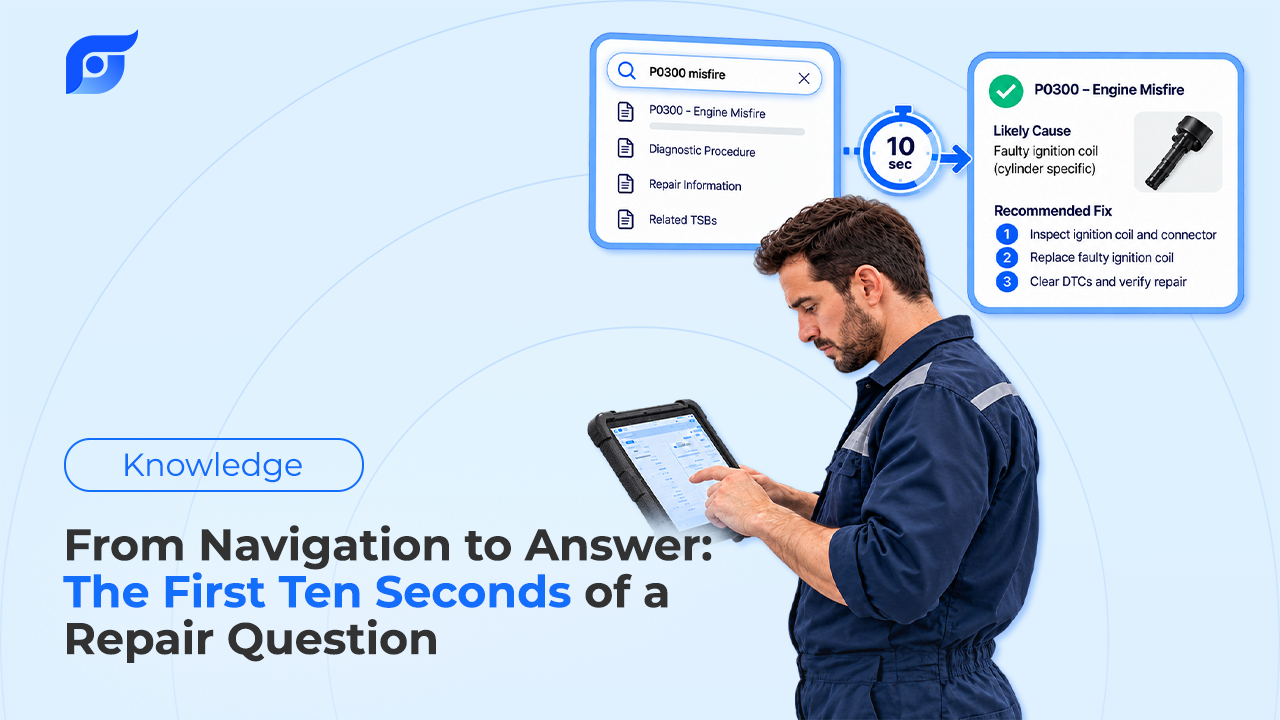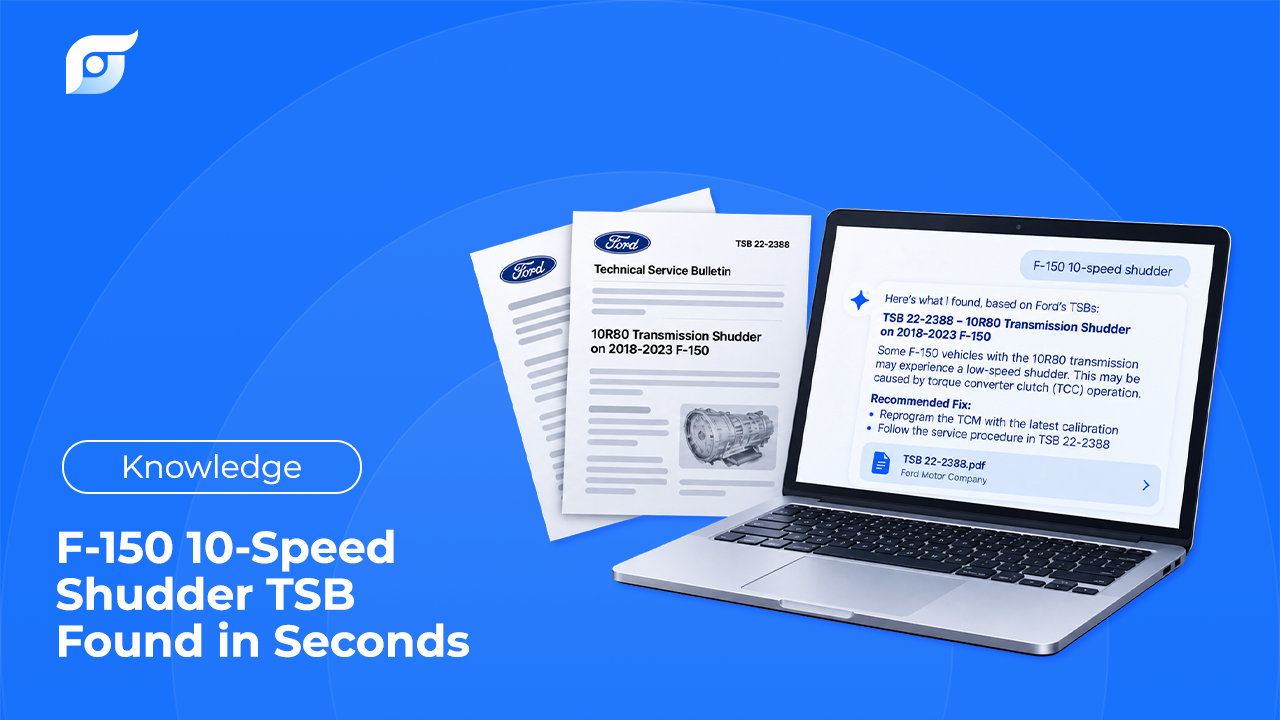
Search “F-150 10-speed shudder TSB” and you get a pile of bulletin numbers: one from a forum thread, another from a transmission shop’s blog, and a Ford document on NHTSA’s site with “Torque Converter Shudder” in the title. That last one doesn’t cover the F-150 at all. The 10R80 has real, documented Ford bulletins, but which one applies depends on the symptom, the DTCs, the build date, and whether a later bulletin has superseded the one you found. Here is what the primary Ford documents actually say, and how to get to the right one for the truck in your bay.
Quick Answer: None of the Ford TSBs reviewed for this page, as posted on NHTSA’s site, is an F-150 10R80 bulletin titled “shudder.” The Ford bulletin titled “Torque Converter Shudder” (TSB 26-2171, 17 April 2026) covers the 2019–2024 Edge and 2019–2023 Nautilus with the 8F35, not the F-150. For 10R80-equipped F-150s, the verified bulletins are TSB 20-2117, for 2017–2018 trucks built on or before 20-Nov-2017 with DTCs P0741 and P1744 from a sticking torque converter clutch (TCC) valve (fix: replace the main control valve body), and the harsh/delayed engagement and shift bulletins 23-2123 and 22-2428, which start with a software update and adaptive learning drive cycle and escalate to a valve body overhaul. TSB 19-2346 is widely cited online for 10R80 TCC shudder with a Mercon ULV fluid exchange, but it could not be confirmed from a primary Ford document for this page. Match any bulletin to the VIN, build date, DTCs, and symptom, and confirm it hasn’t been superseded.
Which Ford TSBs Cover the F-150 10-Speed?
These are the Ford bulletins verified from the documents Ford filed with NHTSA. Each has a narrow scope, and the scope decides whether it applies.
| TSB | Date | F-150 coverage | Trigger | Ford’s action |
|---|---|---|---|---|
| 20-2117 (supersedes 18-2160) | 14 April 2020 | 2017–2018 F-150 with 10R80, built on or before 20-Nov-2017 | MIL with DTCs P0741 and P1744; sticking TCC valve in the main control valve body | Replace the main control valve body |
| 23-2123 (supersedes 22-2139) | 13 April 2023 | 2017–2020 F-150 with 10R80 | Harsh engagement, harsh shift, or delayed shift, with or without listed shift-solenoid and ratio DTCs | Software update and adaptive learning drive cycle, then valve body overhaul if needed |
| 22-2428 (supersedes 22-2139, 22-2102, 21-2377, 21-2434) | 26 May 2023 | 2017–2023 F-150 with 10R80 or 10R80 MHT, built on or before 15-Aug-2022 | Harsh or delayed engagement or shift; causes include software, solenoid ID strategy, sticking valves, and CDF clutch cylinder sleeve movement | Check for later PCM/TCM software first; escalates through valve body overhaul to CDF cylinder replacement |
Two details in that table are easy to miss. First, 20-2117 is tied to a DTC pair and a build date, so a truck built after 20-Nov-2017 with the same complaint isn’t covered. Second, both 23-2123 and 22-2428 list 22-2139 as superseded, with different vehicle and build-date coverage. Transmission-shop and forum sources also report later 2025 updates to the 2017–2020 harsh-shift bulletin, which is exactly why a bulletin number copied from a thread isn’t enough: a technical service bulletin is only useful in its current version, for the build it names.
Is It a Shudder, a Harsh Shift, or Something Else?
The word “shudder” covers several different complaints, and the bulletin you need depends on which one the customer is describing:
- TCC shudder is a vibration that shows up while the torque converter clutch is applying or slipping, usually at light throttle; Ford’s 8F35 bulletin describes it as most noticeable below 60 mph. It points toward the converter clutch, its apply control, or fluid condition.
- Harsh or delayed shifts and engagements are a separate complaint, covered by the 23-2123 and 22-2428 bulletins above.
- Something that feels like a transmission problem but isn’t. Ford’s 26-2171 bulletin for the Edge and Nautilus notes that a converter shudder “may be perceived/felt as an engine misfire.” The reverse is also true: a misfire can read as a transmission shudder to a driver.
Ford’s approach in 26-2171 is worth borrowing even though that bulletin doesn’t apply to the F-150: it requires a traceable shudder event in scan-tool data, comparing actual converter slip against desired slip, before any parts are replaced. Confirming the event in data first keeps a converter complaint from turning into an unneeded valve body job, or the other way around.
What Does Ford’s 10R80 Harsh-Shift Bulletin Tell You to Do?
TSB 23-2123 is a compact example of how a Ford bulletin is built as a decision tree:
- Check for the listed DTCs, including P0751, P0752, P0756, P0757, P0761, P0762, P0766, P0767, P0771, P0772, P2700–P2705, P2707, P2708, P0729, P0731–P0736, P076F, P07D9, P07F6, and P07F7. If any are present, go straight to the valve body overhaul.
- If none are present, reprogram the transmission strategy download into the PCM/TCM and perform the adaptive learning drive cycle.
- If the condition persists, overhaul the main control valve body and road test following the adaptive learning drive cycle.
The labor operations show why the order matters. The reprogram-and-relearn path is 0.8 hours. The valve body overhaul paths for 2017–2020 F-150s run from 4.0 to 5.5 hours, depending on engine and drivetrain. Starting with the overhaul when the bulletin calls for software first turns a sub-one-hour repair into a half-day job, and OEM labor times are how the estimate reflects that difference.
Every one of these Ford bulletins ends with the same note: the transmission uses an adaptive shift strategy, and after a reset, “this relearning process may result in firmer than normal upshifts and downshifts for several days.” Tell the customer before the truck leaves, or a correct repair comes back as a complaint.
Why Is the “Shudder TSB” So Hard to Pin Down?
Following the search trail for this one query shows the problem:
- Forum and shop sources name TSB 19-2346 as the 10R80 TCC shudder bulletin, recommending a Mercon ULV fluid exchange. The number may well be right, but the source documents didn’t surface for verification.
- Other sources point to calibration updates under different numbers.
- The one NHTSA-posted Ford bulletin with “Torque Converter Shudder” in its title is for a different transmission in a different vehicle.
- The bulletins that do apply to the 10R80 F-150 have been superseded and re-scoped more than once.
That trail is the ordinary cost of lookup, and it is where technicians lose time looking for repair information: not in reading the bulletin, but in working out which bulletin is current and applies to this build. The fix isn’t a better search. It’s asking for OEM repair information for the exact vehicle and reading the manufacturer’s document itself.
Is There a Recall on the F-150 Transmission?
Not for the 10R80 shudder complaint, based on the sources reviewed here. There is an open recall on the earlier six-speed. NHTSA campaign 26V-237 (Ford 26S28), announced April 2026, covers about 1.39 million 2015–2017 F-150s with the 6R80 transmission for an unexpected downshift that can cause wheel lockup. If a truck is included, the repair is performed free of charge by an authorized Ford dealer, regardless of vehicle age or mileage. Check the 17-character VIN at nhtsa.gov/recalls to confirm open status.
2017 needs extra care. The 10R80 bulletins above include 2017 F-150s, while the recall covers 2017 trucks with the 6R80, so confirm which transmission is in the truck before deciding which document applies. Keeping a TSB separate from a recall matters here: the recall is a mandatory free remedy, while a TSB repair is billed or claimed under whatever warranty coverage the vehicle has.
What Does the One-Question Version Look Like?
The before-and-after isn’t about typing speed. It’s about how many decisions the tech has to make before reaching the right document.
| Step | Search-and-navigate | Asking Jayda |
|---|---|---|
| Start | Web search returns forum threads, shop blogs, and a mismatched NHTSA document | Ask: “2019 F-150 3.5L 10-speed shudder TSB” |
| Narrow to the vehicle | Select year, model, engine, transmission, then open the bulletin list | The question already names the vehicle |
| Check scope | Open each 10R80 bulletin to compare build dates, DTCs, and supersessions | Read the returned Ford documents, each shown with its source |
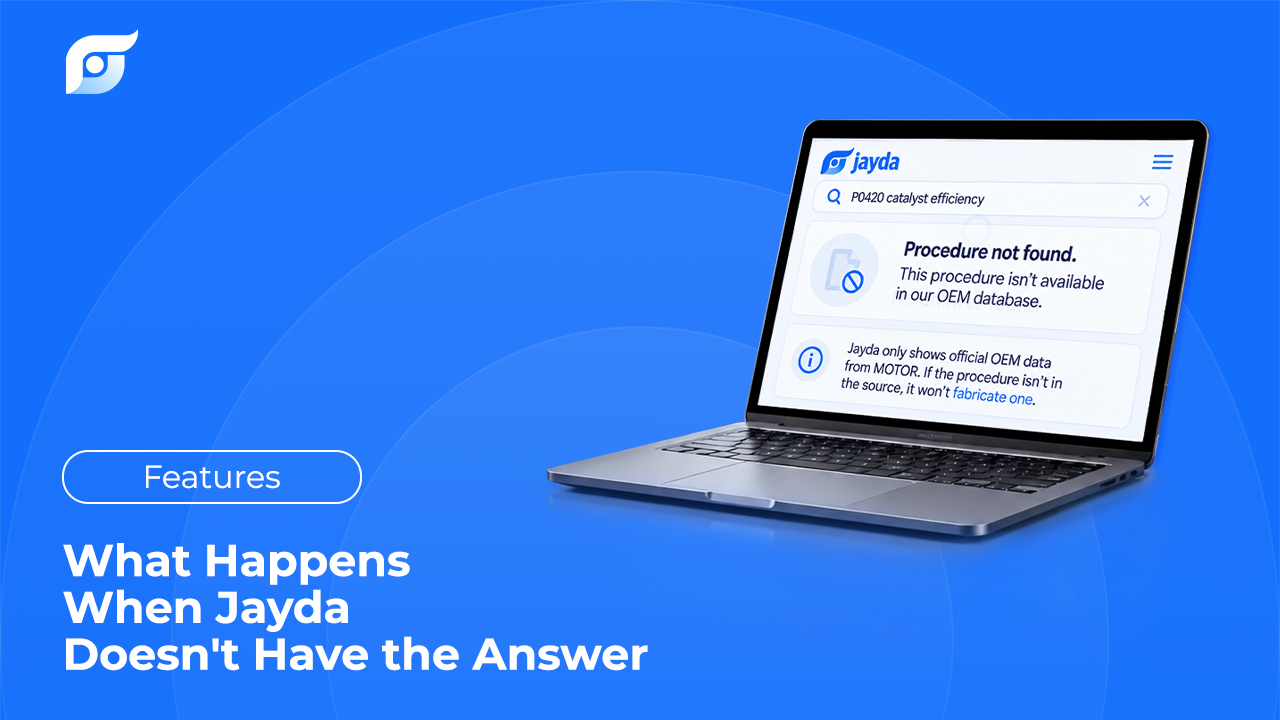
| No match | Keep searching, or settle for a number from a thread | Jayda says it didn’t find one, instead of producing a guess |
Jayda’s data is licensed from MOTOR Information Systems and covers 43 manufacturers from 1985 to 2026. Its AI searches and retrieves OEM documents; it does not write or summarize a bulletin, which is the reason AI should search repair information rather than generate it. Reading the bulletin, matching it to the build date and DTCs, and deciding on the repair stays with the technician. Pro Tech, the individual plan, includes TSBs among all 12 OEM data features and offers a 3-day free trial with 5 questions.