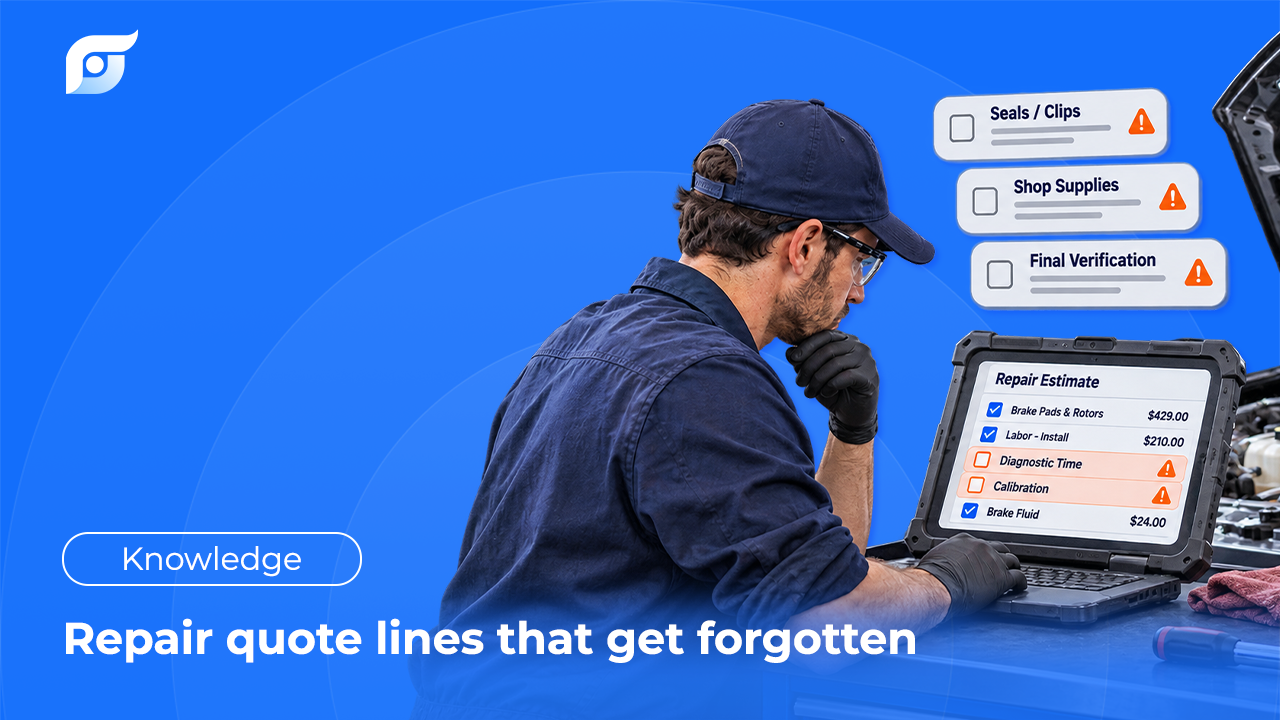
Most underpriced quotes aren’t wrong about the main job. They’re missing a line: the hour of diagnosis before the repair, the calibration the repair triggers, the bolts that can’t go back in, the second side of the car. Each missing line is either work the shop does for free or a conversation with the customer after the price was already agreed. This is a checklist of the eight lines that most often drop off a repair quote, what the OEM information or state rule says about each, and where to look before the quote goes out.
Quick Answer: Before a repair quote goes out, check eight lines that commonly get missed: (1) diagnostic time, quoted and authorized as its own line before teardown; (2) ADAS calibration that the OEM requires after repairs such as alignment, windshield or bumper work; (3) one-time-use bolts and hardware the service information says must be replaced; (4) fluids, by the OEM-specified type and the system’s capacity; (5) the second side, priced with the labor guide’s “each additional” time rather than a second full base time; (6) shop supplies and fees on their own line, because states such as California and Florida regulate how they are charged and disclosed; (7) sales tax, which on repair labor varies by state and can depend on whether parts and labor are stated separately; and (8) any open safety recall, which the manufacturer must remedy free of charge through its dealers and should not appear on the quote at all.
Diagnostic Time
Diagnosis is work, and it happens before anyone knows what the repair is. A diagnostic charge belongs on the quote as its own line, authorized before the teardown starts, not folded into the repair price after the fact. California makes the documentation side explicit: the Bureau of Automotive Repair requires a written estimate before work begins, and a BAR regulatory action on teardowns that took effect July 1, 2025 changed the estimate requirements for jobs that need disassembly to find the fault.
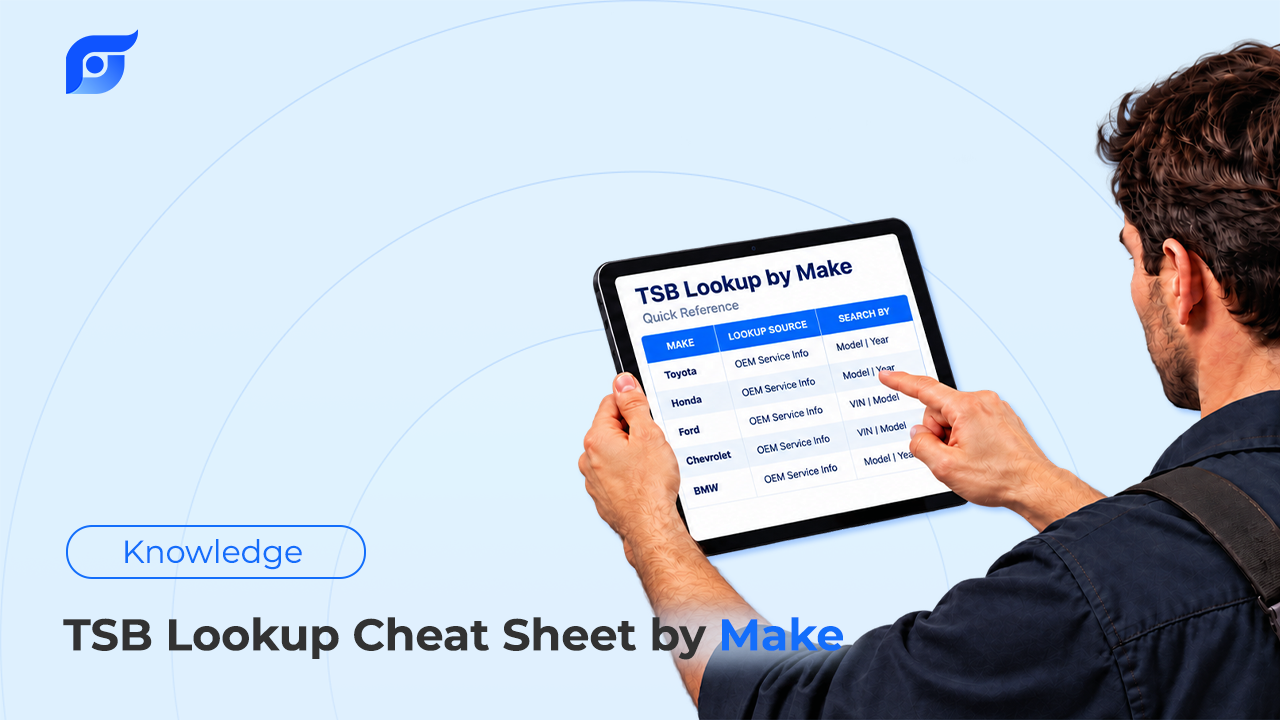
The time itself is easier to defend when it follows the manufacturer’s test sequence rather than an open-ended hunt. An OEM diagnostic procedure lists the steps, and reading the DTC flowchart the OEM way shows how much testing a code actually calls for before parts are named.
ADAS Calibration After the Repair
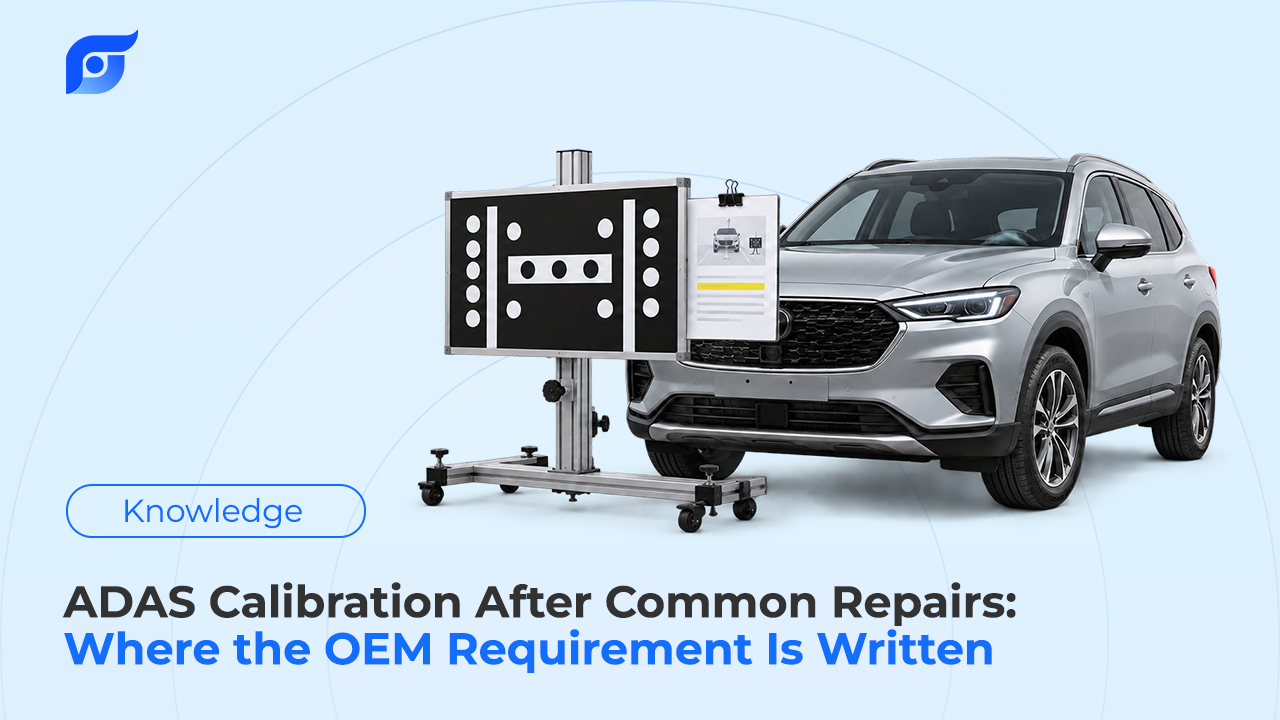
Calibration is the line most often missed because it isn’t attached to an ADAS job. It arrives with an ordinary mechanical or body repair. Ford’s ADAS job aid lists suspension repair or alignment, a windshield replacement, a change in tire size and front air bag deployment among the triggers for lane keeping camera calibration, and requires radar calibration whenever the sensor or its bracket is removed for access.
Other manufacturers draw the line differently. Honda’s aiming job aid says camera and radar calibration isn’t required after a wheel alignment unless the service information calls for it. The requirement has to be checked per vehicle, before the quote, which is the point of knowing where the OEM calibration requirement is written. If the shop can’t meet the procedure’s conditions, the calibration is still a line on the quote, as a sublet.
One-Time-Use Bolts and Hardware
Torque-to-yield bolts stretch on the first tightening and can break or loosen if reused, so the replacement bolts are a parts line, not an afterthought. Most OEM repair manuals call these “one-time-use” fasteners rather than torque-to-yield, and I-CAR notes that the callout can sit under tightening torques, installation notes, or the parts list for the repair procedure. Clips, retainers and seals get the same treatment in some manufacturers’ documents. BMW and MINI publish one-time-use guidance for repairers.
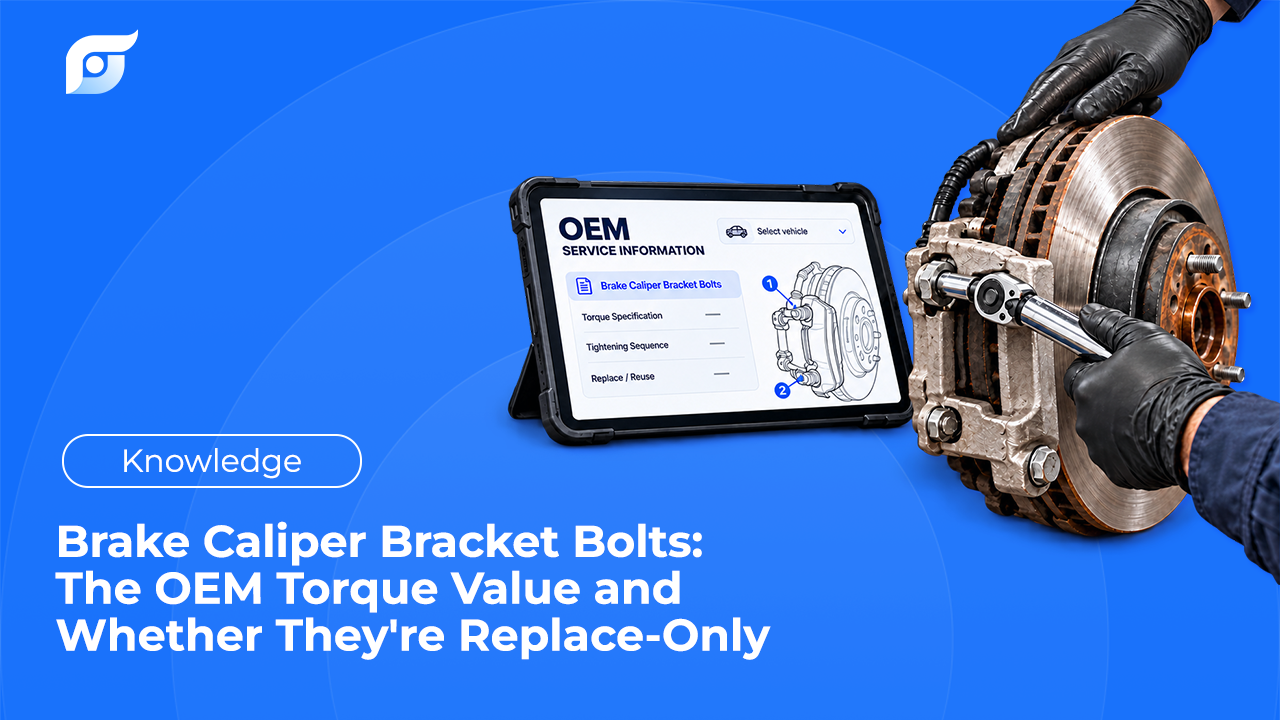
A final angle step in the tightening spec is a common sign, but not proof. Not every angle-tightened bolt is single-use, and some service information explicitly allows reuse. The service information for that fastener decides, which is why a job like caliper bracket bolts, and whether they’re replace-only is a lookup rather than a habit.
Fluids and Capacities
Any job that opens a system needs fluid back in it, and the quote needs both the type and the quantity. The type is OEM-specified. Honda, for example, calls for its own Long Life Antifreeze/Coolant Type 2, premixed 50/50, and its owner’s manuals say not to add straight antifreeze or water. The quantity comes from the system capacity for that exact engine and transmission, not from what the last similar car took.
Older vehicles are where this line goes wrong most quietly, because the under-hood labels are often faded or missing and the car has passed through several owners’ habits. On those jobs the type and capacity come from current OEM data for the older vehicle, not from what’s printed on the last jug someone used.
The Second Side: Base vs. Each Additional
Labor guides price paired work in two parts. The base time covers the first unit, and the “each additional” time covers the next one, because the setup work isn’t repeated. Quoting both sides of an axle as two full base times charges the customer twice for the same setup. Forgetting the second side entirely, when the procedure or the customer’s request calls for both, leaves the work unbilled.
The same logic applies to included and optional operations. A labor time states what it already covers and what is added on top. Reading all three (base, each additional, and what’s included) before the number goes on the quote is what OEM labor times are for: a documented standard instead of an estimate from memory.
Shop Supplies and Fees on Their Own Line
Shop supplies and disposal fees are regulated state by state, and some states restrict them sharply. California generally does not allow a generic “shop supplies” charge. A customer may be charged only for supplies actually used on the vehicle, and those must appear on the estimate and be itemized on the invoice. Florida allows the charge, but its estimates must state whether there is a separate charge for shop supplies or hazardous waste removal. Florida also sets per-unit fees on new tires and batteries. Illinois requires estimates and invoices to itemize parts and labor. In Manitoba, a shop-supplies charge on the estimate must show the amount and how it was calculated.
Putting fees on their own line does two things. It keeps the quote within the rules where the shop operates, and it answers the customer’s “what’s this?” before they ask. Check the current statute or your state regulator before setting the line up, because these rules change.
Tax
Sales tax on auto repair is a state question, and the answer often depends on how the invoice is written. In California, parts are taxable but repair labor generally is not when the two are stated separately. When labor is bundled into the parts price, the whole charge can become taxable. Alabama applies similar logic. Pennsylvania taxes labor for repairing or installing taxable parts. Idaho exempts repair labor. In Florida, a repair job often carries tax on the full amount.
Rules also move. Colorado’s Department of Revenue issued revised auto repair guidance in May 2026, separating parts from labor. A quote template set up years ago can be out of step with current guidance, so confirm the treatment with your state revenue department.
Work a Recall Already Covers (Don’t Quote It)
This is the one line that should come off the quote. When a vehicle has an open safety recall, the manufacturer must provide the remedy free of charge under the federal Safety Act, and the repair is performed by its authorized dealers, who are reimbursed by the manufacturer. An independent shop that quotes and performs recall-covered work charges the customer for something they could have had for free, and manufacturers generally reimburse independent-shop repairs only when the fix was done before the recall was announced.
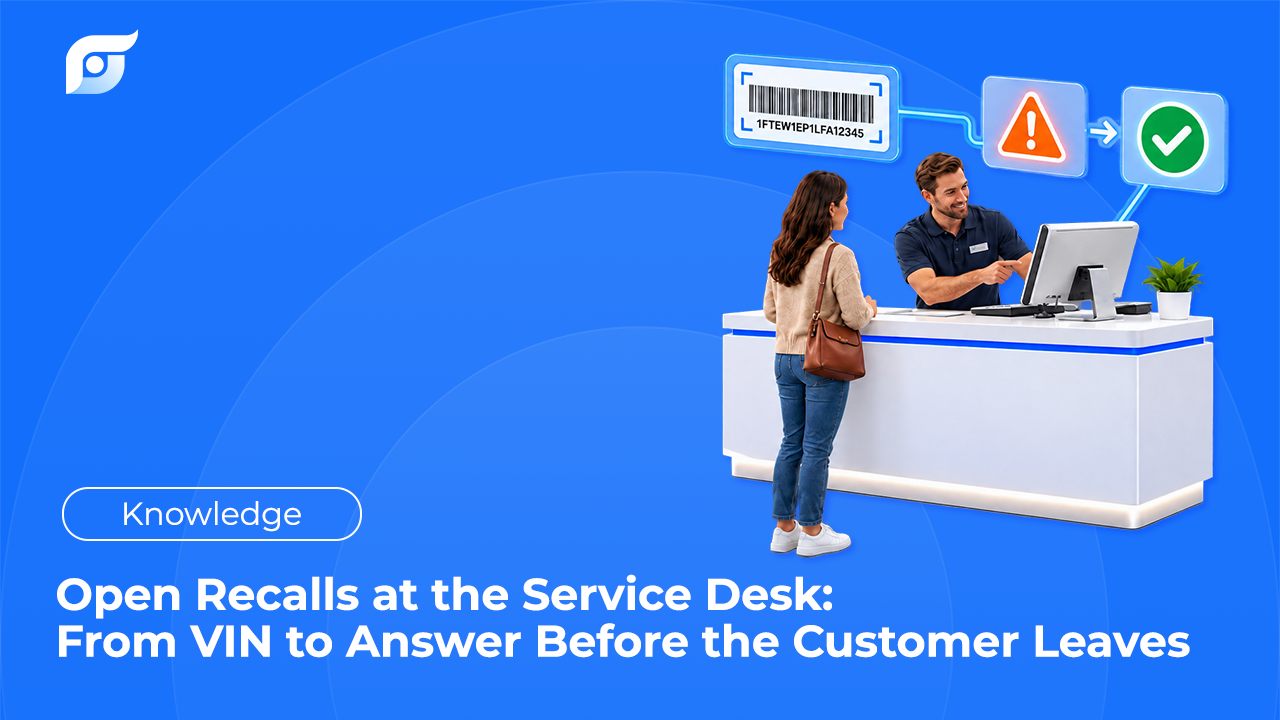
Check the VIN at nhtsa.gov/recalls before quoting any repair that touches a recalled component. Keep the distinction from technical service bulletins in mind: a bulletin is repair guidance, and coverage depends on warranty terms. The difference is laid out in TSB vs. recall, and the desk-side workflow is in open recalls at the service desk.
Where These Lines Come From
Every line on this list traces back to a document: the OEM diagnostic procedure, the calibration requirement, the fastener callout, the fluid specification, the labor time, the state rule, the recall notice. A line that can name its source is a line that holds up when the customer asks about it, and when a job comes back. That’s the reasoning behind tying each number to a cited OEM source.
Jayda returns OEM procedures for the exact vehicle with the source shown: MOTOR-sourced labor times, fluid specifications and capacities, torque values and fastener notes, and diagnostic procedures. To see the flow from VIN to cited answer, see how it works.
This page summarizes manufacturer documents, regulator guidance and published sources, and is not legal or tax advice. Estimate, fee and tax rules differ by state and change over time, so confirm current requirements with your state regulator and revenue department.