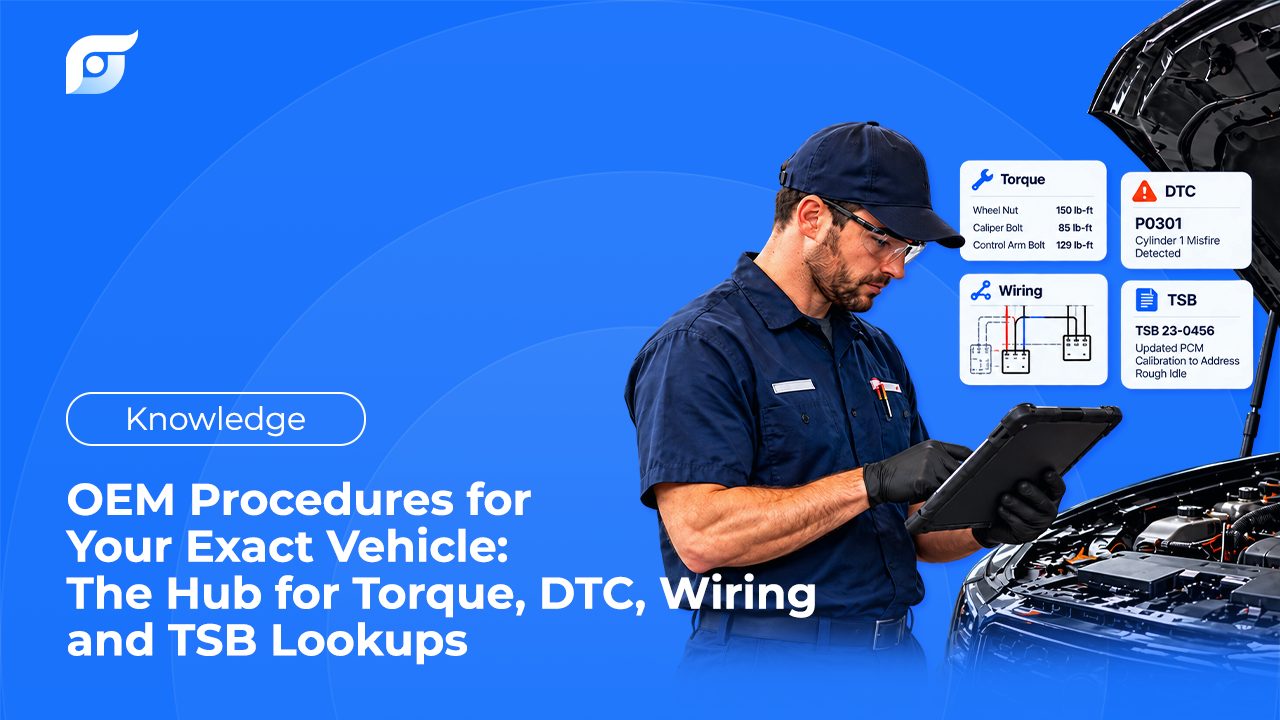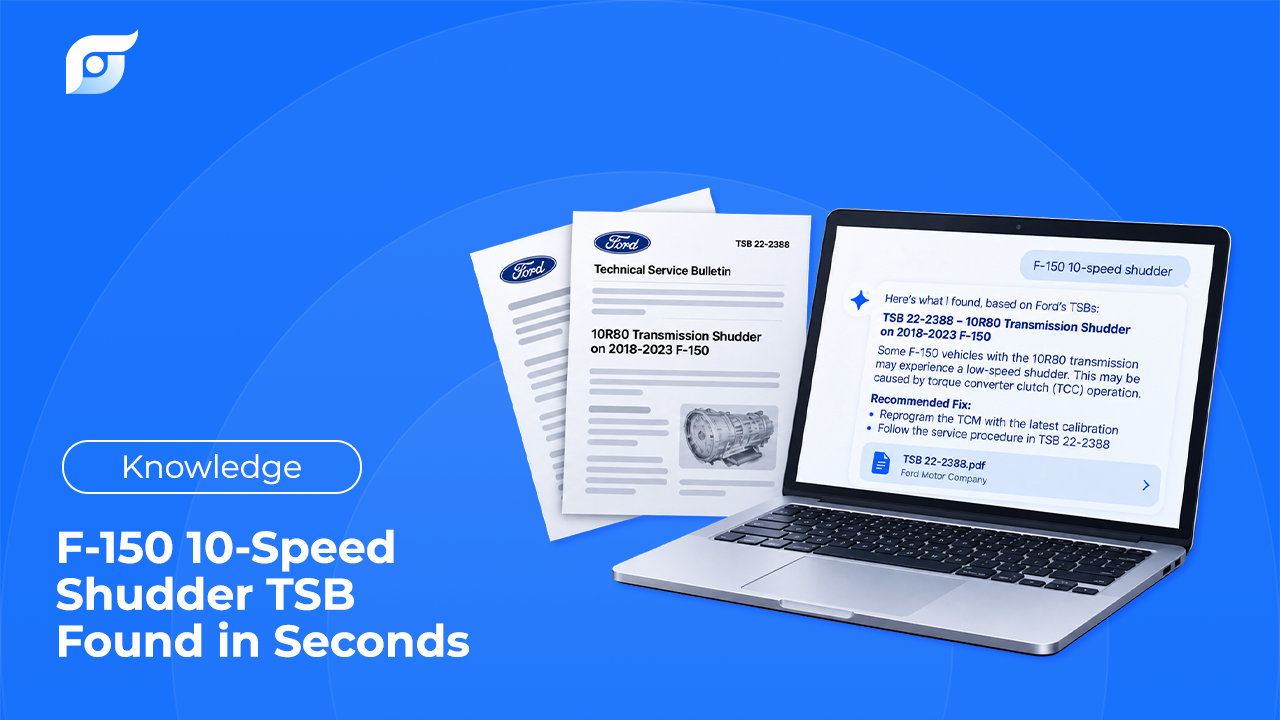
The first hard freeze fills the lot before the doors open. The work orders look simple: a battery, a coolant top-off, a tire light, a check-engine lamp, a squealing belt. The trouble is that each one has a different right answer on a different vehicle, and all five come from different manufacturer documents. Here is a realistic first-hour queue on five vehicles from five manufacturers, with the question as a tech would type it and what the OEM source actually says.
Quick Answer: Cold-weather jobs look generic, but every answer is vehicle-specific. Battery: Ford says the owner’s manual lists which group sizes fit, and retail fitment guides for a 2023 F-150 5.0L list a Group 48 AGM with a 94R AGM as an option. Coolant: Honda specifies Honda Long Life Antifreeze/Coolant Type 2, premixed 50/50, and its owner’s manuals say not to add straight antifreeze or water. TPMS: on a 2014 Chevrolet Silverado, GM’s owner’s manual relearn runs through the Driver Information Center and a relearn tool, in the order left front, right front, right rear, left rear, with two horn chirps confirming each sensor. DTC: Subaru bulletins posted on NHTSA’s site tie P0128 to air left in the cooling system on 2011–2012 Legacy and Outback, and separately to thermostats that open early after an extended cold soak. Belt: on a Jeep Wrangler 3.6L, the routing diagram is on the under-hood label, and the cold air intake assembly comes off for belt access. In each case, the document for the exact vehicle is the answer, not a rule of thumb.
7:02 — 2023 Ford F-150 5.0L: Battery Spec
Typed: “2023 F-150 5.0 battery group size and CCA”
The truck cranked slow at 18°F and the battery tested weak. The question isn’t which battery is on the shelf. It’s which battery the truck was built for. Ford’s own support page puts the authority in the right place: most vehicles accept more than one battery group size, and the owner’s manual lists which group sizes fit.
Retail fitment guides for the 2023 F-150 5.0L list a Group 48 AGM at 760 CCA, with a Group 94R AGM at 800 CCA as an option. Ford sells a Motorcraft 94R AGM rated at 800 CCA. Both listed options are AGM, so the battery type belongs in the lookup alongside group size and CCA. On Ford and Lincoln vehicles from the 2011 model year on, the battery management system also needs a reset after the battery is replaced, either by letting the vehicle sit about eight hours or by running the reset from the Body Control Module with a scan tool.
Sources for older trucks conflict. Third-party sites disagree on group size for early-2000s F-150s, which is exactly why the spec gets looked up by model year and engine rather than carried over from the last truck. The winter battery, coolant and tire specs by exact vehicle follow the same rule.
7:15 — Honda Civic: Coolant Type
Typed: “Honda Civic coolant type and mix”
Low coolant, and the customer wants a top-off before a road trip. Honda’s owner’s manuals answer this one directly. Honda specifies Honda Long Life Antifreeze/Coolant Type 2, which comes premixed at 50% antifreeze and 50% water, and the manuals say not to add straight antifreeze or water. The 2014 CR-V manual adds a warning against rust inhibitors and other cooling system additives.
Honda’s technical information goes further: continued use of non-Honda coolant can cause corrosion that leads to cooling system malfunction or failure. A jug of “all makes” coolant on the shelf is not the same answer.
Hybrids are the exception to watch. Repair sources note that the engine loop on Honda hybrids typically takes Type 2, but separate electric-drive cooling loops may call for a different coolant, so check the manual for the exact model. The Honda Prologue EV, built on GM’s Ultium platform, uses a GM-specified coolant rather than Type 2. Same badge, different answer, which is why the lookup starts from the VIN, not the brand. That’s how Jayda confirms year, make, model and engine before it answers.
7:31 — 2014 Chevrolet Silverado 1500: TPMS Relearn
Typed: “2014 Silverado 1500 TPMS relearn procedure”
The tire light came on overnight, and one sensor was replaced last week. Cold alone can trigger the lamp. A General Motors tire lab manager puts the drop at about 1 psi for every 10°F, and tires gain 2–3 psi back once they warm up on the road. NHTSA’s TPMS requirement sets the warning at 25% below the recommended pressure, so a lit lamp on a cold morning means a real drop, not just normal shrinkage. Set pressures cold, to the door-jamb placard, not the sidewall maximum.
With a new sensor, the relearn is the actual job. GM’s owner’s manual for this generation lays out the sensor matching process:
- Set the parking brake and turn the ignition to ON/RUN with the engine off.
- Use the Driver Information Center to bring up PRESS TO RELEARN TIRE POSITIONS and select it. The horn chirps twice and TIRE LEARNING ACTIVE displays.
- Starting at the driver side front, hold the relearn tool against the tire sidewall near the valve stem and press the button. Two horn chirps confirm the match.
- Repeat in order: passenger front, passenger rear, driver rear.
The button presses differ by model year and display style. Newer trucks reach the relearn through the steering wheel controls, and GM also supports an OBD-based relearn with a scan tool. One trade article on the 2021 Silverado notes the truck may need to be driven above 25 mph for at least two minutes to wake the sensors after a relearn. Same nameplate, three generations, three slightly different procedures.
7:48 — 2012 Subaru Outback 2.5L: P0128 Procedure
Typed: “2012 Outback 2.5 P0128 diagnostic procedure and TSBs”
Check-engine lamp, P0128 (coolant temperature below thermostat regulating temperature), and a customer who mentions the heater feels slow. The right lookup isn’t “what causes P0128.” It’s the OEM diagnostic procedure for this vehicle and any bulletins against it. P0128 shows up more in cold weather, but the code alone doesn’t tell you why. The OEM procedure and the bulletins do.
Two Subaru bulletins posted on NHTSA’s site are relevant here:
- A 2012 Subaru bulletin for 2011–2012 Legacy, Outback and Tribeca notes that if the cooling system isn’t fully purged of air, P0128 can set again. A thermostat replaced without a proper bleed can come back with the same code.
- A 2013 Subaru countermeasure bulletin describes a rare case where, after an extended cold soak, coolant can enter the thermostat’s internal piston and make it open below its specified temperature. Check the bulletin’s model coverage against the VIN before applying it.
That is the value of checking technical service bulletins before parts. Sorting out which bulletin covers which VIN is faster with a TSB lookup routine organized by make. The diagnosis itself stays with the tech. Jayda retrieves the OEM procedure and the bulletin. It doesn’t tell you which part failed, and that line is deliberate. For how an OEM sequence differs from a generic checklist, see the OEM diagnostic workflow for P0300.
8:05 — Jeep Wrangler JK 3.6L: Belt Routing
Typed: “2015 Wrangler 3.6 serpentine belt routing diagram”
A belt squeal that’s worst on cold starts, and a belt that looks glazed. Before ordering one, you need the routing. Many search results for “Wrangler 3.6 belt diagram” are generic pages without an actual diagram, which is a problem when the path wraps around an idler and tensioner in a specific order.
The authoritative routing is on the under-hood belt routing label, usually near the radiator or fan shroud, and in the service information for the exact model year. Mopar sells replacement under-hood labels for the 2016 Wrangler 3.6L when the original is missing or unreadable. On the JK 3.6L, the cold air intake assembly has to come off to reach the belt, which belongs on the estimate before the job starts. Knowing where the tensioner and idlers sit before pulling parts is what OEM component location diagrams are for.
Safety on a Cold-Morning Queue
- Belt inspection: engine off, key out. Never check belt routing or tension with the engine running. A running belt and pulley can catch a hand or a sleeve.
- Battery work: safety glasses on. Follow the OEM terminal order, which is generally negative off first and on last.
- Coolant: only on a cold engine. Don’t open a pressurized cooling system hot.
What the Five Have in Common
None of these were hard questions. Each one has a single right answer for the vehicle in the bay, and a wrong answer that looks reasonable: the shelf battery, the universal coolant, last year’s relearn sequence, the generic P0128 checklist, the diagram from a different engine. The answer that holds up is the OEM document for the exact vehicle, with the source shown, so it can be checked.
That’s the job behind OEM procedures for the exact vehicle. Jayda returns MOTOR-sourced OEM data with the source document cited, so you can verify any answer in one click. When the document isn’t in the database, Jayda says so instead of offering a near match. To see the five-step flow from VIN to cited answer, see how it works.
This page summarizes published manufacturer documents and repair sources and is not a substitute for them. Specifications and procedures change by model year, engine and bulletin revision, so confirm against the current OEM information for the vehicle you’re working on.